VibeDefend by CybeDefend
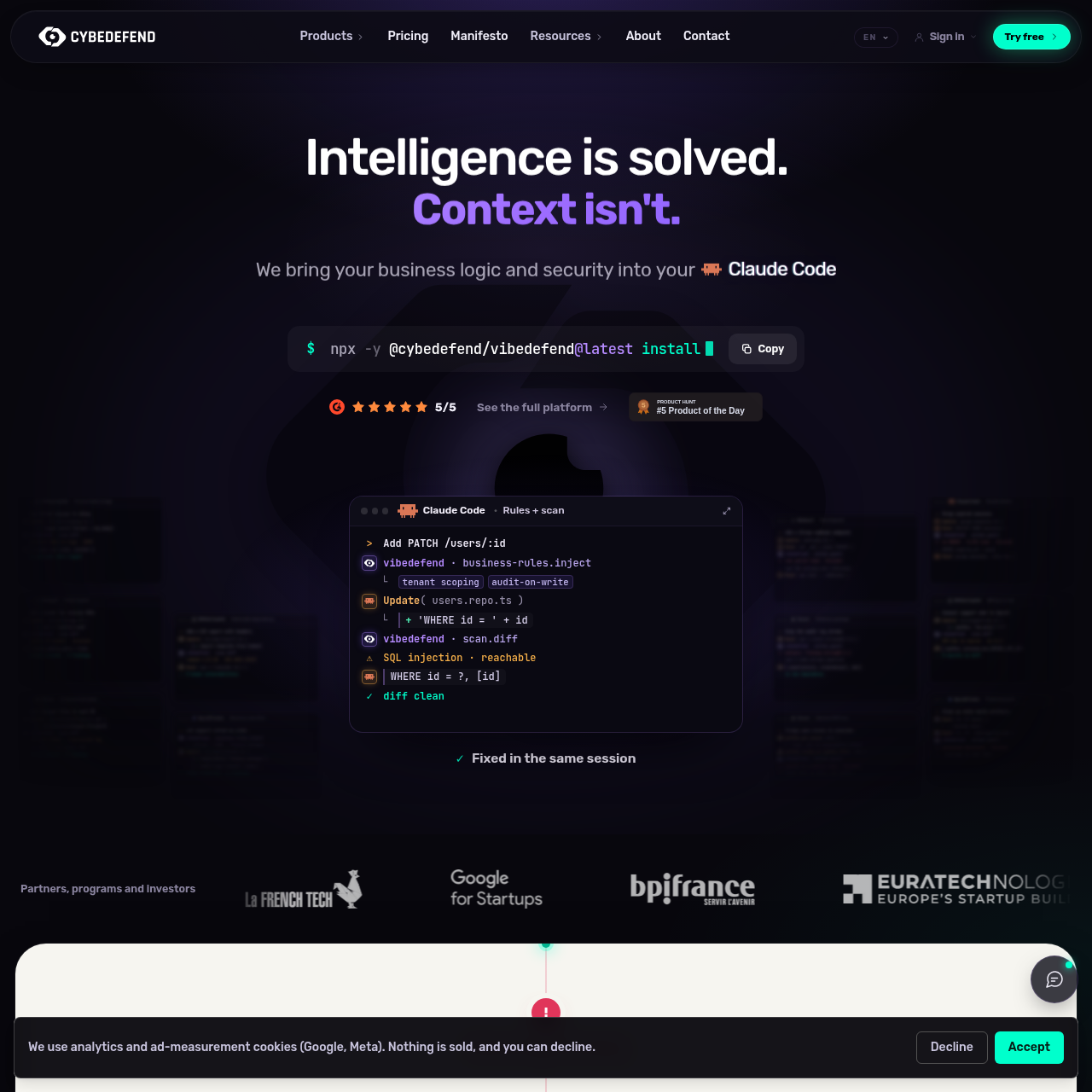
VibeDefend by CybeDefend is an agent-time security tool that injects business rules, guards shell actions, and scans code diffs across AI coding environments to catch vulnerabilities before commit.
What the product does and how it is positioned
VibeDefend by CybeDefend is designed to protect software development workflows that utilize AI coding agents. Installed on developer workstations via a single command, it integrates directly with coding environments to enforce project context, security standards, and business logic before code is committed or pull requests are submitted.
The tool combines proprietary analysis engines with established open-source security scanners covering static analysis, software composition analysis, infrastructure as code, and secret detection. In addition to scanning diffs, VibeDefend features an action guard that intercepts dangerous terminal commands and monitors interactions with Model Context Protocol servers.
Source-supported ways to use the product
Development teams can scan AI-generated diffs in real time for vulnerabilities like SQL injection, exposed API keys, and vulnerable third-party dependencies before changes are committed.
Organizations can enforce terminal safeguards that stop coding agents from executing destructive commands, such as live database schema drops, unconstrained deletions, or unauthorized sudo operations.
Teams can inject custom business logic and regulatory standards like GDPR and ISO 27001 into AI agent contexts to ensure generated endpoints adhere to authorization and logging requirements.
The documented workflow, where available
The developer executes the installation command via npx to detect and configure AI coding agents present on the local machine.
VibeDefend injects mined business logic and compliance standards directly into the AI agent prompt session.
As the agent generates code and shell commands, the action guard inspects terminal executions and scans diffs for security vulnerabilities.
Findings and fixes are presented directly within the agent session or team dashboard, prompting the agent to rewrite insecure lines before pull requests are created.
VibeDefend operates directly within developer environments to intercept actions taken by autonomous coding assistants. Rather than relying solely on static configuration files, the platform injects business rules and compliance requirements into the agent session while monitoring executed commands in real time.
The underlying architecture integrates CybeDefend proprietary analysis engines with established open-source tools including Opengrep for code analysis, Trivy for containers and infrastructure, Syft and OSV for dependencies, Gitleaks for secret detection, and Checkov and KICS for infrastructure as code. This multi-layered approach verifies that both command execution and generated diffs adhere to organizational policies.
Checks to run with your own material and workflow
What was checked and when
Answers based on the source-checked product record
VibeDefend is installed by executing a single command via npx, which automatically identifies and connects to supported coding agents present on the system.
The platform pairs proprietary CybeDefend engines with open-source tools including Opengrep, Trivy, Gitleaks, Checkov, KICS, Syft, and OSV across code, secrets, containers, and infrastructure.
The action guard intercepts terminal executions initiated by AI agents, blocking dangerous operations such as live database schema drops, destructive sudo commands, and unverified package installations.
The system incorporates rules and checks based on OWASP standards, SOC 2, GDPR, and ISO 27001, with an official SOC 2 Type II compliance audit currently under way.
Yes, VibeDefend monitors Model Context Protocol tool usage during agent sessions to guard against tool hijacking and unauthorized data transfers to external repositories.