AgentKit by Scalekit favicon

AgentKit by Scalekit

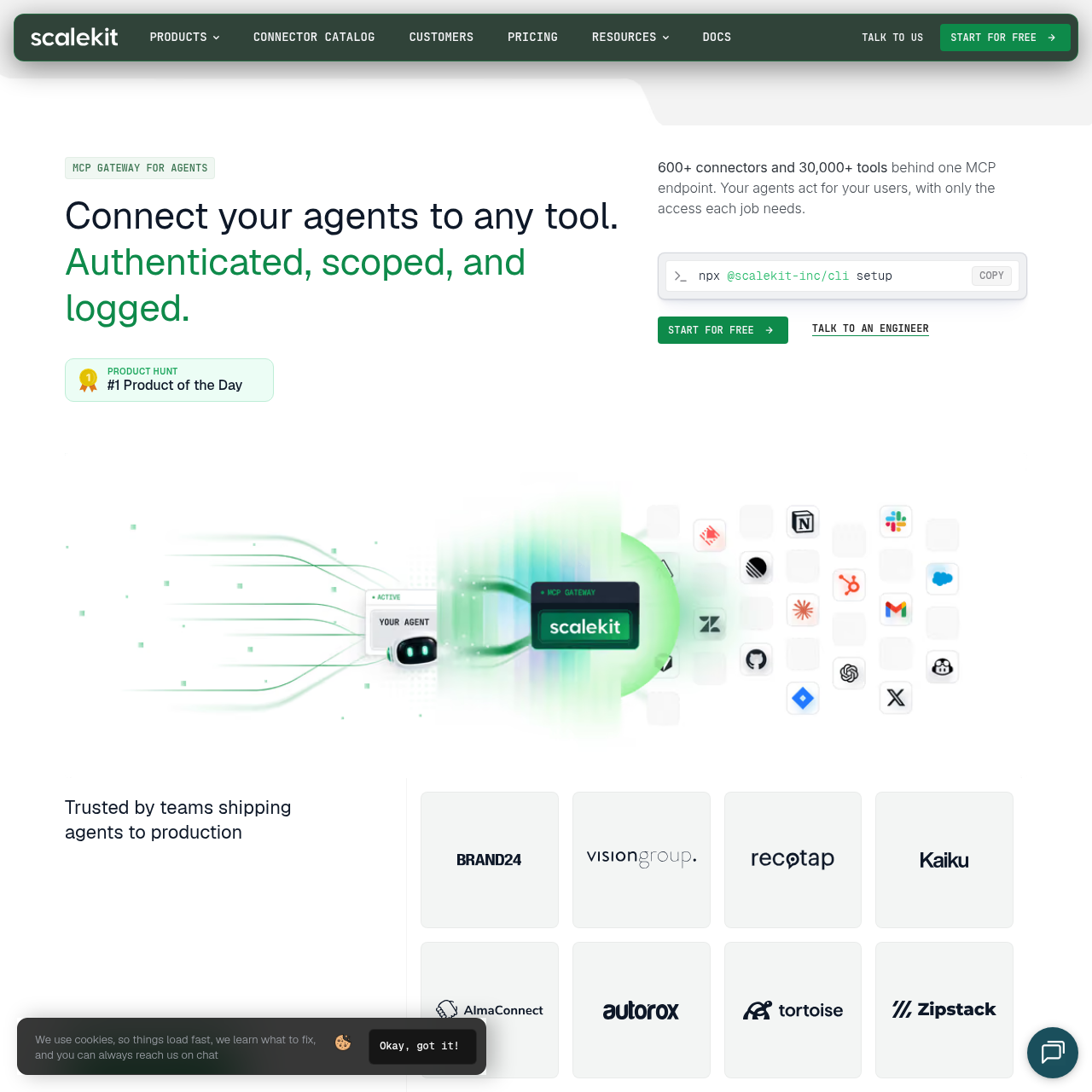
AgentKit by Scalekit provides an MCP gateway that manages user authentication, scopes tool access, and logs tool execution for AI agents.

Code & ITExecuting agent tool calls on behalf of…Classifying execution failures as…Enforcing tenant data residency in US…Restricting gateway and dashboard…
AgentKit by Scalekit product interface screenshot
Estimated monthly visits
113K
Data period:
Listed on AIToolly

What Is AgentKit by Scalekit? Product Overview

What the product does and how it is positioned

AgentKit by Scalekit serves as a managed Model Context Protocol (MCP) gateway that connects AI agents to external applications and APIs. It manages credential storage, token refreshes, and tenant isolation so that agents execute actions as authenticated end users without exposing access tokens to agent prompts or application code.

The platform supports over 600 connectors and 30,000 tools, enabling developers to build Virtual MCP Servers that expose only the necessary tools to specific agents. It includes built-in execution triggers, custom connector extensions, attributed audit logging, and SIEM streaming for enterprise observability.

What Can You Use AgentKit by Scalekit For?

Source-supported ways to use the product

User-Scoped Enterprise Integrations

The official customer story reports that Von deployed agents that interact with Salesforce, Gong, and Google Drive on behalf of customers without rebuilding credential infrastructure.

Role-Based Agent Scoping

The company presents customer implementations, such as Z47, using Scalekit's identity layer to establish discrete agent identities and control tool availability per role.

Event-Driven Workflow Automation

Developers use triggers to automatically start agent runs when upstream application events occur, such as a deal change or incoming email, operating directly under the connected user's permissions.

Gateway Architecture and Enterprise Security

AgentKit operates as an intermediary gateway between AI agent frameworks and third-party SaaS services. By abstracting tool interaction behind an MCP endpoint, it performs permission checks and handles credential injection for each outbound request. User tokens are kept in an encrypted vault, shielding credentials from developer code, context windows, and model prompts.

For enterprise security environments, Scalekit offers self-hosted deployment options, including inside private VPCs or fully air-gapped infrastructures. Organizations can manage their own encryption keys via AWS KMS or GCP KMS, enforce US or EU data residency at the storage layer, and restrict operational access through IP allowlisting and real-time SIEM log streaming.

  • Token encryption isolated per tenant with automatic refresh cycles
  • BYOK key management options using AWS or GCP Key Management Services
  • Deployment support for customer VPCs, self-hosted environments, and air-gapped networks
  • Real-time event streaming to external monitoring platforms like Splunk and Datadog

What to Test Before Choosing AgentKit by Scalekit

Checks to run with your own material and workflow

  • Verify whether the specific SaaS tools required by your agent are covered in the catalog or require custom connector creation.
  • Confirm that your compliance team accepts the US or EU storage residency configurations or requires a self-hosted VPC deployment.
  • Check that your agent orchestration framework supports MCP endpoints or works with one of the supported client libraries.
  • Review the enterprise requirements for HIPAA BAA or BYOK KMS integration prior to implementation.

AgentKit by Scalekit Sources and Last Checked

What was checked and when

Last checked
Category
Code & IT

AgentKit by Scalekit Frequently Asked Questions

Answers based on the source-checked product record

What is AgentKit by Scalekit?

AgentKit by Scalekit is an MCP gateway that connects AI agents to external tools and APIs with managed authentication, scoping, and logging.

How does AgentKit handle user authentication?

Users link their own accounts through supported auth models like OAuth 2.0, API keys, or bearer tokens, which the gateway stores encrypted and refreshes automatically.

What are Virtual MCP Servers in AgentKit?

Virtual MCP Servers are curated subsets of tools from connected applications, exposed via a single endpoint to limit context overhead and scope agent access.

Can AgentKit logs be exported to monitoring systems?

Yes, tool execution logs contain user, agent, and tool attribution and can be exported or streamed directly to Datadog, Splunk, or any SIEM.

Does AgentKit support private or self-hosted deployments?

Yes, AgentKit supports private deployment inside a customer VPC, self-hosted setups, and air-gapped environments.

Explore other recently added tools in the same category.