TheySaid 4.0
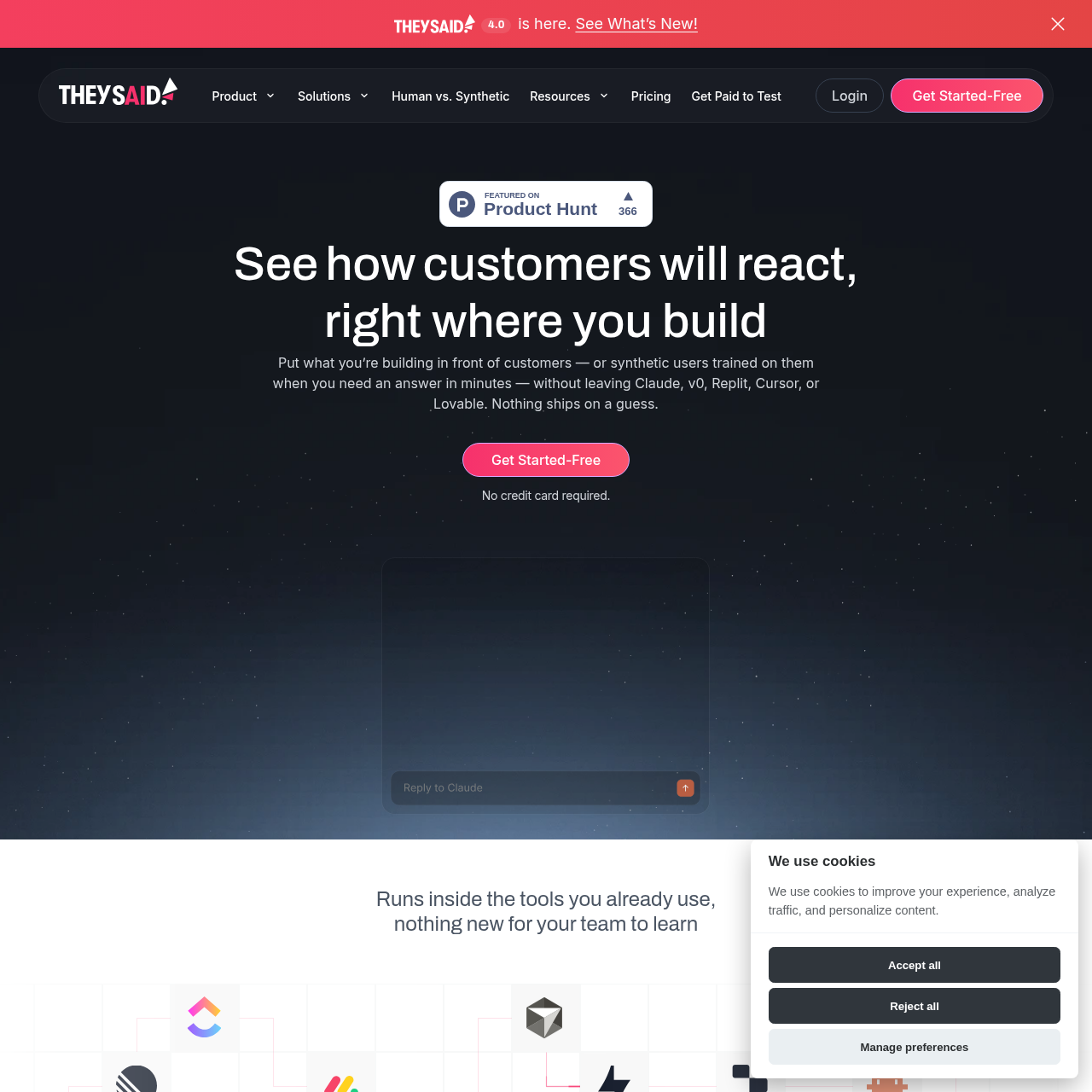
TheySaid 4.0 is a customer validation platform that combines human panels, synthetic testers, and an AI spec reviewer within tools like Claude, Cursor, and Jira to test product designs and builds before release.
What the product does and how it is positioned
TheySaid 4.0 integrates user research and validation directly into developer and design workflows. By connecting to environments such as Claude, Cursor, Replit, Lovable, Bolt, and Jira, the system enables teams to collect feedback on concepts and working code without switching between separate testing applications.
The platform supports three distinct forms of evidence: human testing panels (including proprietary customer bases or recruited testers), synthetic personas calibrated with company records, and an expert AI reviewer that checks builds against technical specifications.
Source-supported ways to use the product
Product teams configure Jira so that moving a ticket to Design Done automatically triggers usability tests and links recorded sessions and transcripts directly to the ticket.
Engineering teams run the expert AI reviewer and synthetic participants against functional builds to detect interface bugs and spec deviations before merging pull requests.
The official customer story reports that ClickUp used TheySaid AI Surveys to collect customer feedback and engagement insights.
The documented workflow, where available
The Experience Hub streams and scores feedback, attaching validation evidence directly to tickets in the product backlog.
Teams run Synthetic Audiences and the Expert AI Reviewer from within design environments to critique early concepts.
The platform tests the functional build against written specifications before code changes are merged into the repository.
Critical experiences are evaluated and scored across the customer journey following product release to verify ongoing performance.
TheySaid synthetic testers originate from a foundational model trained on more than 100,000 hours of human usability sessions. The synthetic agents mimic real user behaviors, including reading patterns, navigation hesitation, confusion, and drop-off tendencies.
Teams can tune these synthetic profiles using first-party customer information, such as call recordings, survey answers, CRM data, and customer support tickets. If internal customer data is not yet available, teams can select pre-built market audience profiles and refine them over time.
To establish reliability, the platform measures synthetic findings alongside human panels on matching interfaces. In comparative tests across multiple studies, synthetic testers uncovered 89 percent of total issues, human testers uncovered 90 percent, and 79 percent of issues were detected by both groups.
Checks to run with your own material and workflow
What was checked and when
Answers based on the source-checked product record
According to published comparative study data, synthetic testers uncovered 89 percent of total issues while human testers uncovered 90 percent. Seventy-nine percent of issues were identified by both groups, 10 percent solely by synthetic users, and 11 percent solely by human testers.
TheySaid 4.0 provides a Model Context Protocol integration that operates within Claude Design, Claude Code, Cursor, Replit, Bolt, and Lovable, alongside automated workflow triggering inside Jira.
Synthetic testers start from a base model trained on over 100,000 hours of usability sessions. Organizations can train them using their own CRM data, customer call recordings, support tickets, and surveys, or begin with pre-built audience profiles.
The unified test builder supports usability testing, AI-led surveys, interactive interviews, forms, and polls, featuring conditional logic, voice conversations, and translation support for more than 70 languages.
When an issue reaches the Design Done stage in Jira, the platform automatically launches the validation test, records and timestamps session findings, attaches the evidence to the ticket, and produces remediation prompts for code editors.