Seldon provides behavioral simulation tools for exploring user experiences, software failures, and decisions in changing conditions.
Research AssistantSimulates how agents make choices and…Supports investigation of user…Evaluates simulated behavior against…Behavioral simulation
Listed on AIToolly
What Is Seldon? Product Overview
What the product does and how it is positioned
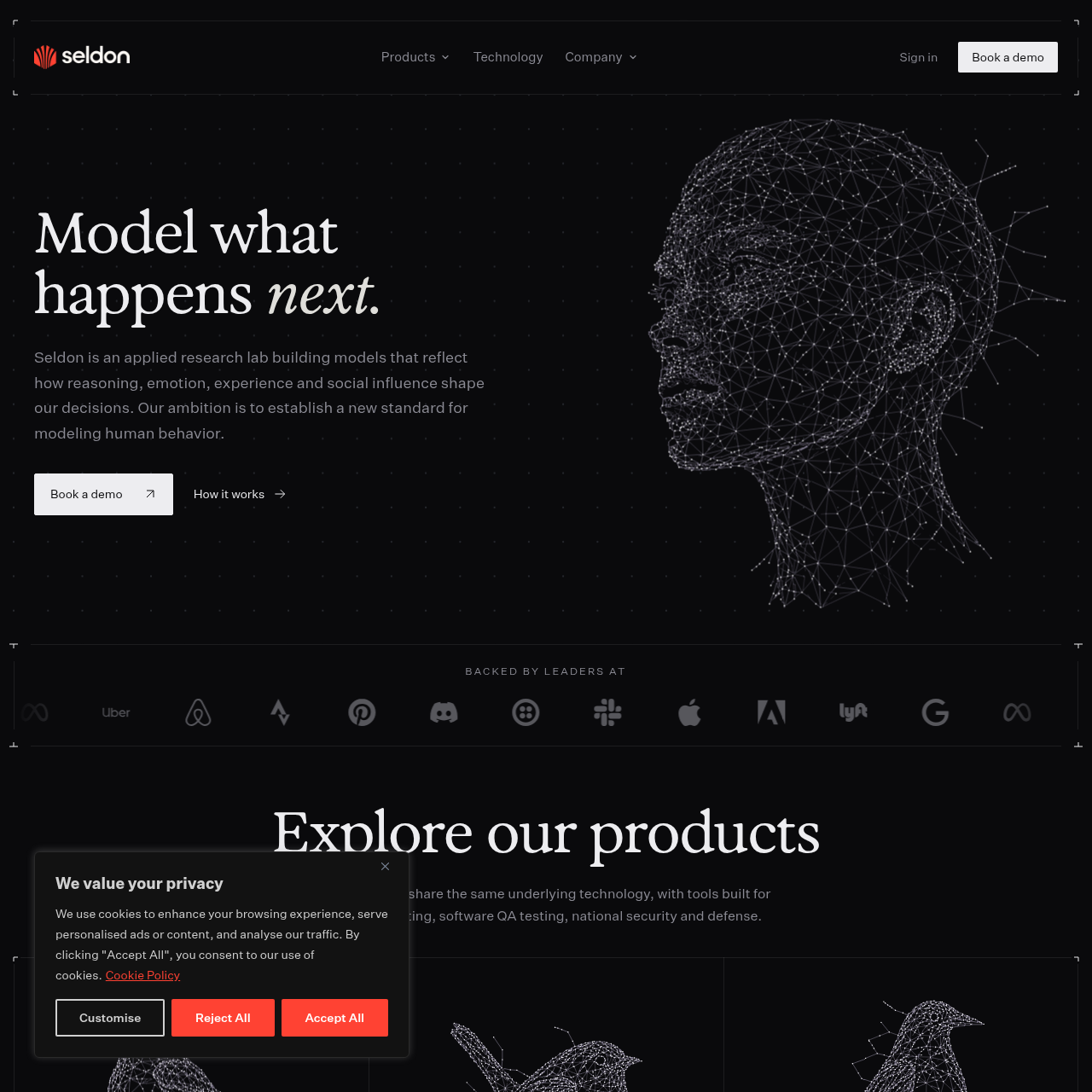
Seldon is an applied research lab that builds models of human behavior using factors such as personality, goals, beliefs, emotions, environment, and experience.
Its product lineup includes Finch for product and user research, Wren for software and QA testing, and Rook for high-risk environment analysis.
What Can You Use Seldon For?
Source-supported ways to use the product
Product and user research
Finch helps teams compare how different simulated users understand and navigate a product.
Software and QA testing
Wren is presented for finding workflow bugs, failed API calls, incorrect totals, and issues outside written test cases.
High-risk decision analysis
Rook supports exploration of decisions, interactions, and consequences in national security and defense contexts.
How to Use Seldon
The documented workflow, where available
1
Set the situation
Define the relevant environment, context, goals, information, and other influences shaping an agent.
2
Follow agent behavior
Observe what agents encounter, the choices they make, and what happens next in the modeled situation.
3
Inspect divergent trajectories
Review where modeled paths diverge and examine the evidence to decide what requires investigation or change.
4
Vary conditions
Change an agent's representation or situation to explore how different conditions affect choices and outcomes.
Behavioral simulation
Seldon's approach represents agents through personality, goals, motivations, beliefs, expectations, emotions, attention, environment, context, experience, and memory. The modeled agents carry these influences into decisions and interactions.
Agents can be examined under incomplete information and competing priorities.
The site describes evaluating simulations against observed human behavior.
The stated comparison measures where decisions align, where they diverge, and how responses change with circumstances.
What to Test Before Choosing Seldon
Checks to run with your own material and workflow
Confirm that the intended use case matches Finch, Wren, or Rook before selecting a product.
Verify which agent attributes, information, and situational conditions can be represented for the planned analysis.
Review how behavioral alignment and divergence are assessed against observed human behavior.
Check which platforms, integrations, and deployment environments are supported, since the source does not specify them.
Answers based on the source-checked product record
What is Seldon?+
Seldon is an applied research lab building models that represent how human factors shape decisions and behavior.
What products does Seldon offer?+
The official site presents Finch for product and user research, Wren for software and QA testing, and Rook for high-risk environment analysis.
What can Seldon's agents represent?+
The models account for factors including personality, goals, motivations, beliefs, emotions, attention, environment, context, experience, and memory.
What kinds of situations can be explored?+
The site describes exploring checkout abandonment, software failures, decisions under uncertainty, and strategy changes caused by new information.
How does Seldon evaluate behavioral fidelity?+
Seldon says it compares simulated users with observed human behavior, examining where decisions align, diverge, and respond differently to changing circumstances.
More Research Assistant AI tools
Explore other recently added tools in the same category.