Google EmbeddingGemma 2
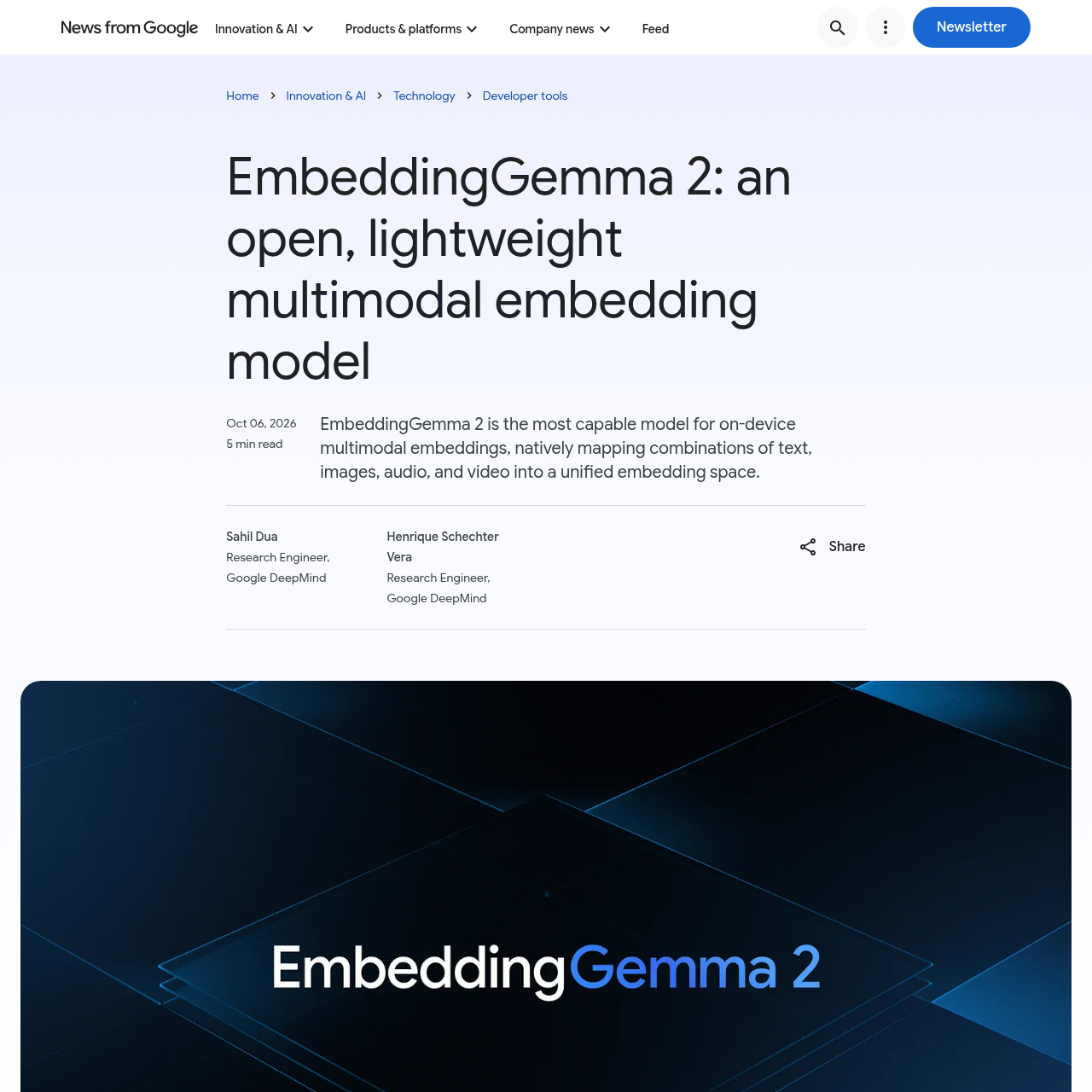
Google EmbeddingGemma 2 is an open 740M multimodal embedding model engineered for local, on-device search across text, code, images, audio, and video.
What the product does and how it is positioned
Google EmbeddingGemma 2 is a lightweight, natively multimodal embedding model designed for local inference on edge hardware. Built upon the Gemma 4 architecture, the model projects text, programming code, images, audio recordings, and video frames into a unified vector space.
The model employs a modular structure, enabling developers to run text-only tasks with 270 million parameters or attach dedicated vision and audio encoders for full multimodal support. It also incorporates Matryoshka Representation Learning to flexibly downscale vector dimensions for constrained storage environments.
Source-supported ways to use the product
Developers can index photo and video libraries locally to facilitate natural language or image-based semantic retrieval.
Programming tools can index source code files to power offline semantic code search and coding agent retrieval systems.
Applications can combine the embedder with generative language models to retrieve contextual local data across multiple formats.
EmbeddingGemma 2 is structured to run efficiently across varying hardware profiles by separating its 740 million total parameters into modular components. Developers focusing exclusively on text tasks can deploy the 270M text base, while applications processing multimedia can load the additional 170M vision and 300M audio encoders.
To optimize performance in local vector databases, the model leverages Matryoshka Representation Learning. This mechanism allows the default 768-dimensional embeddings to be truncated to 512, 256, or 128 dimensions, allowing up to a sixfold reduction in vector storage footprint while maintaining semantic consistency.
Checks to run with your own material and workflow
What was checked and when
Answers based on the source-checked product record
EmbeddingGemma 2 natively processes text, source code, images, video frames, and audio recordings within a single shared embedding space.
When quantized on a Google Pixel 11 Pro, the model requires approximately 191MB of active RAM for text-only operations and about 567MB for the full multimodal model.
The model features an 8,000-token context window, allowing it to process up to 5.5 minutes of audio, 29 images, 58 video frames, or interleaved media combinations.
Using Matryoshka Representation Learning, output vectors can be truncated from 768 dimensions down to 512, 256, or 128 dimensions to reduce database size.
Because it is built on the Gemma 4 architecture, EmbeddingGemma 2 shares its text tokenizer and audio encoder with Gemma 4, reducing combined memory consumption.