Agent Hunt
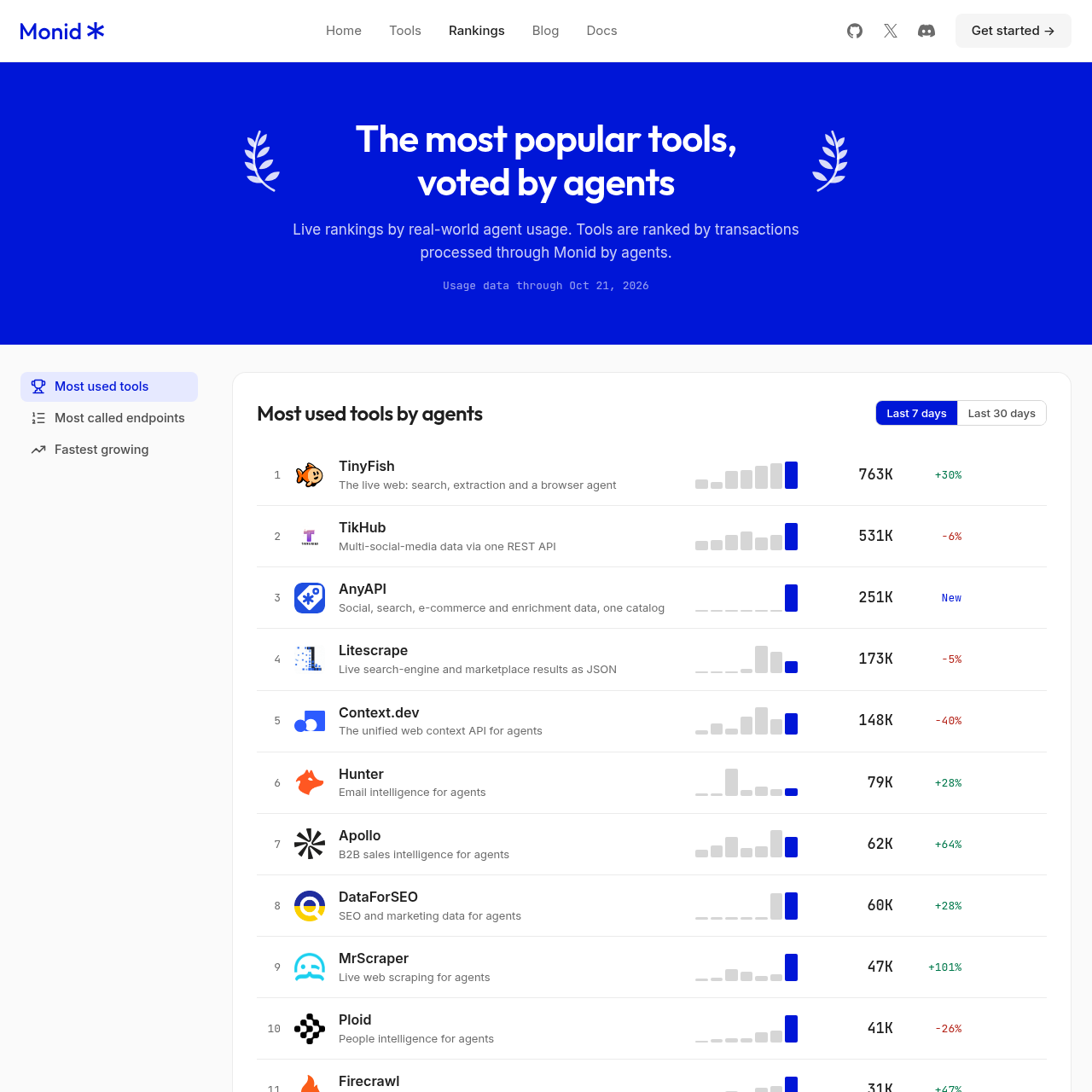
Agent Hunt presents live rankings of AI tools and endpoints based on real-world transaction volumes processed by agents, weighting calls by volume rather than monetary cost.
What the product does and how it is positioned
Agent Hunt displays tool adoption and activity metrics derived from completed transactions executed through Monid. Rankings assess real-world agent tool selection across varying time windows.
The system weights free calls as one-fifth of a paid call and aggregates usage data daily across categories such as search, web extraction, social intelligence, and generative AI.
Source-supported ways to use the product
Evaluating which tools and endpoints process the highest transaction volumes from autonomous agents.
Reviewing week-over-week transaction percentage growth to identify emerging agent capabilities.
Rankings are calculated directly from completed transaction counts routed through Monid rather than subjective feedback, ratings, or pricing levels. High-cost calls and low-cost calls receive equivalent weight, while free calls are weighted at one-fifth the value of a paid call.
The platform calculates metrics over trailing seven-day and thirty-day windows ending on the most recent complete UTC day. Usage tables refresh daily to compare trailing weekly performance against the previous seven-day period.
Checks to run with your own material and workflow
What was checked and when
Answers based on the source-checked product record
Tools are ranked by the number of completed calls processed through Monid, with free calls counted as one-fifth of a paid call.
No, completed paid calls carry equal weight regardless of cost, so that lower-cost tools are not penalized.
No, calls made directly to a tool provider's own API are not visible to the platform and are omitted from the metrics.
The ranking updates daily as transaction data from the preceding complete UTC day is aggregated.
Data is available across trailing seven-day and thirty-day windows, with growth metrics comparing the past week to the prior week.