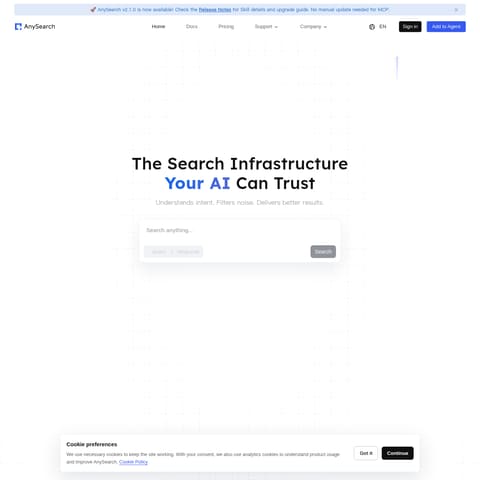
Exa provides an AI search API with flexible latency tiers, structured outputs, and enterprise-grade security controls.
Search EnginesExecute web searches across categories…Provide configurable latency settings…Extract structured output enrichments…Return token-efficient excerpts and…
Estimated monthly visits
757K
Data period:
Listed on AIToolly
What Is Exa Monitors v2? Product Overview
What the product does and how it is positioned
Exa is a search infrastructure platform designed to provide data and context for AI agents and developers. It indexes public web and private information across multiple categories, including news, company data, research, people, and financials.
The platform features customizable latency options, structured JSON outputs, and token-efficient content extraction via highlights. It incorporates enterprise security controls such as SOC 2 Type II certification, GDPR and CCPA compliance, and a zero data retention policy.
What Can You Use Exa Monitors v2 For?
Source-supported ways to use the product
Coding Agent Integration
The company presents this as a customer use case where Cognition uses Exa to power search capabilities across documentation and repositories within Devin.
Agentic Lead Engine
The company presents this as a customer use case where HubSpot utilizes Exa to power an agentic lead engine supported by company data enrichments.
Search Infrastructure and Latency Tiers
Exa operates an index tracking billions of URLs and serving documents through vector database infrastructure. The search API accommodates various application requirements by offering multiple speed and depth configurations.
Lite tier operating at approximately 300ms latency
Auto tier operating at approximately 1s latency
Deep research tier operating at approximately 10s latency
What to Test Before Choosing Exa Monitors v2
Checks to run with your own material and workflow
Verify that the API supports the required latency configuration for your application workflow.
Check the available search categories and verticals to ensure they cover your target data domains.
Review the enterprise security and compliance documentation to confirm alignment with your regulatory requirements.
Answers based on the source-checked product record
What latency options are available in the search API?+
The API provides a Lite tier at 300ms, an Auto tier at 1s, and a Deep research tier at approximately 10s.
What search categories can be queried through the platform?+
Users can search across full web content, news, companies, research papers, people, and financial records.
Does the service support structured data outputs?+
Yes, the platform can return structured JSON outputs and extract token-efficient content highlights from web pages.
What security and privacy standards are supported?+
The platform offers SOC 2 Type II compliance, GDPR support with EU data residency, CCPA rights handling, HIPAA safeguards, and a zero data retention policy.
Are queries and results stored by the provider?+
No, the platform enforces a zero data retention policy supporting queries and results are never stored or trained on.
More Search Engines AI tools
Explore other recently added tools in the same category.