Atlaso
Atlaso: Persistent AI Memory Layer for All Tools
Atlaso provides a shared AI memory layer to sync context across tools like Claude and Cursor. Automatically capture decisions and recall facts in every session.
2026-08-06
--K
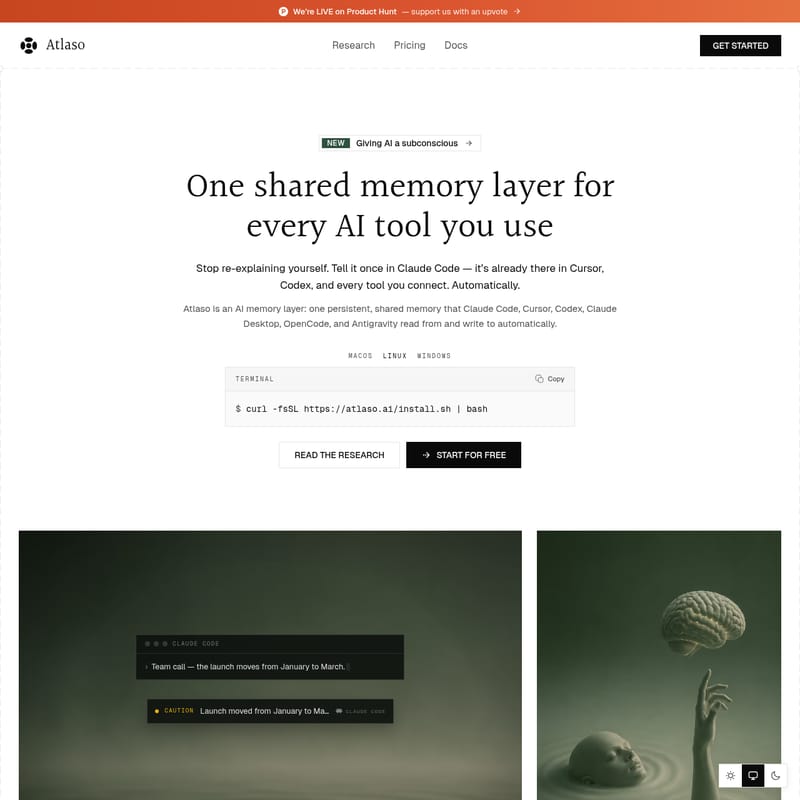
Structured product information
Atlaso: At a glance
Last checked: · Official source
Key features
Shared Memory Layer
A persistent memory layer that allows different AI tools like Claude Code, Cursor, and Codex to read from and write to a single shared context automatically.
Automatic Capture and Recall
Captures decisions, watch-outs, and open threads as you work and recalls relevant context before every turn without manual setup or pasting.
Secrets Scrubbing
Automatically identifies and redacts sensitive information like passwords and API keys before any data is stored.
Personal and Per-Project Memory
Maintains personal memory that follows the user across tools while keeping project-specific memory isolated to its respective repository.
Background Enrichment
A background process that distills raw captures into structured, tagged, and graded memories to improve recall accuracy.
Contradiction Flagging
Identifies conflicting information, retires superseded facts, and grades memories as settled, contested, or thin based on evidence.
Best for
- Software & Engineering
- Finance
- Healthcare & Life Sciences
- Legal
- Research & Education
Supported platforms
- MacOS
- Linux
- Windows
- Terminal
- Claude Code
- Cursor
- Codex
- Claude Desktop
- OpenCode
- Antigravity
Limitations
- If the system encounters an error, it fails silently to avoid blocking the user's workflow.
Privacy & security
- Secrets are scrubbed before storage
- Data is encrypted in transit (TLS) and at rest
- Access tokens are stored only as hashes
- Memory data is never used to train AI models
- Data is never sold to third parties
Atlaso Product Information
Atlaso functions as a dedicated AI memory layer designed to provide a shared AI context across various development and productivity tools. By acting as a centralized repository, it allows different AI assistants to read from and write to a single, persistent AI memory. This architecture addresses the common issue where AI sessions start without prior knowledge, requiring users to repeatedly explain project details, preferences, and past decisions.
Cross-Tool Context Syncing and Shared Memory
The platform enables cross-tool AI memory by connecting disparate applications such as Claude Code, Cursor, Codex, and Claude Desktop. When a user establishes a decision or identifies a project constraint in one tool, Atlaso ensures that information is available in every other connected environment. This one shared memory layer eliminates the isolation of context within individual apps, allowing a project's history to travel with the user.
According to provider research, the system achieves a 92% evidence recall on LongMemEval-S benchmarks. This high rate of retrieval is supported by semantic search capabilities that rank and inject relevant notes into the AI's context window before a prompt is even processed. By maintaining this persistent context, the platform ensures that the AI assistant remains oriented to the current state of a project, regardless of which interface is being used.
Automatic Context Capture and Recall
Atlaso automates AI context management by observing work as it happens. It identifies durable facts, such as team decisions, technical watch-outs, and open threads, and saves them automatically. This process includes a security step where secrets are scrubbed before storage; sensitive data like passwords and API keys are identified and redacted to prevent them from being stored in the memory layer.
Before every turn in a conversation, the system performs an automatic recall. It pulls relevant context from previous sessions and injects it into the current prompt. This mechanism allows the AI to pick up exactly where a user left off without manual setup or the need to copy-paste context from earlier logs. The system distinguishes between personal memory, which follows the user across all tools, and project-specific memory, which remains isolated to its respective repository to prevent context bleeding.
Background Enrichment and Memory Integrity
To maintain the accuracy of stored information, Atlaso utilizes a background enrichment process. This nightly operation distills raw captures into structured, tagged, and graded memories. By deduping information and refining tags, the system aims to improve the precision of future recalls.
One of the critical functions of this AI memory layer is its ability to handle contradictions. If a new decision is made that conflicts with an older record, the system flags the contradiction and retires the superseded fact. Every recalled memory is assigned a verdict—such as settled, contested, or thin—based on the weight of the supporting evidence. This ensures the AI acts on verified, current information rather than outdated or unconfirmed notes.
Privacy and Security Standards
Security is integrated into the data handling process through several layers of protection. All data is encrypted in transit using TLS and remains encrypted at rest within the infrastructure. Access tokens are never stored in plain text; they are kept only as hashes.
Atlaso states that memory data is never used to train AI models and is never sold to third parties. Users maintain control over their data, with the ability to delete specific memories or their entire account at any time. A technical limitation to note is that the system is designed to fail silently in the event of an error. This prevents the memory layer from blocking the user's primary workflow, though it may result in a session proceeding without the usual background context.
Frequently Asked Questions
What is Atlaso?
Atlaso is an AI memory layer for existing AI tools. It connects to various platforms to recall relevant context before each turn and capture durable facts afterward, ensuring your AI remembers decisions, preferences, and progress across different tools.
Which AI tools does Atlaso work with?
Atlaso works with Claude Code, Cursor, Codex, Claude Desktop, OpenCode, and Antigravity. It also supports any tool that speaks MCP (Model Context Protocol), with support for ChatGPT and Meta AI listed as coming soon.
How do I install Atlaso?
Installation is completed by running a single command in the terminal to link your machine and account. For tools without a terminal, Atlaso can be added as a connector URL. The process requires no manual configuration files or API keys.
How does Atlaso handle contradictions or outdated information?
Atlaso flags contradictions and retires superseded facts. Every recalled memory is assigned a verdict—such as settled, contested, or thin—based on supporting evidence, so the AI acts on current and verified information.
Is my data private with Atlaso?
Yes. Atlaso scrubs secrets before storage and encrypts data both in transit and at rest. The service does not train AI models on user memory or sell user data. Users maintain control and can delete memories or their account at any time.