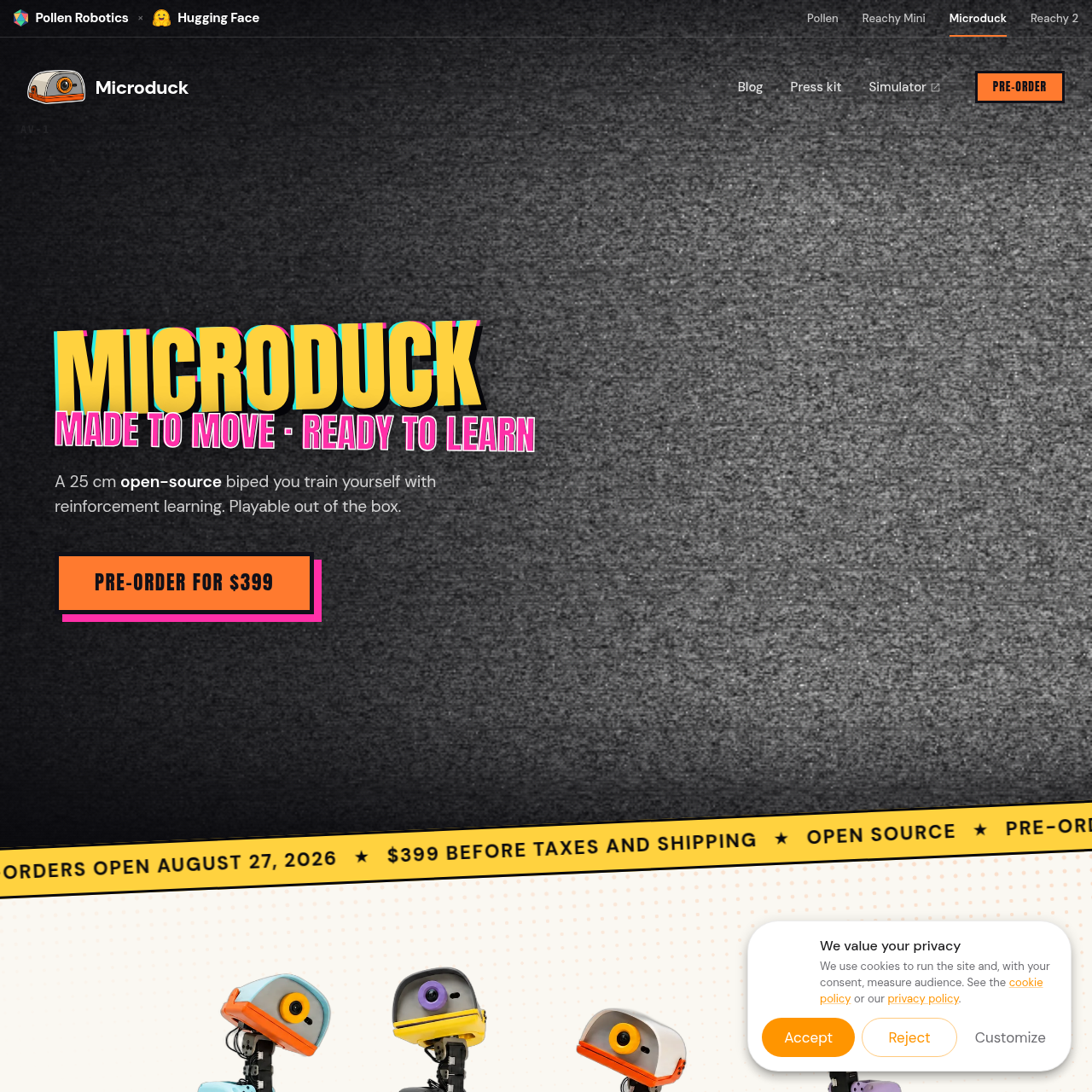
Microduck is a 25 cm open-source bipedal robot designed for AI builders to train and deploy custom behaviors using reinforcement learning and simulation.
Microduck provides an open-source platform for robotics enthusiasts to experiment with reinforcement learning. The robot is designed to learn behaviors in a physics-based simulation environment before deploying those policies to the physical hardware.
The system includes a full software stack, including SDKs and training tools, allowing users to fork, retrain, and share their own behavioral policies with the community.
What Can You Use Microduck For?
Source-supported ways to use the product
Reinforcement Learning Research
Users can develop and test new movement policies in a simulated environment before deploying them to the physical robot.
Behavioral Customization
Developers can create and share unique robot behaviors, such as specialized gaits or interaction routines, with the broader community.
How to Use Microduck
The documented workflow, where available
1
Train in simulation
Develop and learn behavioral policies within a physics simulation environment on a local machine or via cloud services.
2
Deploy on the robot
Transfer the trained policy from the simulation environment to the physical Microduck hardware.
3
Refine the simulation
Analyze performance, tune parameters, and re-train the model to improve behavioral outcomes.
4
Publish the policy
Share the finalized behavioral policy with the community for collaborative development.
Sim-to-Real Architecture
The Microduck ecosystem is built on a sim-to-real workflow, which bridges the gap between virtual training and physical execution. By utilizing the MuJoCo physics engine, users can iterate on complex movements without risking hardware damage.
Policies are trained in a physics-accurate virtual twin.
Onboard policy loops execute at 50 Hz on the physical robot.
The entire software stack is open-source and available on GitHub.
What to Test Before Choosing Microduck
Checks to run with your own material and workflow
Confirm that the local development environment supports the MuJoCo physics simulator and the required reinforcement learning stack.
Review the GitHub repository to verify compatibility with existing SDKs and robot configuration tools.
Answers based on the source-checked product record
Is the Microduck software open source?+
Yes, the SDK, simulation environment, and the full reinforcement learning training stack are open source and licensed under Apache-2.0.
Can I train my own behaviors for the robot?+
Yes, every behavior is a policy that can be trained in a physics simulation on your own machine or via Hugging Face Jobs and then deployed to the robot.
What hardware sensors are included on the robot?+
The robot is equipped with a camera, LiDAR, and two IMUs to support its movement and interaction capabilities.
Does the robot come with pre-trained moves?+
Yes, the robot ships with seven trained moves out of the box, including walking, sitting, standing, kicking, grabbing, and getting back up.
How do I interact with the robot's software?+
Users can monitor, configure, and update the robot using the provided robotctl command-line interface.
More Code & IT AI tools
Explore other recently added tools in the same category.