Cognition's SWE-2
SWE-2 is Cognition's flagship coding model post-trained from Kimi K3, designed for agentic software engineering with focused codebase navigation and disciplined verification across multiple effort levels.
What the product does and how it is positioned
SWE-2 is a specialized coding model developed by Cognition, post-trained from the 2.8-trillion-parameter Kimi K3 base model using reinforcement learning tailored to agentic software engineering.
Integrated directly across Devin environments, SWE-2 executes end-to-end development workflows including repository search, multi-file code editing, build verification, and test authoring.
Source-supported ways to use the product
Developers can assign codebase issues to SWE-2 to inspect relevant files, plan changes, apply code updates, and commit verified fixes.
Engineering teams can use the model to write end-to-end tests that independently validate software modifications against edge cases.
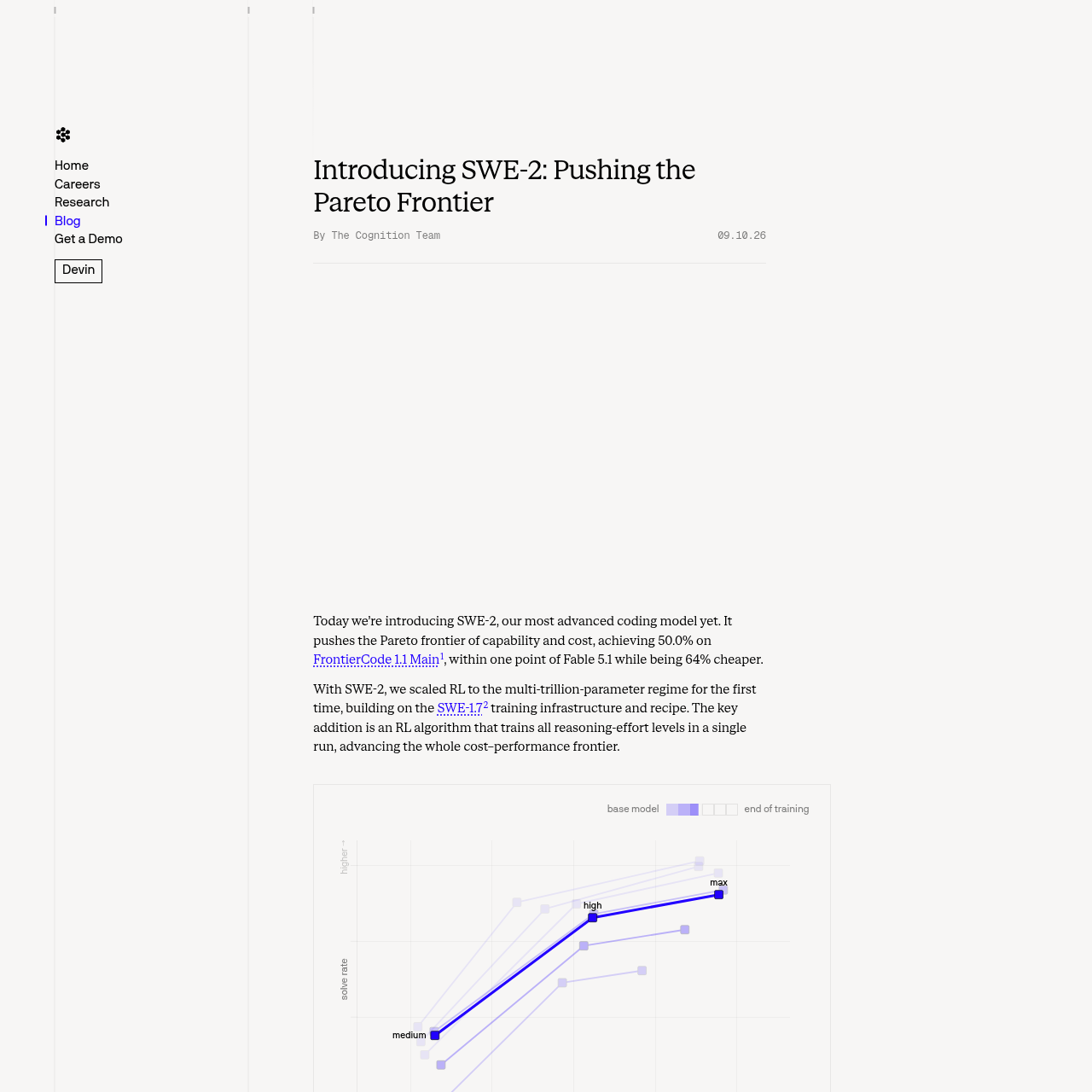
SWE-2 is post-trained from Kimi K3, scaling reinforcement learning to a multi-trillion-parameter model to optimize performance across reasoning-effort tiers in a single training run.
The training architecture uses a length-weighted reward baseline to stabilize gradient variance without requiring extra backward passes. Serving rollouts rely on NVFP4 and FP8 kernels alongside speculative decoding supported by an online-updated draft model.
Checks to run with your own material and workflow
What was checked and when
Answers based on the source-checked product record
SWE-2 is post-trained from Kimi K3, a 2.8-trillion-parameter model with prior reinforcement learning for agentic coding.
SWE-2 is available within Devin Desktop and Devin CLI, with rollouts extending to Devin Web and Devin Fusion.
SWE-2 focuses its exploration on relevant files, enabling it to initiate code editing in fewer exploratory steps than SWE-1.7.
The model supports medium, high, and max effort levels, providing options between rapid code edits and deeper planning or verification.
SWE-2 re-derives conclusions by executing test artifacts and inspecting technical evidence rather than accepting user hypotheses without verification.