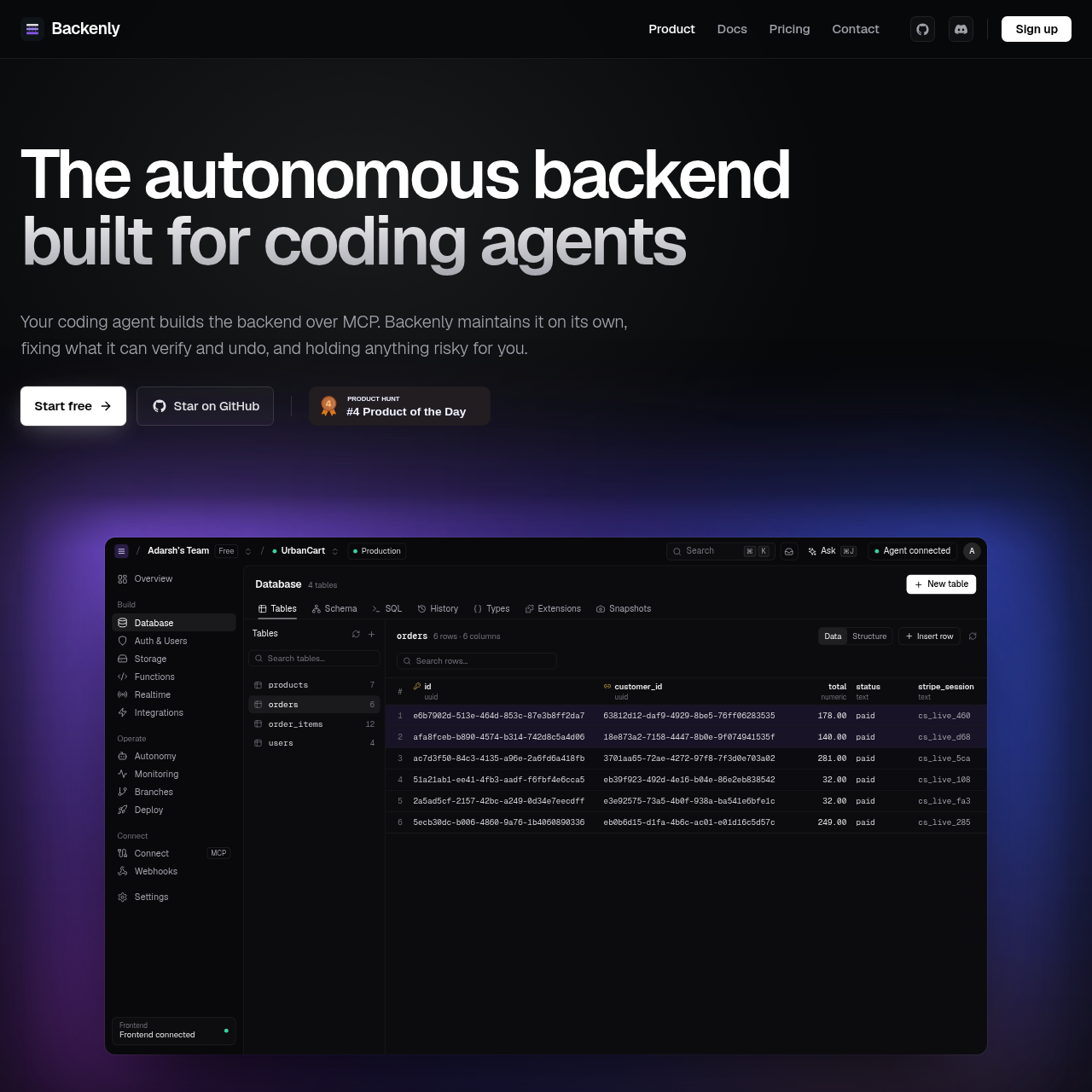
Backenly is an autonomous PostgreSQL backend platform designed for AI coding agents to provision resources over MCP while automated guardrails safely audit, self-heal, and gate risky changes.
Backenly is an autonomous backend platform designed to work alongside AI coding agents such as Claude Code, Cursor, Codex, and Cline. Coding agents provision schemas, configure row-level security, set up user authentication, and enable realtime streams over the Model Context Protocol (MCP) or through a command-line interface.
Beyond initial generation, Backenly operates a continuous observation loop that evaluates backend health every minute. Additive performance enhancements, such as missing indexes, are automatically applied with point-in-time undo snapshots, whereas potentially breaking modifications and schema drops remain gated behind mandatory administrator approvals.
What Can You Use Backenly For?
Source-supported ways to use the product
Agent-Driven Backend Provisioning
Developers use coding agents connected via MCP to generate database tables, define row-level security policies, and activate authentication schemes directly against isolated PostgreSQL schemas.
Continuous Database Optimization
Teams run continuous minute-by-minute checks that detect slow queries and missing indexes, allowing the platform to apply additive database optimizations autonomously.
Protected Schema Restructuring
Operators split multi-responsibility tables by rehearsing structural migrations on real row duplicates, reviewing non-destructive data synchronization before releasing to production.
How to Use Backenly
The documented workflow, where available
1
Agent Connection
Connect a supported coding agent to Backenly using the official MCP server integration or the CLI tool.
2
Schema and Service Generation
Direct the agent to generate database tables, specify row-level security rules, configure authentication, and wire storage or realtime streaming.
3
Continuous Observation
Backenly runs health checks every minute to evaluate active database queries and relational structures.
4
Autonomous Repair and Gating
The system applies safe, additive index updates with automatic undo points while holding destructive or relational write-altering requests for manual review.
5
Approval and Deployment
Administrators inspect staged changes, review schema refactoring rehearsals, and approve actions through the project dashboard.
Autonomy Engine and Change Verification
Backenly balances agent automation with strict operational safety by categorizing system updates based on risk. A self-healing loop runs every minute to inspect system performance across the backend. When safe optimizations such as missing indexes are discovered, Backenly generates a snapshot of the prior state, executes the additive change, and verifies query execution before marking the issue resolved.
High-risk changes are intentionally blocked by safety guardrails. Operations involving dropped tables, foreign keys that alter write behavior, authentication adjustments, or destructive statements are placed in a pending state. For structural refactoring, the platform rehearses operations on row copies to ensure existing applications remain functional while awaiting human review.
Health checks run automatically every minute
Automated index additions capture undo snapshots prior to execution
Verification checks confirm query improvements after automated repairs
Destructive operations and dropped tables require explicit user confirmation
Schema restructuring rehearses modifications on data copies before human sign-off
What to Test Before Choosing Backenly
Checks to run with your own material and workflow
Verify that MCP server connectivity and tool execution function smoothly with your chosen coding agent environment.
Check that your deployment architecture accommodates either Backenly Cloud regional locations or a self-hosted installation.
Confirm that automatic snapshot and undo behavior operates as expected when additive index optimizations occur.
Review the administrative approval dashboard to verify that destructive operations and drop requests are reliably halted.
Answers based on the source-checked product record
How do AI coding agents interact with Backenly?+
Coding agents connect using the Backenly Model Context Protocol server, a dedicated command-line interface, or predefined agent skills to manage schemas, authentication, and integrations.
What happens when an agent executes a destructive command?+
Destructive operations, schema drops, and authentication adjustments are blocked by safety guardrails and held in the dashboard for manual human approval.
How is tenant data isolated across projects?+
Each project is provisioned with a dedicated PostgreSQL schema and private signing secret rather than filtering shared tables with application-level WHERE clauses.
Which deployment options and regions are supported?+
Backenly Cloud operates across regions in Mumbai, Frankfurt, US East, US West, and Singapore, and the Apache-2.0 open-source version can be self-hosted on custom servers.
How does the autonomous self-healing process function?+
Backenly evaluates database health every minute, applies safe additive fixes after taking a state snapshot, and re-runs the initial check to verify problem resolution.
More Code & IT AI tools
Explore other recently added tools in the same category.