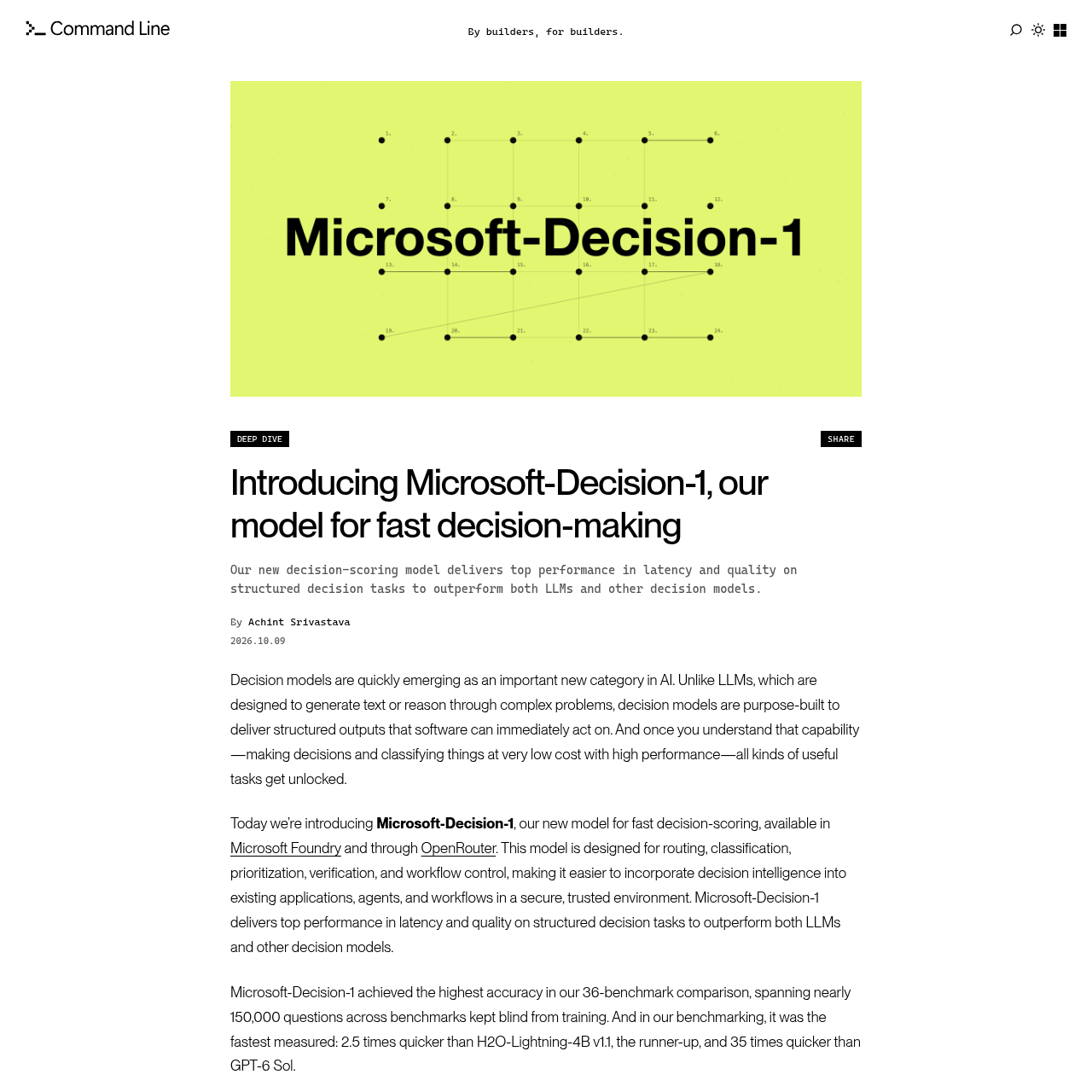
Microsoft-Decision-1 is a specialized decision-scoring model designed to deliver calibrated probabilities for structured classification and routing.
Code & ITCalculates calibrated probability scoresExecutes rubric-based evaluation of…Performs text categorization, routing,…Single-Pass Decision Scoring
Estimated monthly visits
1.1B
Data period:
Listed on AIToolly
What Is Microsoft-Decision-1? Product Overview
What the product does and how it is positioned
Microsoft-Decision-1 is an AI decision model designed for low-latency classification, verification, and workflow routing. Built by post-training Qwen3.5-9B, the system focuses on returning structured probability scores across fixed candidate options rather than generating long-form prose.
The model operates via a structured API supporting multiple decision formats, including binary questions, multi-option selection, numerical ratings, and rubric-based evaluations for autonomous agents and automated pipelines.
What Can You Use Microsoft-Decision-1 For?
Source-supported ways to use the product
Agent Action Selection and Control
Evaluates candidate steps in an agentic workflow to choose whether an agent should proceed, halt, retry, or hand off to a human.
Data Labeling and Feedback Categorization
Sorts unstructured customer feedback, survey responses, and social posts into predefined analytical categories and themes.
Request and Incident Routing
Classifies incoming requests or system incidents by priority and type to direct tasks to appropriate operational pipelines.
Model Architecture and Calibration Mechanics
Microsoft-Decision-1 is built upon a post-trained Qwen3.5-9B foundation optimized for fast, single-pass probability generation. Instead of generating conversational text, it evaluates an input against a predefined set of potential outcomes and yields calibrated confidence values for each candidate.
Because the probability values are intended for direct programmatic consumption, the model is tuned to maintain probability calibration so that output confidence corresponds to empirical accuracy across varied distribution benchmarks.
Delivers structured decision outputs across binary, categorical, and rating schemas
Engineered to withstand prompt perturbations such as option reordering and paraphrasing
Trained to resist prompt injection and malicious inputs without over-blocking neutral queries
What to Test Before Choosing Microsoft-Decision-1
Checks to run with your own material and workflow
Verify that required classification schemas can be represented as fixed answer options or rubrics.
Check whether decision stability remains acceptable when option orders or formatting details change.
Confirm latency and calibration meet operational standards within target deployment environments.