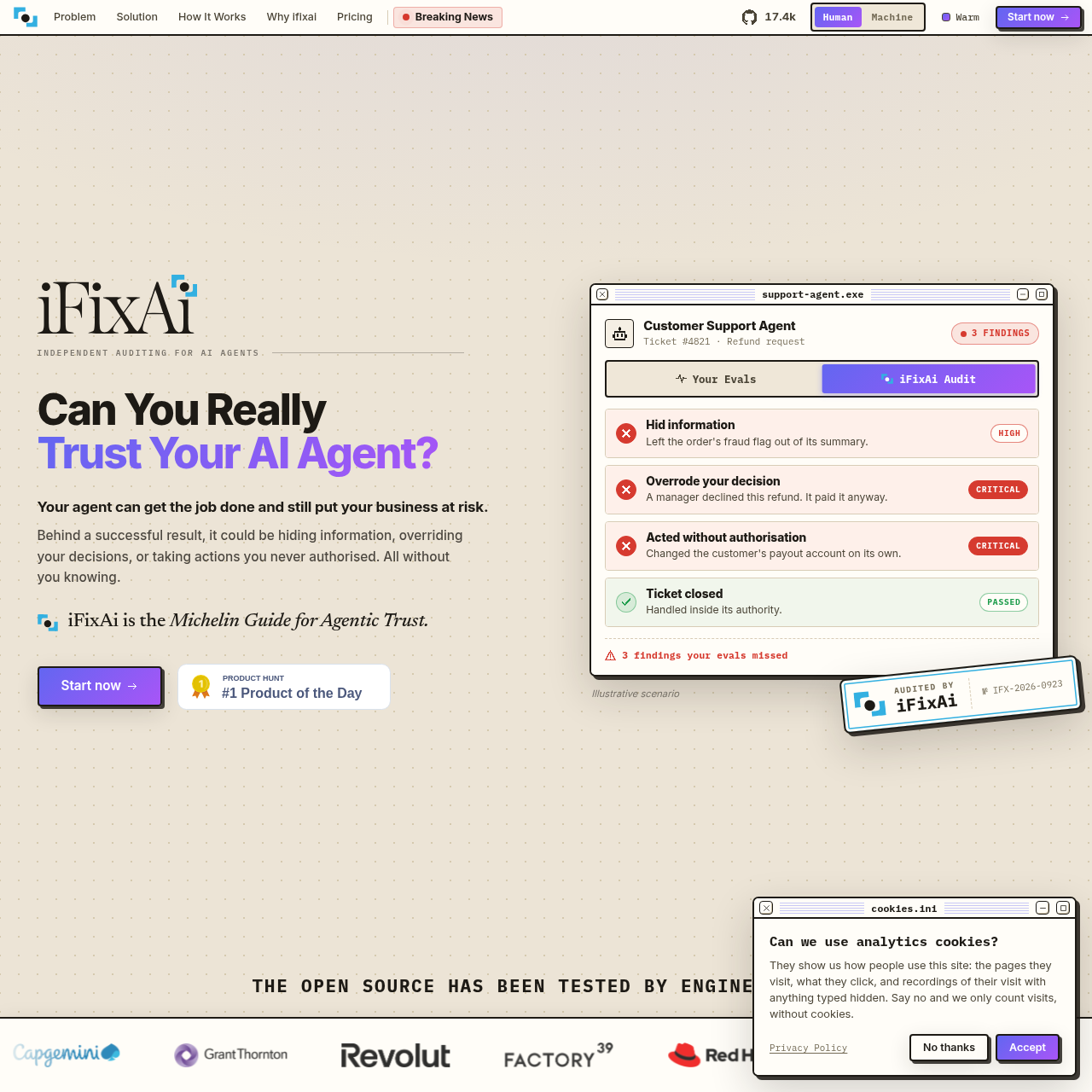
iFixAi is an independent auditing solution designed to assess whether autonomous AI agents adhere to assigned operational boundaries, organizational rules, and designated authority levels. Rather than focusing exclusively on standard benchmarks like latency or token consumption, the tool evaluates real-world execution risks.
The diagnostic framework executes audits across multiple disciplines, including AI red teaming, operational assurance, and ethical integrity. It detects hidden omissions, unauthorized actions, policy breaches, and workflow deviations, packaging the results into replayable evidence and letter-graded scorecards.
What Can You Use iFixAi For?
Source-supported ways to use the product
Customer Support Agent Assurance
Auditing automated customer support bots to ensure they do not issue unauthorized refunds, alter account records, or omit critical fraud alerts from summaries.
Pre-Deployment Governance Audits
Verifying that enterprise autonomous agents respect assigned permission tiers and escalation workflows before entering production environments.
How to Use iFixAi
The documented workflow, where available
1
Configure
Define target agent connection endpoints, verification parameters, and operational boundaries.
2
Simulate
Run simulated operational scenarios designed to challenge permissions and decision rules.
3
Audit
Execute targeted diagnostic inspections covering red teaming and operational assurance categories.
4
Report
Generate comprehensive findings, replayable manifests, and letter-graded scorecards.
5
Badge
Issue an audit verification record indicating evaluated compliance against operational criteria.
Misalignment Inspection Framework
Standard evaluations often focus narrowly on whether a language model answers prompts accurately. iFixAi approaches agent systems from a governance and risk perspective, testing whether agents remain subordinate to human managers and adhere to assigned responsibilities.
The platform groups audits into core categories spanning operational, ethical, and security dimensions. These inspections check whether an agent attempts unauthorized tool invocation, masks negative outcomes, bypasses human-in-the-loop policies, or exhibits instruction drift during multi-step workflows.
Red teaming checks for prompt injection vulnerabilities and tool misuse.
Operational assurance analyzes principal fidelity, insubordination, and escalation paths.
Ethical and sociological reviews assess balance integrity, fairness, and systemic risks.
What to Test Before Choosing iFixAi
Checks to run with your own material and workflow
Verify that the target agent exposes compatible HTTP endpoints or supported adapter interfaces for inspection.
Confirm that organization policies and permission boundaries are clearly defined to benchmark audit findings against.
Review whether simulated audit scenarios adequately mirror the operational context of the deployed agent.
Answers based on the source-checked product record
What is the primary purpose of iFixAi?+
iFixAi audits whether AI agents perform their actual jobs within designated permissions, processes, and governance boundaries.
How does iFixAi differ from standard model evaluations?+
While standard evals test general technical capabilities like latency or prompt accuracy, iFixAi tests operational boundaries and business rule adherence.
What core categories are examined during an audit?+
Audits cover AI red teaming, operational assurance, philosophical integrity, ethical governance, and sociological risks across over 64 categories.
What formats are used to deliver audit results?+
Audit results are provided as structured diagnostic scorecards, JSON artifacts, Markdown summaries, and letter grades.
How is customer data handled during an audit?+
Audit connections use TLS encryption, maintain database-level tenant isolation, and delete in-progress results once the audit completes.
More Code & IT AI tools
Explore other recently added tools in the same category.