Onepin
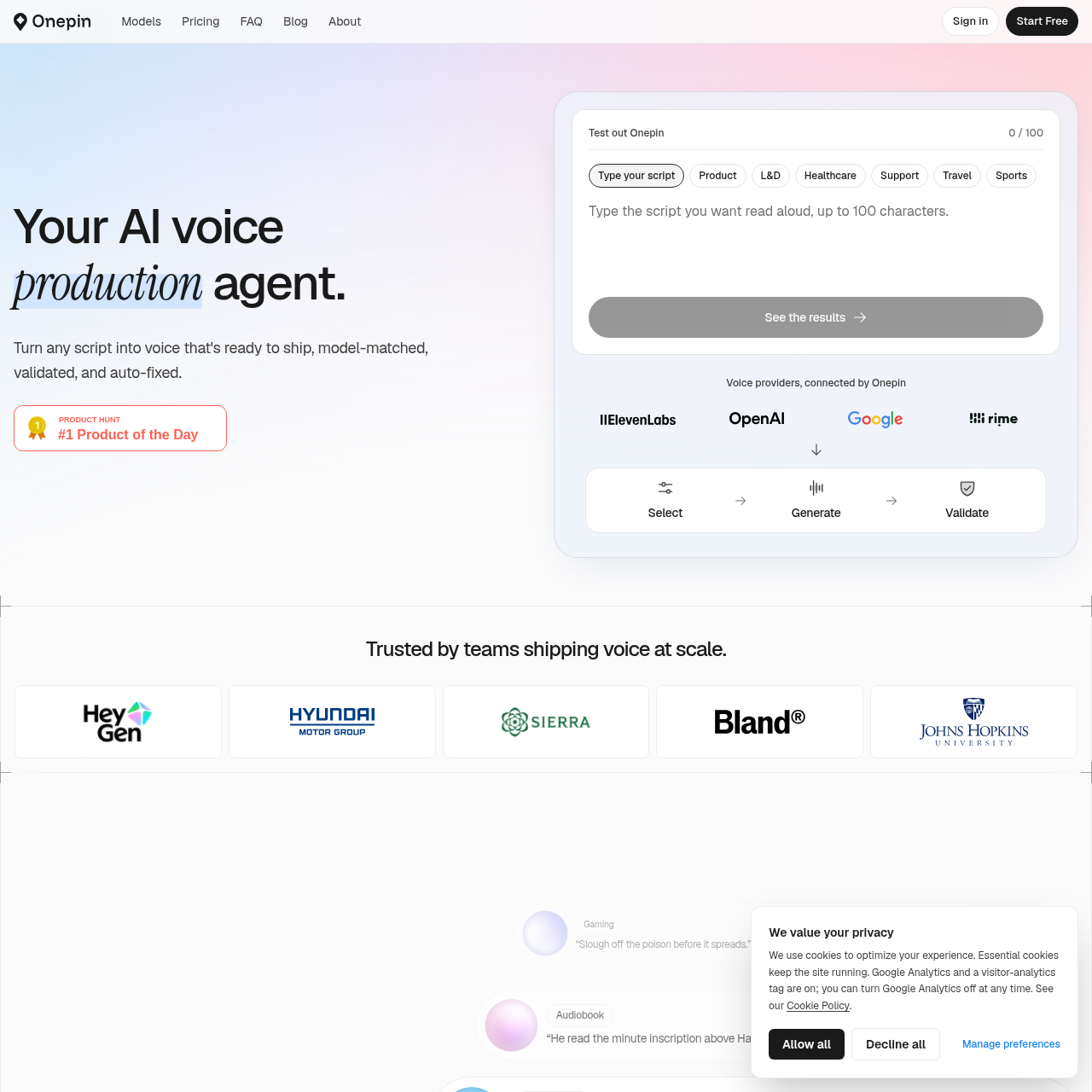
Onepin is an AI voice production agent that routes text scripts across more than 30 text-to-speech models, applying automated text normalization, pronunciation dictionaries, line-by-line quality validation, and selective re-voicing.
What the product does and how it is positioned
Onepin provides an automated voice production agent designed to coordinate script synthesis across external text-to-speech providers. Rather than relying on a single engine, the service unifies more than 30 models under one account, allowing lines to be routed and generated across different providers.
The platform applies pre-synthesis text preparation and post-synthesis quality control. Text inputs undergo automated cleanup for abbreviations and dates, followed by phonetic checks against a large dictionary. Once synthesized, outputs are scored across naturalness, accuracy, clarity, and pronunciation, triggering automatic re-voicing for lines that fail validation.
Source-supported ways to use the product
Producing voice tracks for learning and healthcare scripts containing complex drug names, anatomical terms, or scientific phrasing.
Distributing dialogue and commercial scripts across various voice engines while enforcing standardized pronunciation and quality validation.
The documented workflow, where available
The system cleans input text by expanding street names, dates, numerical values, and abbreviations before sending text to speech engines.
Brand names, proper nouns, and specialized technical terms are matched against a four-million-word dictionary for correct phonetic delivery.
Synthesized audio lines are evaluated and scored across naturalness, word accuracy, clarity, and pronunciation against set benchmarks.
If an output line fails validation, the system adjusts model parameters to regenerate the complete line or correct the specific missed word.
Onepin acts as an orchestration and quality-control layer between written scripts and external speech synthesis engines. Scripts are distributed across a catalog of over 30 text-to-speech providers, including OpenAI, ElevenLabs, Google, Microsoft, AWS, Cartesia, Murf AI, Deepgram, MiniMax, and Inworld.
The generation workflow automates common manual editing steps through staged preparation and remediation. Normalization rules convert tricky formats such as dates and street addresses into spoken phrases before generation, while post-generation scoring catches defects and re-voices lines automatically.
Checks to run with your own material and workflow
What was checked and when
Answers based on the source-checked product record
Onepin uses a normalizer that expands abbreviations, street addresses, dates, and numbers into their spoken equivalents across languages before the text is sent to synthesis engines.
The platform incorporates a four-million-word pronunciation dictionary that provides phonetic pronunciations for brand names, proper names, and specialized scientific and pharmaceutical terms.
Onepin integrates more than 30 speech models into one account, including engines from ElevenLabs, OpenAI, Google, Microsoft, AWS, Cartesia, Murf AI, Deepgram, MiniMax, and Inworld.
Each generated audio line is scored across four specific metrics: naturalness, word accuracy, clarity, and pronunciation, using consistent evaluation standards across supported languages.
The system automatically initiates a remediation process, re-voicing either the entire line using adjusted model settings or regenerating only the specific word that missed validation.