Claude Watermark Remover favicon

Claude Watermark Remover

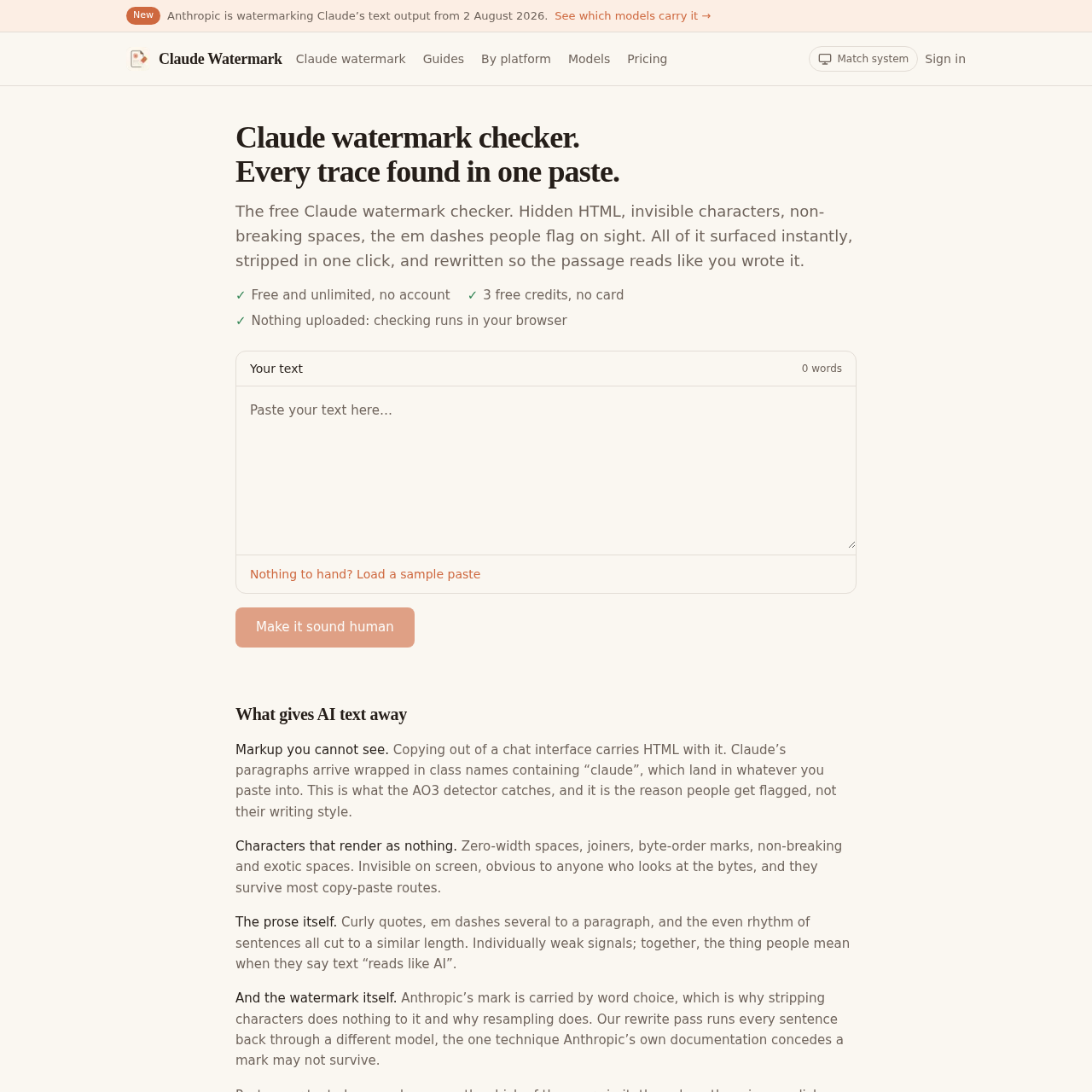
A browser-based utility designed to identify and remove technical artifacts, hidden HTML, and statistical watermarks from Claude-generated text to ensure clean, human-readable prose.

Writing AssistantIdentifies hidden HTML class names…Detects and removes invisible Unicode…Resamples proseBrowser-based artifact detection
Claude Watermark Remover product interface screenshot
Listed on AIToolly

What Is Claude Watermark Remover? Product Overview

What the product does and how it is positioned

Claude Watermark provides a suite of tools to identify and strip metadata and stylistic markers from AI-generated prose, focusing on deterministic findings like hidden Unicode characters and HTML class names.

The tool operates primarily within the user's browser to maintain privacy during the initial detection phase, cleaning text for various platforms by removing technical traces left behind when copying content.

What Can You Use Claude Watermark Remover For?

Source-supported ways to use the product

Removing Chat Interface Metadata

The tool strips hidden HTML class names that are often included when copying text directly from the Claude web interface.

Disrupting Statistical Watermarks

The rewrite engine processes sentences through alternative models to vary word choice and rhythm, helping to mitigate statistical watermarking signals.

How to Use Claude Watermark Remover

The documented workflow, where available

  1. 1

    Input Text

    Paste the text passage into the browser-based interface for immediate analysis of technical artifacts.

  2. 2

    Review Findings

    Examine the count and position of detected HTML tags, invisible characters, and stylistic markers surfaced by the checker.

  3. 3

    Clean and Rewrite

    Use the one-click removal tool for technical artifacts or initiate a rewrite pass to modify sentence rhythm and word choice.

Addressing Statistical Watermarking through Resampling

Anthropic utilizes a statistical watermark based on keyed bias in word choice, which cannot be reliably detected without access to a private key. To address this, the tool employs a rewrite engine that processes every sentence through a different model.

This resampling technique is intended to disrupt the specific word-choice patterns that constitute the watermark. By varying sentence length and rhythm, the system aims to produce prose that lacks the predictable signals often associated with machine-generated output.

  • Sentence-by-sentence resampling through alternative models
  • Variation of sentence rhythm and length to reduce predictability
  • Disruption of word-choice bias associated with statistical watermarking

What to Test Before Choosing Claude Watermark Remover

Checks to run with your own material and workflow

  • Confirm the tool identifies specific HTML class names associated with the Claude interface.
  • Verify that the rewrite engine modifies sentence structure and word choice to address statistical watermarking.

Claude Watermark Remover Sources and Last Checked

What was checked and when

Last checked

Claude Watermark Remover Frequently Asked Questions

Answers based on the source-checked product record

What specific artifacts does the tool remove?

The tool removes hidden HTML class names, zero-width Unicode characters, non-breaking spaces, and stylistic markers like excessive em dashes.

How does the tool handle statistical watermarks?

Since statistical watermarks are embedded in word choice, the tool uses a rewrite pass to resample text through a different model to disrupt those patterns.

Is the text uploaded during the checking process?

No, the initial check for artifacts and invisible characters runs entirely within the user's web browser without uploading data.

How does the tool address detection on platforms like AO3?

It strips the specific CSS class names that certain platform detectors use to identify text pasted directly from the Claude interface.

Does the tool store text used in the rewrite engine?

Text sent for rewriting is processed by a model provider and is not stored or used for training purposes after the task is complete.

Explore other recently added tools in the same category.