Caldera
Caldera is a developer-focused social platform connecting GitHub and Obsidian to transform repositories into interactive virtual cities, surface AI coding agent activity, and publish locally processed profiles.
What the product does and how it is positioned
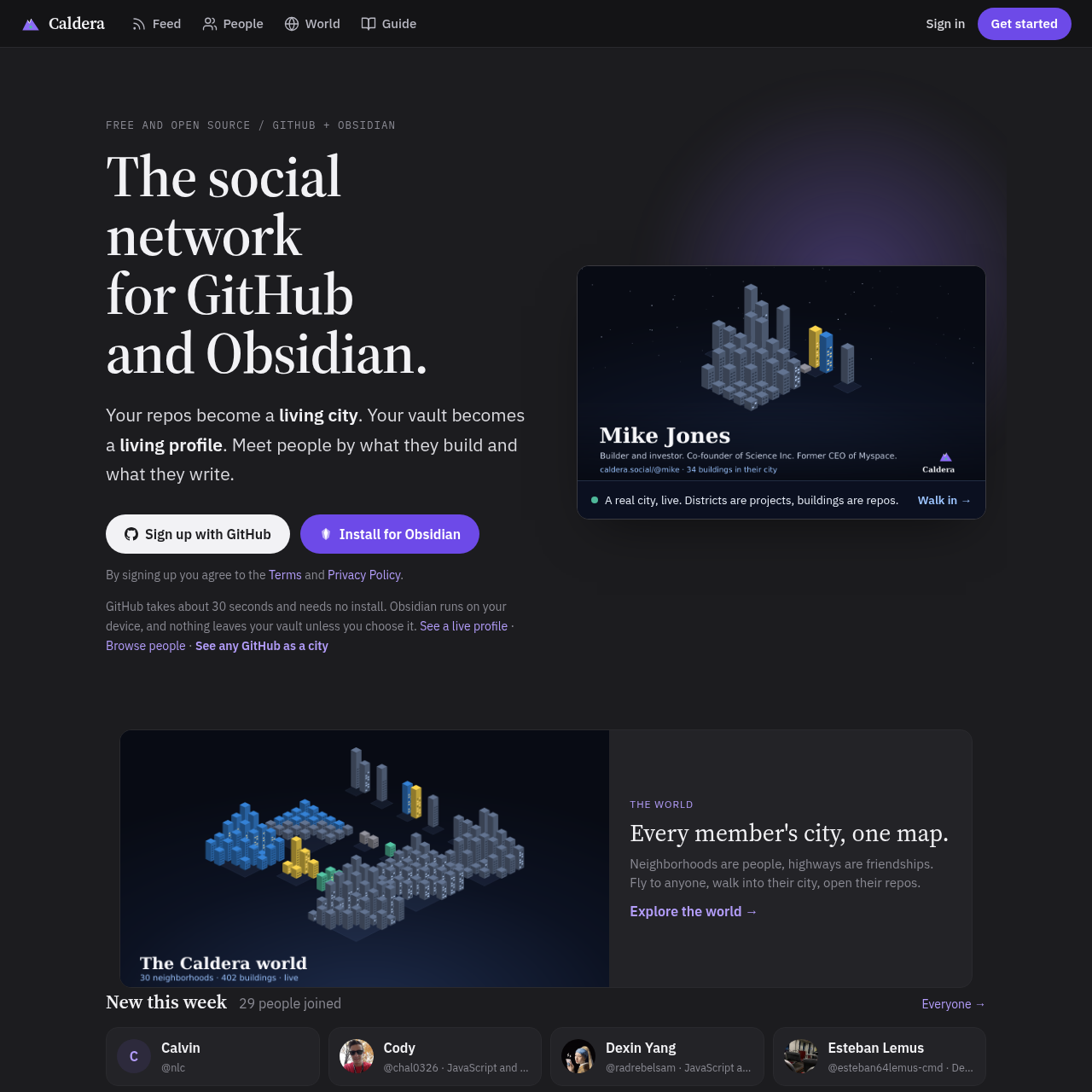
Caldera combines developer collaboration and knowledge management by linking GitHub repositories and Obsidian personal vaults into an interactive visual ecosystem. Repositories and projects are rendered as a virtual city where buildings represent code repositories, lit windows indicate active weekly commits, and drones signify running AI coding agents.
For Obsidian users, the system compiles daily journals, activity metrics, and project timelines directly on the local machine before publishing. The platform incorporates end-to-end encrypted note exchange between users, automated privacy sanitization for personal journal entries, and token consumption tracking sourced from coding assistant logs.
Source-supported ways to use the product
Engineers can showcase repositories, commit frequency, and real-time website traffic through an interactive city visualization generated from GitHub data.
AI practitioners can display automated drone representations of coding agents over specific repositories and report model token usage from development logs.
Obsidian users can exchange specific notes privately with collaborators using end-to-end encryption while keeping the remainder of their local vault offline.
The documented workflow, where available
Users authenticate through GitHub to automatically generate a city profile displaying repositories as buildings and projects as districts.
Developers choose whether private repositories appear as padlocked structures, anonymous districts, or remain hidden by installing the GitHub application on selected projects.
Users install the local Obsidian plugin across supported desktop or mobile operating systems to connect vault notes, timeline events, and activity scores.
Builders ingest Claude Code or Codex logs to surface token metrics and coding drones, and insert site tracking lines to render real-time visitor parachutes.
Caldera enforces a local-first privacy boundary between the user workspace and the public network. When connecting an Obsidian vault, profile generation occurs on the local device, so that raw notes, internal structure, and device contents are not uploaded to remote servers. Only selected sections and notes carrying explicit public metadata are transmitted to the network.
Privacy filtering runs automatically over journal entries to sanitize confidential data, stripping out unshared names, scheduled meetings, and physical locations before publication. For GitHub repositories, Caldera ingests commit counts, repository names, and programming languages without accessing or reading underlying source code files.
Checks to run with your own material and workflow
What was checked and when
Answers based on the source-checked product record
Caldera accesses repository names, primary programming languages, and commit counts. It never inspects or reads source code files stored inside the repositories.
No. Caldera compiles the user profile locally on the device and only transmits the completed public page. Individual notes remain private unless explicitly tagged with public metadata.
Private repositories appear only if the user explicitly installs the Caldera GitHub app on them. They can be rendered as padlocked buildings without names, an anonymous padlocked district, or hidden completely.
Notes shared between friends are encrypted end-to-end before transmission. The central hub only handles and stores ciphertext that it cannot decrypt or read.
Caldera parses local logs from Claude Code and Codex to calculate token consumption by model and provider, and illustrates active agents as flying drones above target repositories.