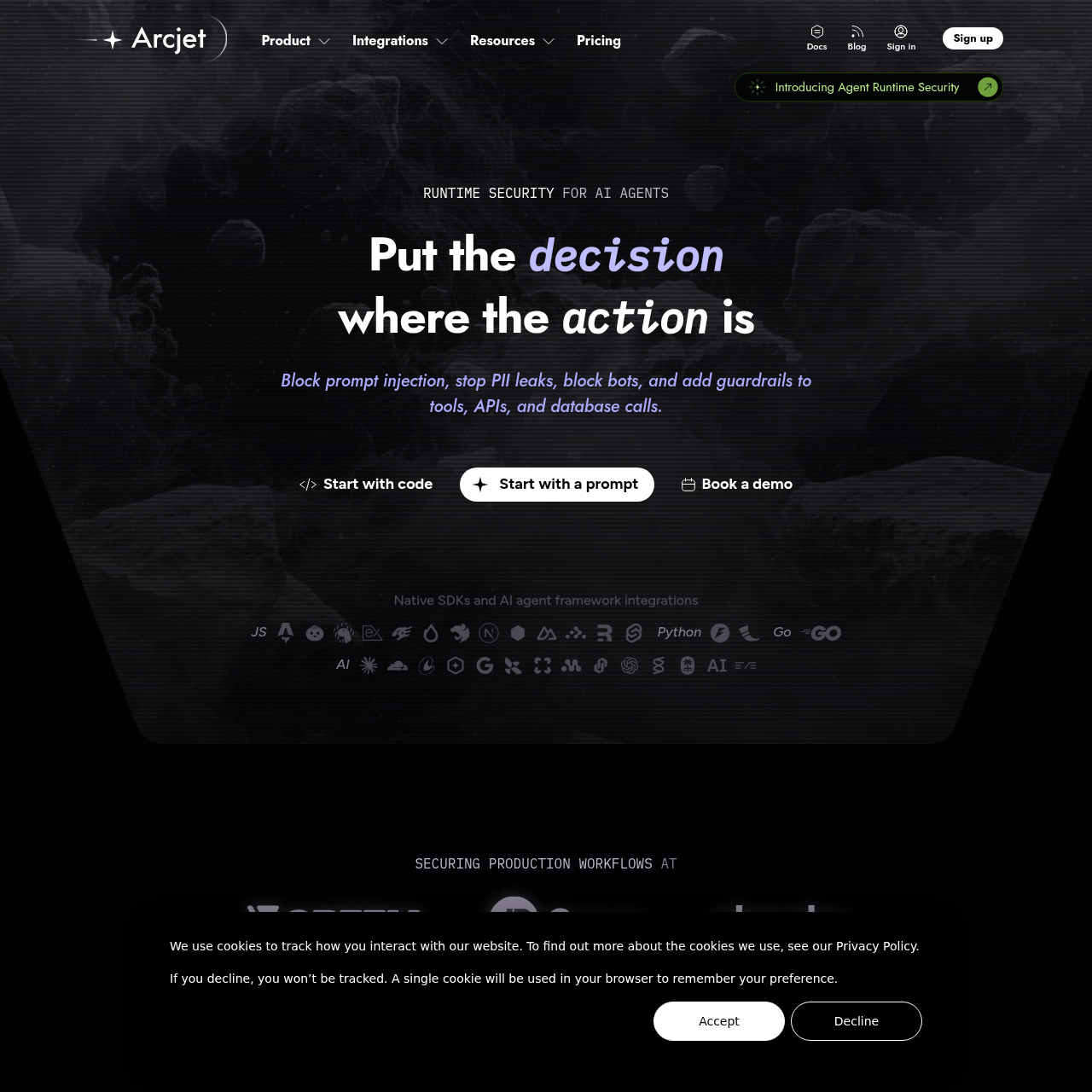
Arcjet is an in-code runtime security SDK and agent guardrail system that detects prompt injections, enforces tool execution policies, is intended to reduce data leaks, and manages token budgets.
Code & ITScopes and blocks unauthorized agent…Identifies prompt injection attempts in…Identifies and strips PII and financial…Tracks sequence drift and multi-step…
Estimated monthly visits
80K
Data period:
Listed on AIToolly
What Is Arcjet? Product Overview
What the product does and how it is positioned
Arcjet provides embedded runtime security controls designed for modern web applications and autonomous AI agents. Unlike perimeter reverse proxies or gateways, it integrates directly into application handlers and agent workflows to inspect typed arguments and context at the exact moment an action is called.
The system monitors user identity, input arguments, and sequential execution histories to return programmatic decisions such as allow, block, redact, or hold for review. It combines in-process evaluations with centralized audit tracking and supports both code-defined rules and remote policies.
What Can You Use Arcjet For?
Source-supported ways to use the product
Autonomous Agent Tool Scoping
Restricting agent tool actions by user role and typed parameter limits to help reduce unauthorized financial or system operations.
Prompt Injection and Context DLP
Filtering untrusted tool outputs and user inputs to stop prompt injection attacks and prevent PII from entering LLM context.
Agent Spend and Loop Capping
Enforcing shared token bucket budgets across multi-step agent runs to stop runaway recursive loops from draining token quotas.
How to Use Arcjet
The documented workflow, where available
1
Observe
Captures application actions, sessions, routes, actors, tool labels, arguments, and prior execution steps inside the application.
2
Enforce
Assesses action context against security policies and returns a decision such as allow, block, redact, or hold for review before execution.
3
Audit
Logs decisions, policy versions, actors, inputs, and run histories as evidence while keeping sensitive checks in process.
Runtime Security and Dual Policy Architecture
Arcjet positions security evaluation directly at the function call boundary inside application code rather than at an external network proxy. This positioning gives the security engine access to the actor identity, typed parameters, and previous actions in a workflow sequence before any function executes.
The architecture separates rule implementation into two complementary paths. Engineering teams can declare version-controlled rules within codebase repositories that undergo unit testing and dry runs, while security teams can configure remote cloud policies that update operational thresholds in real time without triggering software redeployments.
Delivers local decision overhead of under 1ms, with cloud API checks requiring 20 to 30ms.
Correlates sequential actions across runs to detect sequence drift over time.
Supports dry-run operational modes to verify policy impact before activating blocking behavior.
What to Test Before Choosing Arcjet
Checks to run with your own material and workflow
Confirm compatibility with the project runtime environment, such as Node.js, Bun, Deno, Python, or Go.
Verify whether the 100ms latency overhead introduced by the prompt injection model fits within workflow performance targets.
Check whether in-process PII inspection satisfies organization-specific compliance and data sovereignty standards.
Answers based on the source-checked product record
How does Arcjet prevent AI agents from executing unsafe actions?+
Arcjet evaluates security checks at the action boundary inside the application rather than relying on prompt text, scoping tool calls by identity, role, route, and typed inputs before execution.
How does Arcjet differ from an AI control plane or MCP gateway?+
Gateways and control planes sit outside applications and lack visibility into incoming function arguments, whereas Arcjet runs in code where it inspects user identity, typed parameters, and historical execution context.
How does prompt injection detection operate within the system?+
Arcjet analyzes user inputs and external tool outputs with a specialized detection model before the payload reaches the LLM, adding approximately 100ms of latency and returning a typed decision for handling in code.
How does the system enforce token and spend budgets on agents?+
It applies a token bucket rate limiter tied to user or organization identifiers across the full execution run, so that runaway loops consume from a single shared quota rather than resetting limits at each endpoint.
Can security policies be modified without deploying new code?+
Yes, security teams can manage remote policies in the cloud that take effect immediately across services, allowing threshold updates without requiring engineering pull requests or code releases.
More Code & IT AI tools
Explore other recently added tools in the same category.