Timbal AI
Timbal: The End-to-End AI Ecosystem for Enterprise Agents and Workflows
Timbal is a comprehensive AI platform designed for enterprise teams to build, deploy, and scale production-ready agents and workflows. It offers a full AI stack, including an Action Control Engine (ACE), Hybrid DB, and 100+ native integrations, ensuring reliability and security without vendor lock-in.
2026-07-11
2.0K
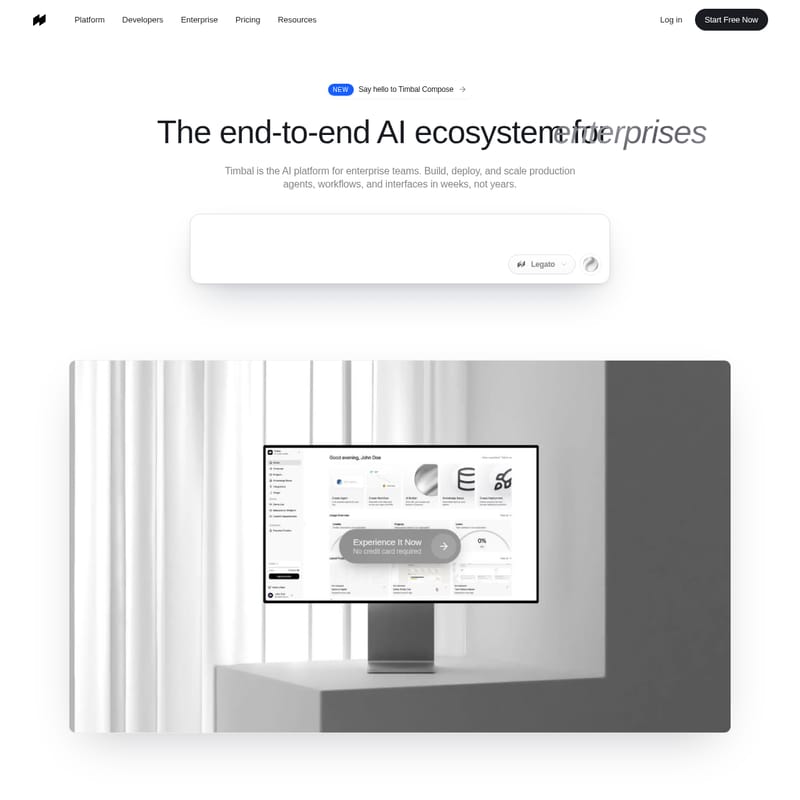
Timbal AI Product Information
Timbal: The Ultimate Enterprise AI Ecosystem for Production-Ready Agents
In the rapidly evolving landscape of artificial intelligence, enterprise teams require more than just a simple wrapper around large language models. They need a robust, scalable, and secure infrastructure to manage complex operations. Timbal is the premier end-to-end AI ecosystem designed specifically for enterprises to build, deploy, and scale production-grade agents, workflows, and interfaces in weeks rather than years. By consolidating the full AI stack into one platform, Timbal enables organizations to move from experimental prototypes to reliable production systems with ease.
What is Timbal?
Timbal is a comprehensive AI platform tailored for enterprise teams. It serves as a unified environment where developers and business units can collaborate to create autonomous AI systems capable of performing real-world work. Unlike fragmented tools that require extensive "glue code," Timbal provides a seamless integration of data, intelligence, and interface layers.
At its core, Timbal is built on the philosophy of "no black boxes." Every agent, workflow, and integration created within the Timbal ecosystem compiles down to clean, exportable code. This eliminates vendor lock-in, allowing teams to read, edit, run locally, and self-host their AI applications. Whether you are building an internal helpdesk assistant or a customer-facing support agent, Timbal provides the governance and reliability required for enterprise-level deployment.
Key Features of Timbal
Timbal stands out by offering a highly integrated feature set that addresses the common pitfalls of AI development. Here are the core components that make up the Timbal platform:
1. Agents and Workflows
Timbal distinguishes between autonomous agents and deterministic workflows to provide maximum flexibility:
- Agents: These are autonomous AI entities designed for real work, featuring advanced reasoning capabilities, tool access, and memory. They are production-ready and can handle complex, non-linear tasks.
- Workflows: For processes that require strict logic, Timbal offers deterministic AI pipelines. You can chain steps, branch based on logic, and guarantee specific outcomes, making them ideal for regulated industries.
2. Action Control Engine (ACE)
Reliability is often a challenge in AI production. Timbal solves this with the Action Control Engine (ACE). ACE is a behavioral runtime that acts as a proxy in front of any LLM. It ensures agents remain consistent in production, providing a 30% reliability gain and reducing the cost per run to 0.1x compared to baseline prompt hacking.
3. Knowledge Bases and Hybrid DB
Timbal features an enterprise-grade RAG (Retrieval-Augmented Generation) system built on a custom Hybrid DB engine. This engine combines vectors, full-text search, and SQL capabilities (using LanceDB and DuckDB). It allows for sophisticated syncing, chunking, and retrieval of data, ensuring your AI has access to the right information at the right time.
4. Custom Interfaces and API
Every AI application shipped via Timbal can be paired with a custom interface, ranging from chat interfaces and dashboards to voice-activated systems. Furthermore, when you ship an application, Timbal automatically generates a live API, allowing for immediate integration into your existing software stack.
5. Native Integrations and MCP
With over 100 native connectors, Timbal links seamlessly with tools like SAP, Salesforce, Slack, Microsoft Teams, Google Drive, Jira, and more. It also supports the Model Context Protocol (MCP), allowing you to plug in any MCP server or build custom tools in minutes.
How to Use Timbal
Timbal is built by developers for developers, offering multiple ways to interact with the platform, including a CLI, SDK, and a clean Python framework.
Getting Started with the CLI
The Timbal CLI allows you to authenticate, scaffold projects, and deploy without needing complex Docker setups.
- Initialize your project:
$ timbal init my-agent - Deploy to production:
$ timbal deploy --env prodThis command provides an instant URL (e.g.,api.timbal.ai/agents/cs-v3) for your live agent.
Using the TypeScript SDK
You can access your workforce and knowledge bases from React, Node, or Bun using the Timbal SDK:
import Timbal from "@timbal-ai/timbal-sdk";

const timbal = new Timbal({
  token: process.env.TIMBAL_API_KEY,
});

const res = await timbal.callWorkforce("support", {
  message: "Refund #8812",
});
Building with the Python Framework
For those preferring Python, Timbal offers a stream-native framework for agents:
from timbal import Agent

agent = Agent(
    model="claude-opus-4-7",
    tools=[crm, search],
)
Enterprise Use Cases
Timbal has been utilized to build over 10,097 enterprise use cases across various sectors including Retail, Logistics, and Services. Some notable examples include:
- Internal Helpdesk Assistants: Automating employee queries and support tickets.
- Vendor Risk Assessors: Using AI to evaluate and manage third-party risks.
- Meeting Notes to Action Items: Automatically converting recorded discussions into structured tasks.
- Supply Chain Management: Companies like Frigorífics Ferrer use Timbal as a source of truth for cold-chain operations and back-office tasks.
- Customer Support: VICIO replaced three internal tools with a single Timbal workflow, cutting support handling time in half.
Flexible and Secure Deployment
Timbal is built to pass rigorous security reviews, offering various deployment options to meet data residency and compliance needs:
- Multi-tenant SaaS: For quick setup on Timbal’s managed infrastructure.
- Dedicated VPC or On-premise: Deploy on AWS, Azure, or GCP within your own perimeter.
- Governance: Timbal is SOC 2 Type II (in progress), ISO 27001, and GDPR compliant. It also aligns with the EU AI Act.
- Model Agnostic: You are never locked into one provider. Switch between OpenAI, Anthropic, Google, Mistral, or self-hosted models per agent or even per step.
FAQ
What is Timbal?
Timbal is the production AI platform enterprise teams use to build, deploy, and govern agents, workflows, and knowledge bases. It allows you to define behavior in code or via the Timbal Studio and ship to various interfaces from a single runtime.
How is Timbal different from LangChain or Zapier?
While LangChain is a framework and Zapier is a no-code tool, Timbal is a full production stack. It includes a typed Python framework, a visual Studio, a dedicated runtime for orchestration, enterprise governance, and native system integrations.
Does Timbal support enterprise deployments?
Yes. Timbal supports sovereign hosting (on-premise or cloud), customer-owned API keys, and full observability. Every agent run and tool call is auditable and replayable.
Is Timbal model agnostic?
Absolutely. Timbal works with OpenAI, Anthropic, Google, Mistral, Meta, or any OpenAI-compatible endpoint. It even supports provider fallbacks to ensure high availability.
Where does Timbal host data?
Data is hosted in the region of your choice. Timbal Cloud defaults to the EU, but on-premise deployments keep all data within your own security perimeter. Timbal never trains on customer data.