Living Brain
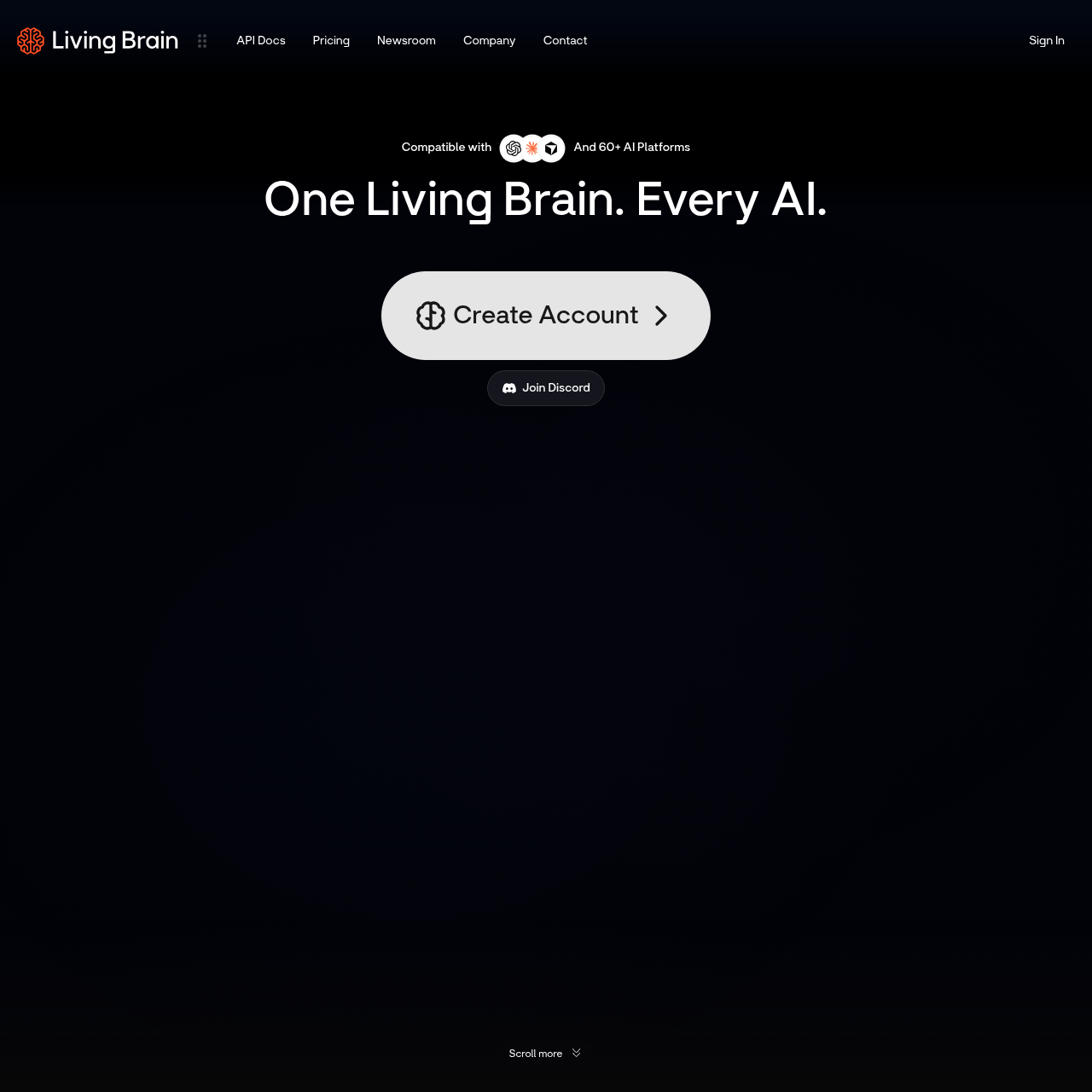
Living Brain is an interoperable memory layer that compiles conversations, files, and updates into external, structured knowledge for AI agents and models via API, SDK, and MCP.
What the product does and how it is positioned
Living Brain is an external, persistent memory layer created by ChatAndBuild that connects with artificial intelligence agents and models. It structures scattered conversations, files, and task updates into persistent knowledge records, allowing systems to retrieve relevant context without repeatedly processing entire historical logs.
The system uses compiler and memory policies alongside distinct scoring metrics to decide what information is retained and resurfaced during task execution. In addition to inference-time retrieval, Living Brain enables developers to compile stored interactions, decisions, and feedback into training datasets for downstream model adaptation.
Source-supported ways to use the product
AI agents retrieve task-relevant context on demand rather than loading entire multi-session conversation histories into prompt windows.
Engineering teams curate accumulated task outcomes, user corrections, and feedback into structured datasets for model post-training.
Developers link custom tools, data sources, and agent harnesses to shared memory using Model Context Protocol connections.
Living Brain operates as an externalized memory infrastructure designed to decouple long-term information retention from model context limits. By compiling input files, messages, and state changes into structured records, the platform selects and surfaces relevant context through an agent harness only when required for a task.
The platform supports two approaches to AI adaptation. At inference time, it retains knowledge, decisions, and corrections to adjust model responses without modifying weights. For post-training adaptation, accumulated interaction logs and evaluation outcomes can be exported into curated training samples for open-weight models or closed-weight models with training access.
Checks to run with your own material and workflow
What was checked and when
Answers based on the source-checked product record
Living Brain stores knowledge outside the language model and retrieves relevant context for each individual task, reducing the need to repeatedly send full conversation histories or document collections.
The system uses compiler and memory policies alongside metrics including Markdown Quality Score, Memory Worthiness Score, Placement Fit Score, Connection Resonance Score, and Re-entry Priority Score to organize and prioritize data.
Living Brain connects to compatible tools and agent frameworks through an API, an SDK, and custom Model Context Protocol (MCP) integrations.
Yes. Accumulated knowledge, user feedback, and task outcomes can be curated into training examples and evaluation datasets for fine-tuning open-weight models or closed-weight models with provider training access.
In internal testing on LoCoMo, Living Brain achieved a 464 ms median memory retrieval latency and 92.2% judged accuracy across 1,540 questions. On LongMemEval-S, internal tests showed 22.6 times fewer tokens per question against a 116K-token full-context baseline.