Automations in Perplexity Computer
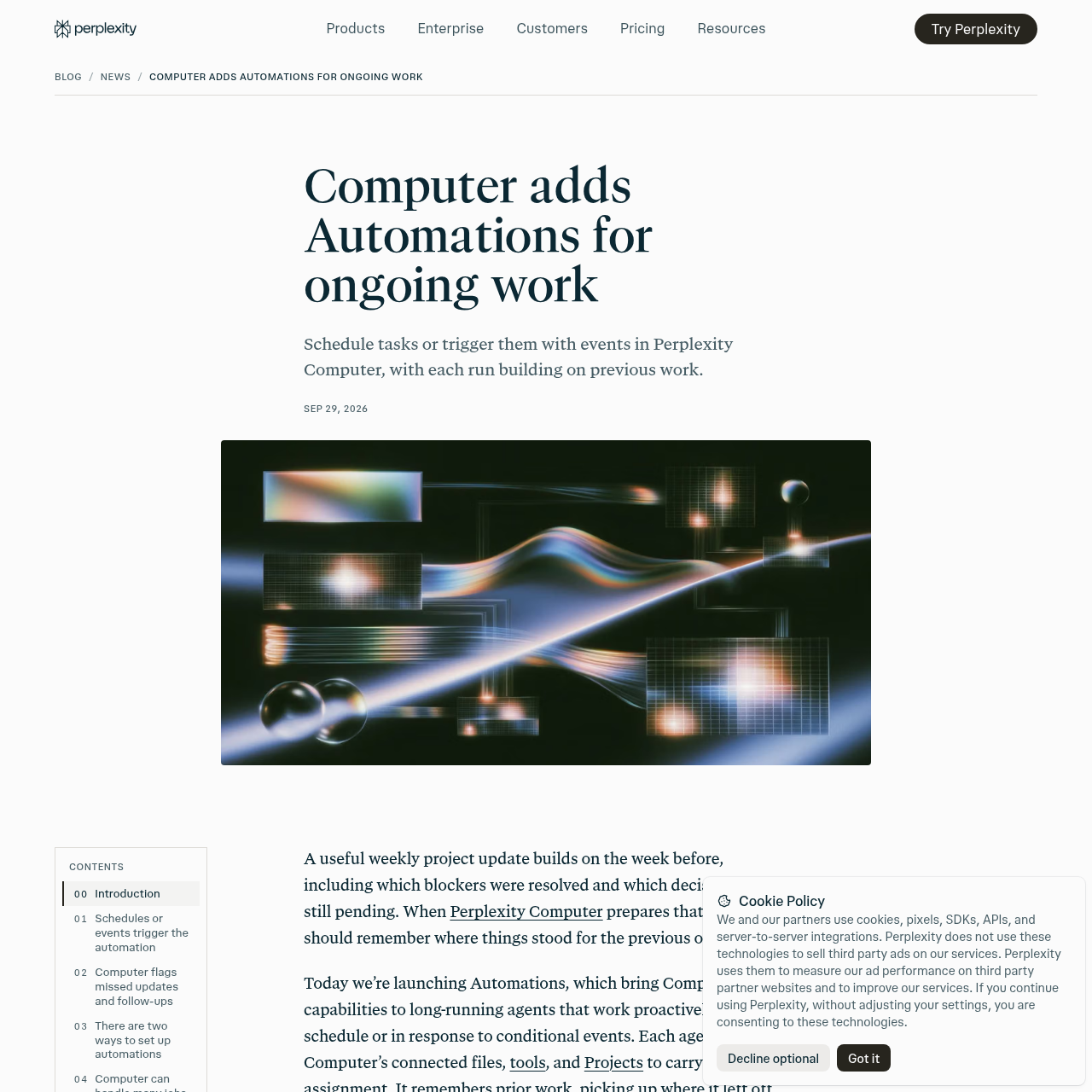
Automations in Perplexity Computer provides scheduled and event-driven agents that preserve state across runs to monitor updates, draft responses, and process workflows across connected tools.
What the product does and how it is positioned
Automations in Perplexity Computer introduces persistent, long-running agent functionality that operates on defined schedules or responds to specific external events. Unlike systems that start from scratch on every invocation, Automations retains context from earlier runs, allowing it to evaluate changes over time, track ongoing commitments, and reference prior correspondence.
The system integrates with connected workspace accounts, repositories, and Projects. Users define operational instructions, choose external destinations for deliverables, and assign human review requirements, while organizational administrators maintain control over connector permissions and action scopes.
Source-supported ways to use the product
Monitors incoming emails from designated accounts, consults historical exchanges, and prepares suggested draft replies for human review.
Detects when issues are flagged as ready in Linear, examines the repository, implements code adjustments, and submits a pull request for review.
Checks competitor pricing on a recurring schedule, contrasts findings against previous reports, and records notable updates in a comparison spreadsheet.
The documented workflow, where available
Enter the assignment description into Computer's omnibar or navigate to Automations and select New Automation.
Specify the intended outcome, attach relevant Projects, and select the tools and connected accounts Computer should use.
Define a time schedule or conditional event trigger, specify where output should be sent, and designate actions that require human review.
Automations replaces previous scheduled task capabilities by pairing time-based execution with event-driven triggers. When monitoring external services such as email clients, chat systems, or issue trackers, the agent applies conditional filters to evaluate whether specific criteria are satisfied before initiating work.
Because each run retains access to historical outputs, the system can identify deviations from expected schedules. It tracks outstanding deliverables and alerts users when expected deployments, messages, or decisions have failed to arrive within defined time thresholds.
Checks to run with your own material and workflow
What was checked and when
Answers based on the source-checked product record
Automations can be triggered either on a set time schedule or by conditional events occurring in integrated platforms such as Slack, Gmail, Outlook, Linear, and GitHub.
The system references the history and outputs of earlier runs, allowing it to identify what has changed, track unfinished tasks, and build directly on previous work.
Existing Scheduled Tasks appear directly within the Automations interface and include an option to migrate each task when opened.
Yes, users can specify which actions the automation may execute autonomously and which require human review before completion.
Users can edit an automation's instructions, review its execution history, or pause it whenever an assignment is placed on hold.