Temporal Organization and Card Handoff Mechanics
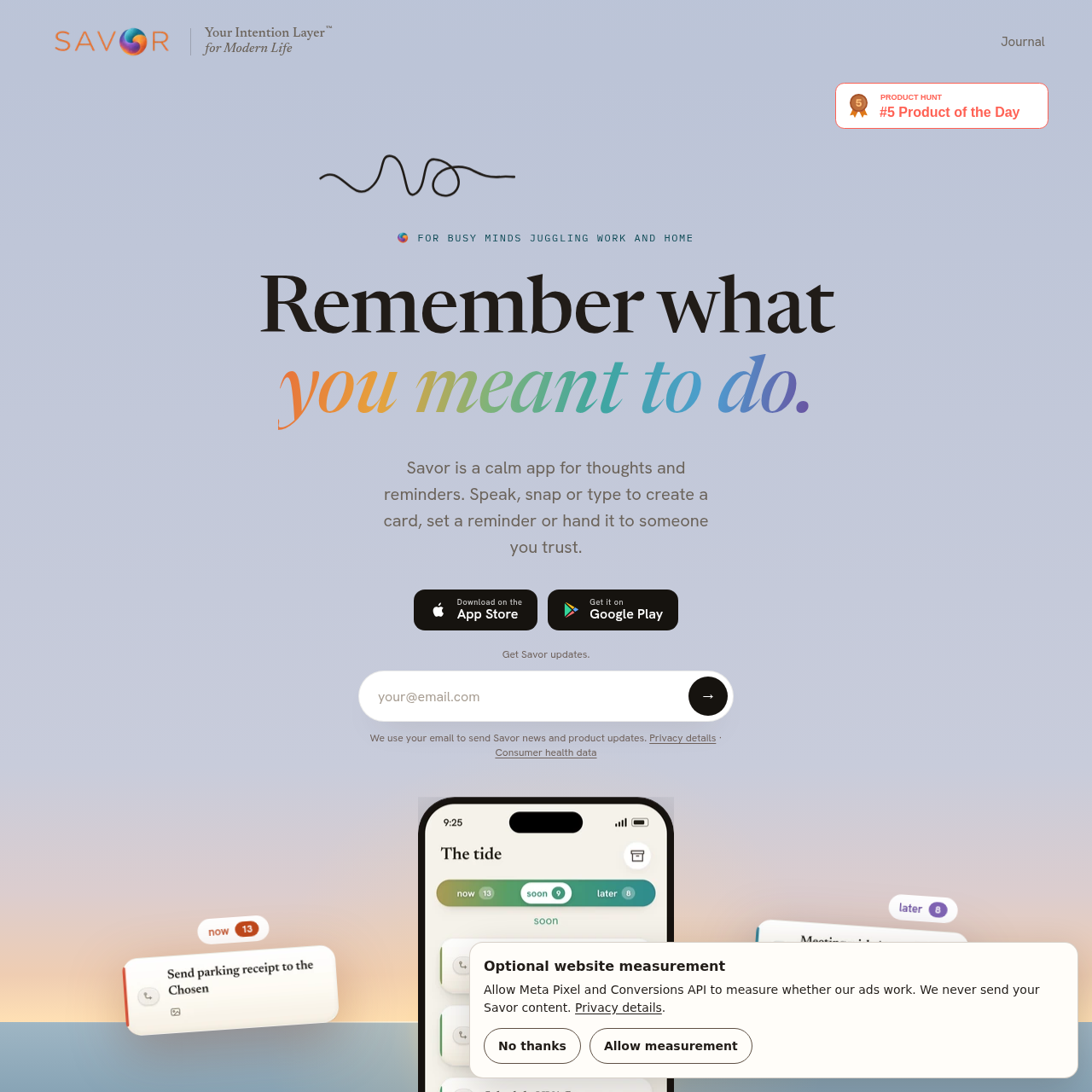
SavorApp_AI structures user entries into an intention-tracking layer divided across three chronological lanes: Now, Soon, and Later. By default, Now displays cards scheduled for the current day or overdue, Soon contains cards for the upcoming two days, and Later holds items beyond that window. Users can adjust these time thresholds in the application settings or move cards manually between lanes.
Collaboration functions through an explicit card delegation mechanism rather than shared global lists. A user can hand off an entire card or an individual subcard to another registered contact. If accepted, the recipient gains primary editing authority and receives all associated notifications, while the sender retains a read-only tracking view, an option to reclaim the card, and an embedded discussion thread.
- Lanes default to Now (today and overdue), Soon (next two days), and Later (future items).
- Lane time windows can be modified within application settings.
- Delegation transfers editing control and notifications to the recipient upon acceptance.
- Original senders retain read-only visibility, reclaim capabilities, and card chat access.
Teen Safety Guardrails and AI Processing
The platform enforces age-specific operating safeguards for users aged 13 and older, relying on operating system and app store account age signals rather than internal birth date forms. Store accounts reported under age 13 are prohibited from registering. For accounts identified in the 13 to 17 age range, AI-generated guidance from the Take Action tool is kept hidden until cleared by an output-safety filter.
The Take Action beta integrates Anthropic Claude Sonnet 5.5 for conversational processing and OpenAI GPT-5.6 Luna for public-information research. Input text across all accounts is monitored using an automated moderation service, and personal capture records are withheld from general model training and ad networks.
- Registrations reported under age 13 by store age signals are blocked.
- Take Action responses for users aged 13 to 17 require safety check clearance before display.
- Inputs across all accounts are screened through automated moderation systems.
- Private cards, audio recordings, and scanned photos are excluded from model training datasets.