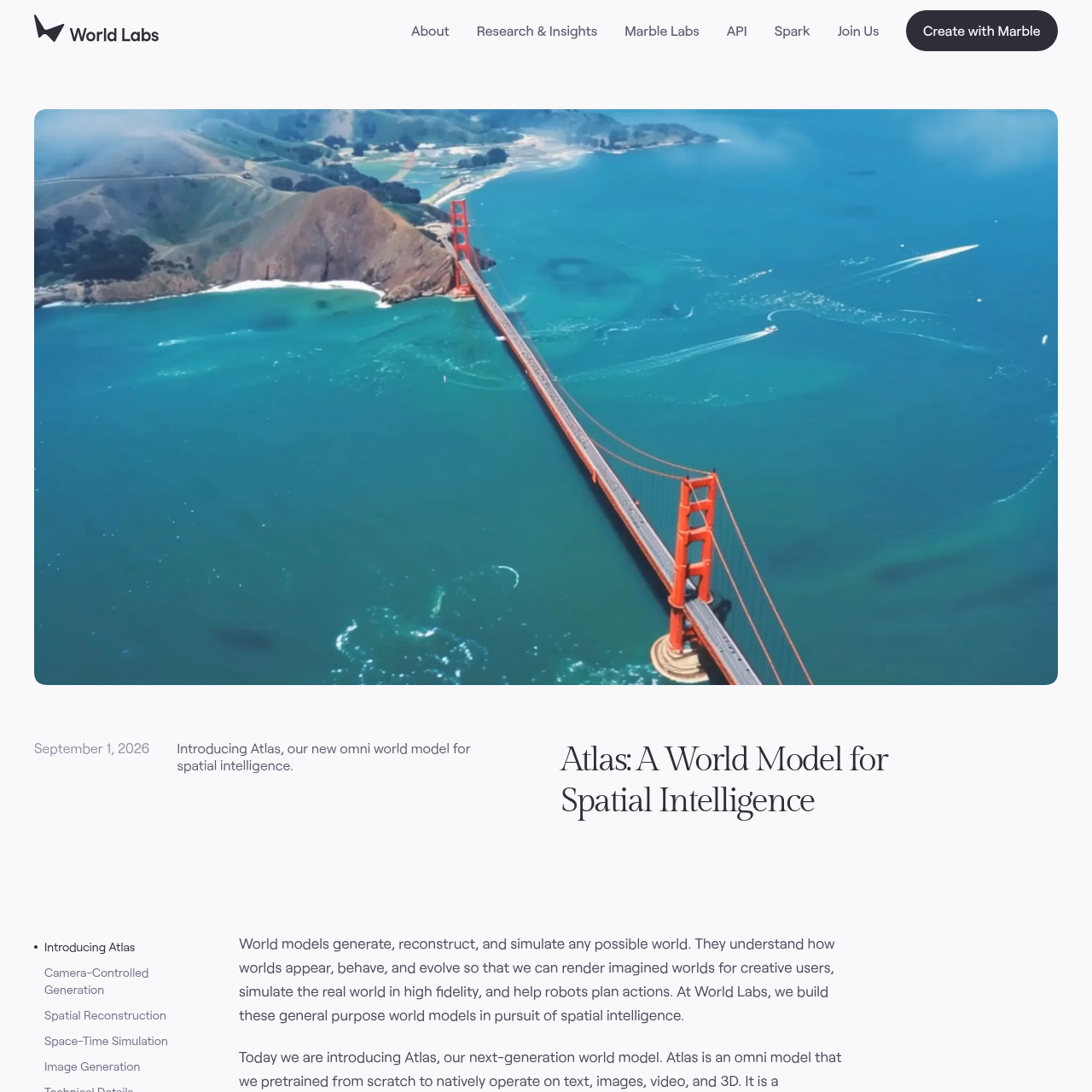
Atlas by World Labs is an omni world model designed for spatial intelligence, capable of generating, reconstructing, and simulating 3D environments from multimodal inputs like text, images, and video.
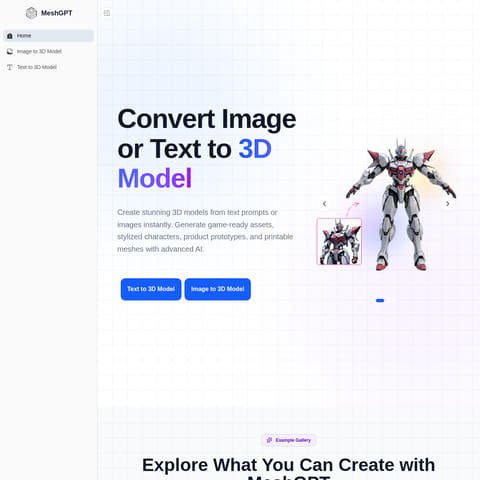
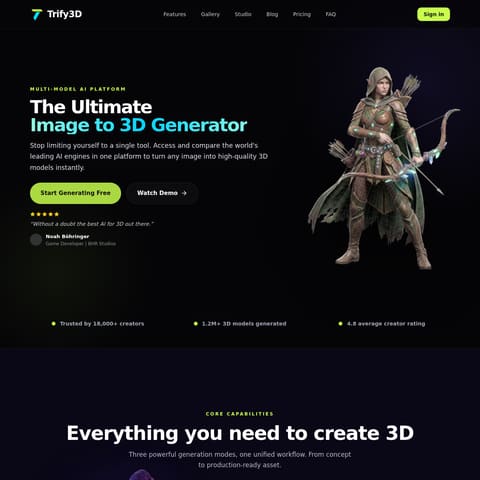
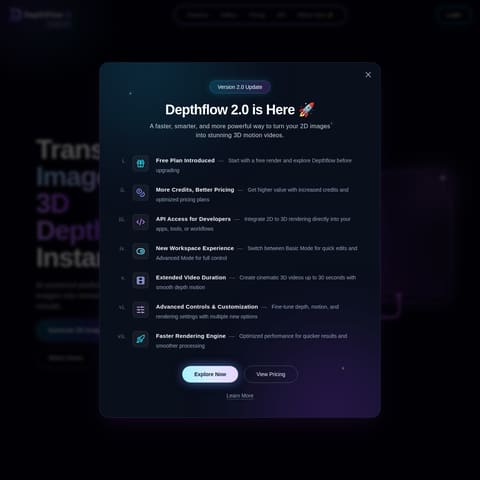
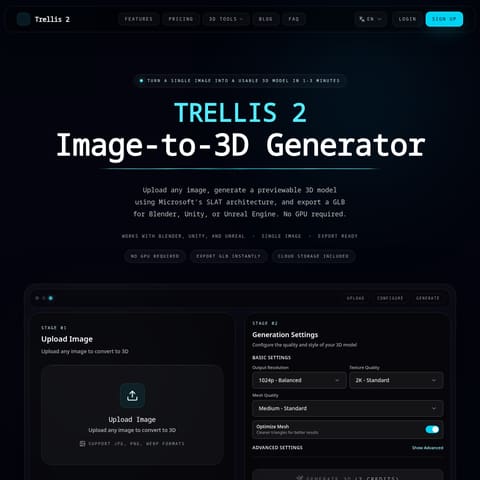
Animation & 3D ModelingGenerates up to 1 minute of video at…Reconstructs 3D scenes from sparse…Simulates space and timeGenerates 360 panoramas from text or…
Estimated monthly visits
274K
Data period:
Listed on AIToolly
What Is Atlas by World Labs? Product Overview
What the product does and how it is positioned
Atlas is a multimodal autoregressive diffusion transformer developed by World Labs. It is engineered to understand the appearance, behavior, and evolution of worlds, enabling users to generate consistent 3D content and simulate real-world environments.
The model integrates spatial context by grounding inputs in 3D space, allowing for precise camera control and the synthesis of novel views. It is designed to scale with increased training compute, aiming to provide high-fidelity outputs for creative, robotics, and simulation workflows.
What Can You Use Atlas by World Labs For?
Source-supported ways to use the product
Robotics Simulation
Enables Real-to-Sim workflows by reconstructing physical spaces and generating sensor data, such as RGB and depth, to train and test robot navigation and manipulation.
Visual Effects and Content Creation
Allows creators to reframe videos from multiple angles, freeze time, and generate consistent long-form video content using precise camera paths.
Spatial Intelligence Architecture
Atlas departs from standard LLM and video model architectures by utilizing a multimodal autoregressive diffusion transformer. This design treats spatial control as a core component by conditioning all inputs and outputs on explicit camera poses and 3D positions.
Multimodal processing of text, images, video, and depth maps.
Autoregressive generation where outputs are conditioned on preceding sequence elements.
Diffusion-based denoising to model high-dimensional continuous data.
Transformer backbone optimized for modern hardware acceleration.
What to Test Before Choosing Atlas by World Labs
Checks to run with your own material and workflow
Verify the required number of input images for the specific reconstruction or generation task to ensure optimal scene fidelity.
Review the camera geometry requirements to confirm compatibility with the model's native input format for precise motion control.
Answers based on the source-checked product record
What types of data can Atlas process?+
Atlas is a multimodal model that natively operates on text, images, video, 3D depth maps, and camera poses to form a shared spatial context.
Does Atlas require specialized equipment for 3D reconstruction?+
No, Atlas can reconstruct real-world spaces from as few as one to dozens of ordinary images, eliminating the need for dense capture equipment.
How does Atlas handle camera control?+
Atlas uses precise camera geometry as a native input type, allowing users to specify exact camera positions and angles rather than relying on text-based instructions.
Can Atlas generate 3D assets for use in other applications?+
Yes, the model can output explicit 3D representations, including point clouds and 3D Gaussian splats, which are suitable for robotics, gaming, and design workflows.
Is Atlas capable of simulating robot environments?+
Yes, Atlas supports Real-to-Sim workflows by reconstructing environments and generating the RGB and depth data that a robot's sensors would observe during navigation or manipulation.
More Animation & 3D Modeling AI tools
Explore other recently added tools in the same category.