Meituan Technical Team Releases LARYBench: A New Benchmark for Latent Action Representation in Embodied AI
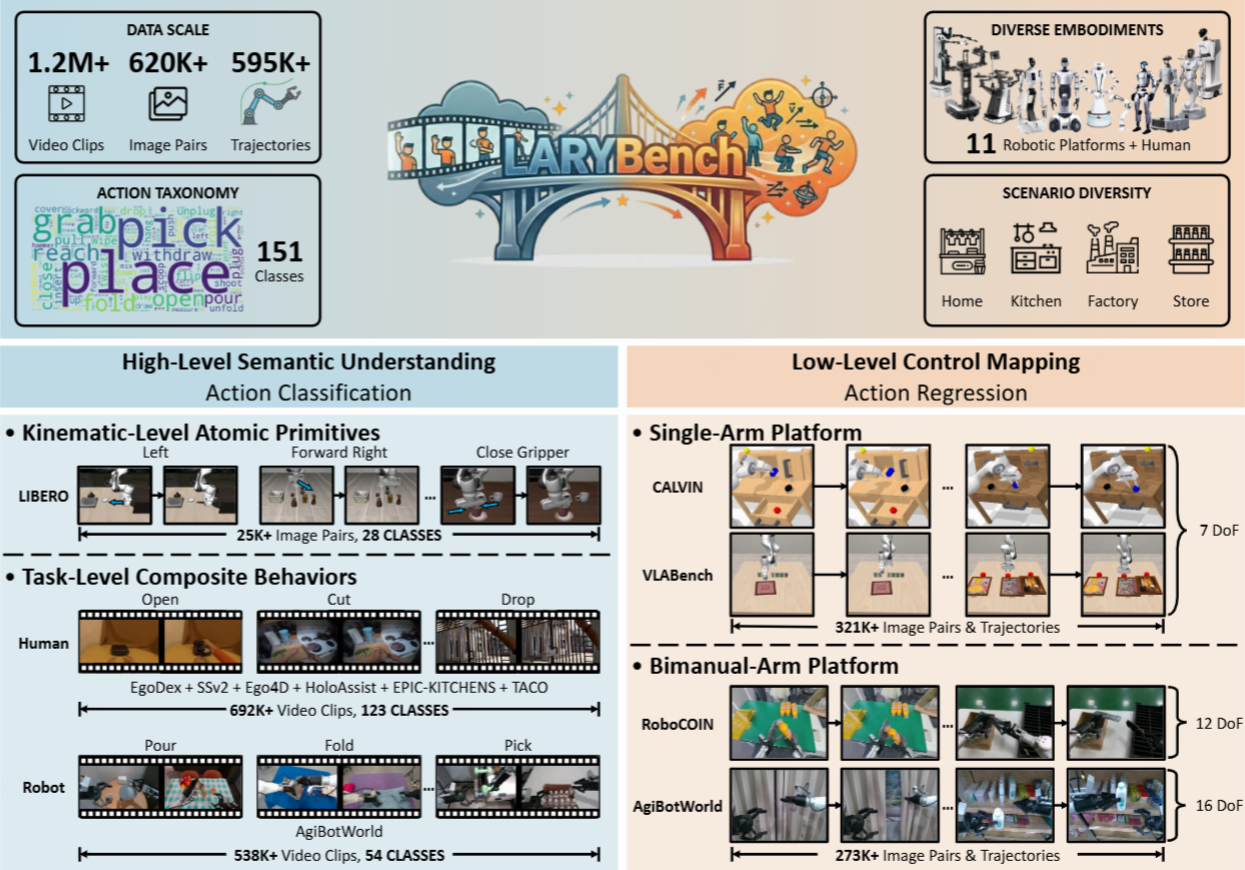
The Meituan technical team has officially released LARYBench (Latent Action Representation Yielding Benchmark), a systematic evaluation framework designed to guide the learning of general latent action representations from large-scale visual data. This benchmark represents a significant milestone in embodied AI, often compared to the 'ImageNet' moment for action representation. Experimental results from the benchmark reveal a paradigm shift: general-purpose vision models significantly outperform specialized embodied AI expert models in both action generalization and control precision. Most notably, the research demonstrates that embodied action representations can naturally emerge from large-scale human video data, suggesting that AI can learn complex physical interactions by observing human behavior at scale rather than relying solely on task-specific robotic datasets.
Key Takeaways
- Introduction of LARYBench: A systematic benchmark designed to evaluate and guide the learning of general latent action representations from visual data.
- Superiority of General Models: General vision models demonstrate significantly better performance in action generalization and control precision compared to specialized embodied AI models.
- Emergence from Human Video: The benchmark proves that embodied action representations can emerge from large-scale human video datasets, reducing the need for specialized robotic training data.
- New Industry Standard: LARYBench aims to serve as the 'ImageNet' for the embodied AI field, providing a standardized metric for measuring how models learn to act from visual input.
In-Depth Analysis
Defining the 'ImageNet' for Embodied Action
The release of LARYBench (Latent Action Representation Yielding Benchmark) by the Meituan technical team marks a critical evolution in the field of embodied intelligence. For years, the AI industry has lacked a unified, systematic benchmark to measure how effectively models can translate visual information into latent action representations. By positioning LARYBench as a foundational evaluation system, the researchers are providing a standardized framework to measure the 'generalization' of actions. This is analogous to how ImageNet provided the necessary infrastructure for the explosion of computer vision capabilities, shifting the focus from task-specific heuristics to generalizable representation learning.
LARYBench focuses specifically on 'Latent Action Representation,' which refers to the internal mathematical understanding an AI develops regarding how movements and actions are structured. By evaluating these representations across diverse visual data, the benchmark allows researchers to see which architectures are truly capable of understanding the physics and logic of movement in a way that can be applied to various physical embodiments, such as robots or autonomous agents.
The Shift from Specialized Experts to General Vision Models
One of the most provocative findings highlighted by the LARYBench experimental results is the performance gap between different model architectures. Traditionally, the development of embodied AI has leaned toward 'action expert models'—systems specifically trained on narrow, high-fidelity robotic data to perform specific tasks. However, LARYBench demonstrates that general vision models, which are trained on vast and diverse sets of visual information, actually perform significantly better.
This superiority is observed in two critical metrics: action generalization and control precision. Generalization refers to the model's ability to apply learned action logic to new, unseen environments or tasks. Control precision refers to the accuracy with which the model can execute a specific movement. The fact that general vision models excel here suggests that the broad features learned from diverse visual contexts provide a more robust foundation for physical action than the narrow features learned by specialized models. This finding could lead to a major shift in how AI developers allocate resources, moving away from niche data collection toward leveraging large-scale general-purpose vision models.
Emergence of Action from Human Video Data
Perhaps the most significant discovery facilitated by LARYBench is the confirmation that embodied action representations can 'emerge' from large-scale human video data. Previously, it was often assumed that to teach a robot how to move, one needed data specifically from a robot's perspective or telemetry from robotic sensors. LARYBench proves that by observing the vast quantities of human activity available in video format, general models can internalize the underlying principles of action.
This 'emergence' suggests that the visual world contains enough inherent structure for a sufficiently powerful model to deduce the mechanics of action without explicit supervision. This has massive implications for data scaling. While robotic data is expensive and difficult to collect, human video data is abundant. If general action representations can be harvested from existing video archives, the speed at which embodied AI systems can be trained and deployed will likely increase exponentially.
Industry Impact
The introduction of LARYBench is poised to reshape the embodied AI landscape in several ways. First, it provides a clear target for researchers: instead of optimizing for specific robotic tasks, the goal is now to improve general latent action representations. This shift encourages the development of more versatile AI agents that can operate in unpredictable real-world environments.
Second, the finding that general vision models are superior to specialized ones validates the trend of 'foundation models' in robotics. Companies and research labs may now prioritize the integration of large-scale vision-language models into physical systems, knowing that these models carry a latent understanding of action that exceeds that of task-specific experts. Finally, by proving that human video is a viable source for learning action, LARYBench lowers the barrier to entry for training sophisticated embodied agents, potentially leading to a surge in innovation across manufacturing, logistics, and consumer robotics.
Frequently Asked Questions
What is the primary purpose of LARYBench?
LARYBench stands for Latent Action Representation Yielding Benchmark. Its primary purpose is to provide a systematic evaluation framework for learning general, implicit action representations from large-scale visual data, helping researchers measure how well AI models understand and generalize physical actions.
How do general vision models compare to specialized expert models in this benchmark?
According to the experimental results, general vision models significantly outperform specialized embodied AI expert models. They show superior performance in both action generalization (applying actions to new scenarios) and control precision (the accuracy of the executed movement).
Can AI learn to act by watching videos of humans?
Yes. A key finding of the LARYBench research is that embodied action representations can emerge from large-scale human video data. This means that models can learn the foundational logic of physical actions by observing human behavior, rather than relying solely on data collected from robots.