Google Research Introduces Planetary Prediction Engine: Automating Global Models via Earth AI
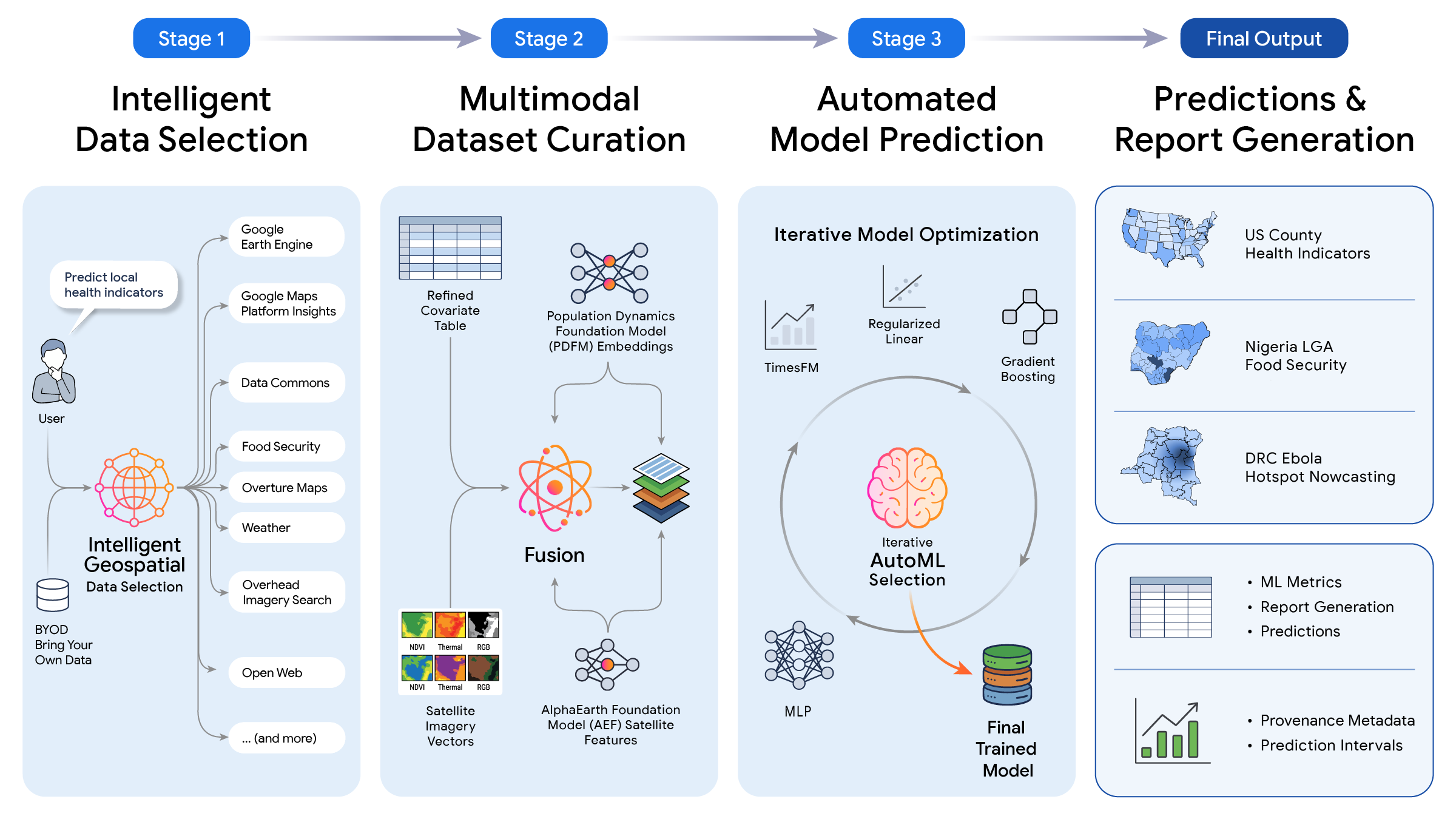
Google Research has announced the development of the Planetary Prediction Engine, a sophisticated framework designed to automate global modeling through the application of Earth AI. This initiative represents a significant advancement in the field of planetary science, focusing on the transition from manual modeling processes to automated, AI-driven systems. By leveraging Earth AI, the engine aims to streamline the creation and deployment of models that analyze and predict phenomena on a global scale. This development highlights Google's ongoing commitment to utilizing artificial intelligence for environmental and planetary-scale insights, potentially transforming how researchers interact with complex global datasets and improving the efficiency of planetary predictions.
Key Takeaways
- Introduction of the Planetary Prediction Engine: A new system developed by Google Research to facilitate global-scale modeling.
- Automation of Global Models: The core focus is on reducing manual intervention in the creation and execution of planetary-scale simulations.
- Powered by Earth AI: The engine utilizes Earth AI technology as its foundational framework for predictive analytics.
- Streamlined Research Workflows: The system is designed to improve the efficiency of processing and modeling vast planetary datasets.
In-Depth Analysis
The Evolution of Global Modeling through Automation
The announcement of the Planetary Prediction Engine marks a pivotal shift in how global models are constructed and maintained. Traditionally, modeling planetary-scale systems—such as climate patterns, geographical changes, or atmospheric shifts—has required intensive manual labor, specialized expertise, and significant computational oversight. By focusing on "automating global models," Google Research is addressing a major bottleneck in planetary science.
Automation in this context implies the creation of end-to-end pipelines where data ingestion, model training, and predictive output generation occur with minimal human interference. This transition is crucial for handling the increasing volume of satellite imagery and sensor data available today. The Planetary Prediction Engine acts as a bridge, allowing researchers to move from static, labor-intensive models to dynamic, automated systems that can adapt to new data in real-time. This automation not only speeds up the research cycle but also reduces the potential for human error in complex model configurations.
Earth AI: The Core Framework
At the heart of this development is "Earth AI," a specialized branch of artificial intelligence tailored for planetary data. While the original announcement remains concise regarding the specific architecture, the integration of Earth AI into a "prediction engine" suggests a focus on high-dimensional data analysis and pattern recognition across diverse geographical layers.
Earth AI likely encompasses machine learning models trained on multi-modal datasets, including geospatial information, temporal sequences, and environmental variables. By framing this as an "engine," Google Research indicates that this is not a single model, but a platform or infrastructure that can support various types of global predictions. The synergy between Earth AI and the Planetary Prediction Engine allows for a more holistic view of the planet, where individual environmental factors are not analyzed in isolation but as part of a complex, interconnected global system.
Industry Impact
The introduction of the Planetary Prediction Engine has significant implications for the AI and environmental science industries. First, it sets a new benchmark for AI-driven environmental monitoring. As organizations and governments seek more accurate ways to predict climate-related events, the ability to automate these models becomes a competitive and societal necessity.
Second, this development reinforces the trend of Specialized AI Frameworks. Rather than relying on general-purpose AI, the industry is moving toward domain-specific engines like Earth AI that are optimized for the unique constraints of planetary data, such as spatial autocorrelation and temporal dependencies.
Finally, the automation of these models lowers the barrier to entry for planetary research. By providing a standardized engine for prediction, Google Research may enable a broader range of scientists and policy-makers to generate high-quality global insights without requiring the massive computational infrastructure typically associated with planetary modeling.
Frequently Asked Questions
What is the primary purpose of the Planetary Prediction Engine?
The Planetary Prediction Engine is designed to automate the creation and management of global models. It leverages Earth AI to streamline the process of making large-scale predictions about planetary phenomena, making the modeling process more efficient and scalable.
How does Earth AI differ from standard AI models?
While the original source does not provide a technical breakdown, Earth AI is specifically mentioned in the context of planetary prediction and global models. This suggests it is optimized for geospatial and environmental data, focusing on the complexities of planetary-scale systems rather than general-purpose tasks.
Why is automation important for global modeling?
Automation is critical because planetary data is vast and constantly changing. Manual modeling is often too slow to keep up with real-time data updates. By automating these models, researchers can generate predictions faster, iterate on model designs more quickly, and handle larger datasets than would be possible through manual processes.