What If An AI Could Code a 3D Scene Before Generating Your Video? Exploring Video-Coder
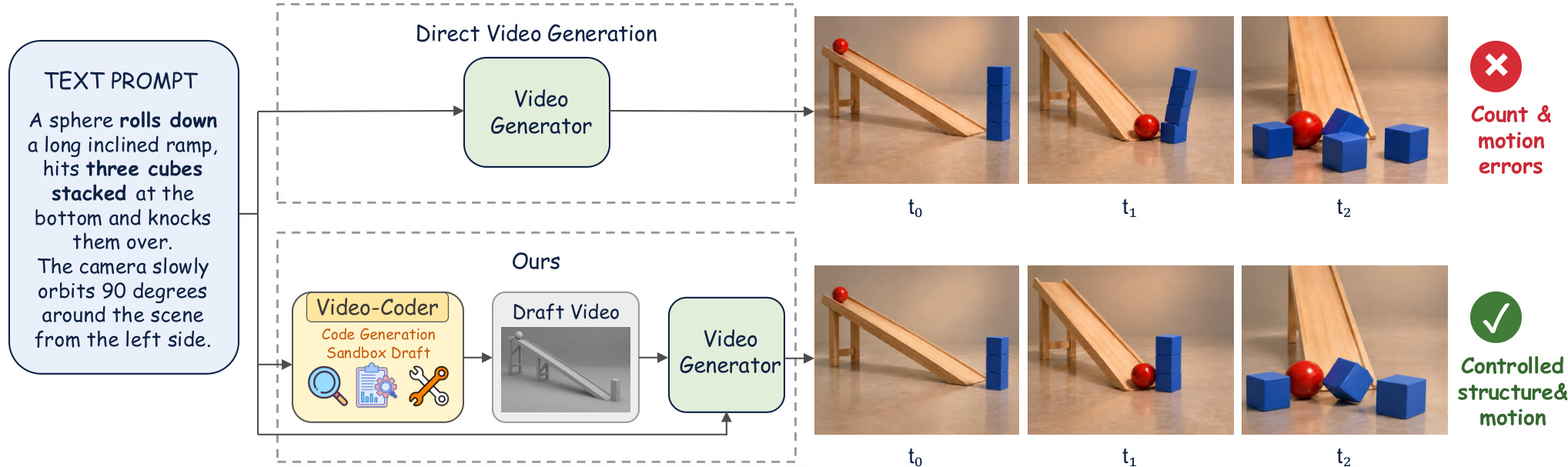
Recent developments in artificial intelligence introduce Video-Coder, a novel approach that leverages a coding agent to translate text prompts into executable 3D scenes before final video generation. By training a coding agent to write and revise Python code for environments like Blender, the system generates draft videos that serve as explicit structure-and-motion guidance for downstream video generators. This intermediate representation bridges the gap between text commands and precise spatial dynamics, offering significant improvements in mechanical accuracy and physical consistency compared to conventional direct text-to-video generation methods.
Key Takeaways
- Video-Coder trains a coding agent to turn a text prompt into an executable Blender scene, using the rendered draft as structure-and-motion guidance.
- The agent programs motion first through a write-run-revise loop, allowing a separate video model to supply appearance.
- Training pairs coding demonstrations with rewards for execution and video quality.
- The method provides explicit structure and motion, improving metrics on physical benchmarks such as PhyGenBench and VBench-2.0.
In-Depth Analysis
The Mechanics of Agentic 3D Coding for Video Generation
Video-Coder shifts the paradigm of video generation by introducing an intermediate code-based representation. Instead of mapping text prompts directly to video pixels, the system employs a coding agent that works in a write-run-revise loop. It writes Python code for a 3D scene, runs it inside an isolated Blender environment, and leverages errors, scene checks, and sampled rendered frames to revise the program. This process ensures that motion and structural foundations are established programmatically before any appearance-dependent material effects are applied by a separate video generator.
Training Strategies and Structural Guidance
Training Video-Coder involves pairing coding demonstrations with specific rewards focused on execution success and overall video quality. This methodology demonstrates that evidence heavily favors motion and structure over purely appearance-driven generation. By converting a prompt into an executable 3D draft that supplies explicit structure and motion, downstream generators achieve enhanced control over complex spatial dynamics. Performance indicators show notable gains, such as scoring higher on physical dimensions in evaluations like PhyGenBench and VBench-2.0 compared to baseline models alone.
Industry Impact
The introduction of Video-Coder highlights a shift toward hybrid agentic architectures in visual content creation. By combining explicit programmatic 3D scene creation with generative video models, the AI industry can address persistent challenges involving temporal consistency, physical plausibility, and spatial structure. This approach opens new pathways for controllable video generation, enabling tighter programmatic oversight over mechanics and motion dynamics without relying solely on end-to-end black-box diffusion models.
Frequently Asked Questions
Question: What is Video-Coder?
Answer: Video-Coder is a method that trains a coding agent to turn text prompts into executable Blender scenes, using the rendered draft as structure-and-motion guidance for a separate video generator.
Question: How does the coding agent operate during scene creation?
Answer: The agent works in a write-run-revise loop, where it writes Python code for a 3D scene, executes it in an isolated Blender environment, and revises the code based on errors, scene checks, and sampled rendered frames.
Question: What are the main performance advantages of using Video-Coder?
Answer: Video-Coder provides explicit structure and motion guidance, leading to enhanced performance on physical benchmarks like PhyGenBench and VBench-2.0 by improving mechanical accuracy and spatial consistency.