
Microsoft Research Unveils GigaPath-Flash and GigaTIME-Flash: Efficient Foundation Models for Population-Scale Pathology
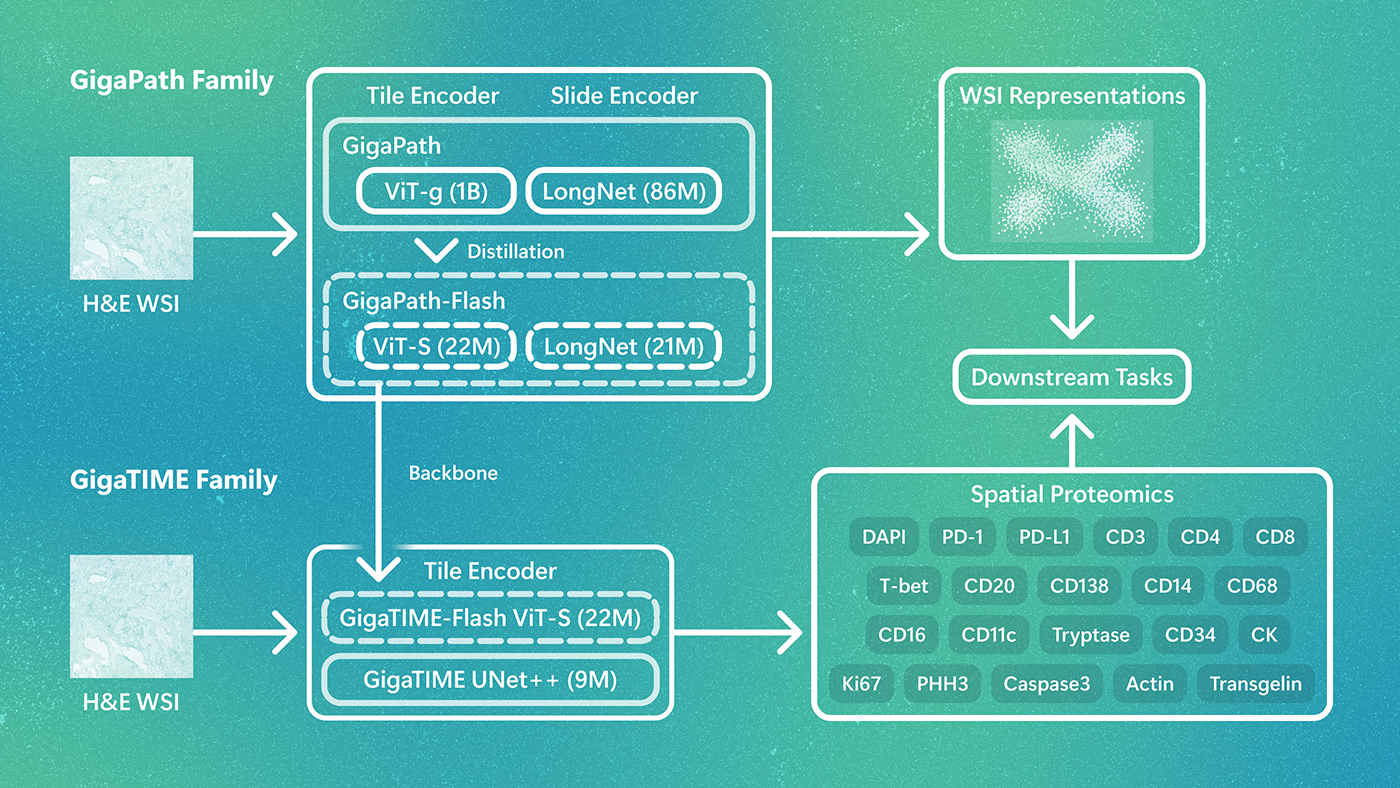
Microsoft Research has announced the release of GigaPath-Flash and GigaTIME-Flash, two groundbreaking pathology foundation models designed to bring high-performance AI to population-scale medical discovery. By utilizing advanced distillation techniques and efficient architectures like LongNet, GigaPath-Flash achieves 97% of the performance of its billion-parameter predecessor while requiring 50x less computational power. Simultaneously, GigaTIME-Flash revolutionizes tumor microenvironment analysis by predicting spatial proteomics from routine H&E slides 6x faster than previous methods. These models, released under an open-source Apache-2.0 license, aim to democratize advanced computational pathology, enabling researchers to analyze massive real-world datasets and accelerate the development of precision medicine and cancer diagnostics without the prohibitive costs of traditional large-scale AI infrastructure.
Key Takeaways
- Massive Efficiency Gains: GigaPath-Flash reduces computational requirements by 50x compared to the original billion-parameter GigaPath model while retaining 97% of its diagnostic performance.
- Advanced Architecture: The models utilize a compact 22M-parameter ViT-S tile encoder and a 21M-parameter LongNet slide encoder, optimized for whole-slide imaging.
- Spatial Proteomics at Scale: GigaTIME-Flash enables the prediction of tumor microenvironments directly from H&E slides, operating 6x faster and using 8x less GPU memory than earlier CNN-based versions.
- Open-Source Democratization: Both models are released under the Apache-2.0 license, providing the scientific community with accessible, high-performance tools for clinical research.
- Population-Scale Discovery: The efficiency of these "Flash" variants allows for the analysis of vast, real-world datasets that were previously too expensive or slow to process with standard foundation models.
In-Depth Analysis
The Evolution of Efficiency: From GigaPath to GigaPath-Flash
The field of computational pathology has been transformed by foundation models capable of learning from massive histopathology datasets. However, the first generation of these models, such as the original Prov-GigaPath, often relied on massive parameter counts (up to 1 billion) that made them computationally expensive for routine clinical use or large-scale research. Microsoft Research’s introduction of GigaPath-Flash represents a strategic shift toward "efficiency-first" AI.
GigaPath-Flash achieves its remarkable efficiency through a two-stage architecture. First, it employs a 22-million-parameter Vision Transformer (ViT-S) tile encoder. This encoder is distilled from the much larger billion-parameter GigaPath (ViT-g) teacher model, allowing the smaller model to inherit complex feature representations without the associated computational weight. Second, it utilizes a 21-million-parameter LongNet slide encoder. LongNet is specifically designed to handle the extremely long sequences inherent in whole-slide images (WSIs), which can contain tens of thousands of individual image tiles. By combining these two components, GigaPath-Flash maintains a high level of accuracy—97% of the original model's average slide-level performance—while slashing compute costs by a factor of 50. This makes it feasible to run advanced AI diagnostics on standard hardware, significantly lowering the barrier to entry for medical institutions.
GigaTIME-Flash and the Future of Tumor Microenvironment Modeling
While GigaPath-Flash focuses on general pathology classification, GigaTIME-Flash is specialized for the intricate task of modeling the tumor immune microenvironment (TIME). Traditionally, understanding the spatial distribution of proteins within a tumor required expensive and time-consuming techniques like multiplexed immunofluorescence (mIF). GigaTIME-Flash changes this paradigm by learning to predict spatial proteomics directly from routine, widely available Hematoxylin and Eosin (H&E) stained slides.
Compared to the original CNN-based GigaTIME model, the Flash variant is a significant leap forward in both speed and resource management. It runs 6x faster and consumes 8x less GPU memory. This efficiency is critical for "virtual population" generation—a process where researchers translate thousands of H&E images into virtual mIF images to discover associations between cell states and biomarkers at a pan-cancer level. By making these complex spatial predictions more accessible, GigaTIME-Flash enables researchers to perform patient stratification and treatment-response prediction at a scale that was previously unimaginable, potentially uncovering new insights into immuno-oncology and precision health.
Enabling Population-Scale Medical Discovery
The primary significance of the "Flash" family lies in its ability to facilitate population-scale discovery. In medical research, the ability to analyze datasets involving tens of thousands of patients is often limited by the time and cost of data processing. When a model requires 50x less compute, research that would have taken months can be completed in days, and projects that required massive GPU clusters can now be executed on more modest infrastructure.
This scalability is particularly important for real-world clinical data analysis. By applying GigaPath-Flash and GigaTIME-Flash to large-scale longitudinal datasets, scientists can more effectively identify rare biomarkers, refine cancer subtyping, and improve prognostic accuracy across diverse populations. The open-weight nature of these models further accelerates this process, as it allows the global scientific community to build upon Microsoft’s foundation, fine-tuning the models for specific diseases or local clinical needs without starting from scratch.
Industry Impact
The release of GigaPath-Flash and GigaTIME-Flash marks a pivotal moment for the healthcare AI industry. By prioritizing efficiency without sacrificing significant performance, Microsoft Research is addressing one of the biggest hurdles to AI adoption in medicine: the high cost of inference and fine-tuning. This move is likely to pressure other players in the medical AI space to move away from "black box" or prohibitively large models toward more transparent, efficient, and open-source alternatives.
Furthermore, the ability to predict spatial proteomics from H&E slides could disrupt the diagnostics market. If AI can reliably extract high-dimensional protein data from standard slides, the demand for expensive specialized staining might decrease in early-stage research and triaging, leading to faster and more cost-effective clinical workflows. Ultimately, these models pave the way for a future where advanced computational pathology is a standard part of precision medicine, accessible to hospitals and research centers regardless of their computational budget.
Frequently Asked Questions
Question: How does GigaPath-Flash maintain high accuracy with so few parameters?
Through a process called knowledge distillation, the 22M-parameter GigaPath-Flash tile encoder is trained to mimic the feature representations of the 1B-parameter GigaPath teacher model. This allows the smaller model to capture the essential diagnostic patterns learned by the larger model while remaining significantly more efficient.
Question: What is the benefit of using LongNet in the slide encoder?
Whole-slide images are massive, often consisting of thousands of tiles. Standard transformers struggle with such long sequences due to quadratic complexity. LongNet allows the model to aggregate these thousands of tile embeddings into a single slide-level representation with much lower computational overhead, making whole-slide analysis faster and more memory-efficient.
Question: Can GigaTIME-Flash replace traditional protein staining methods?
While GigaTIME-Flash is a powerful tool for research and triaging—capable of predicting spatial proteomics from H&E slides—it is currently designed to complement rather than replace gold-standard physical staining in definitive clinical diagnoses. Its primary value lies in its ability to perform large-scale screening and discovery on existing H&E archives where specialized staining is not available.

