Back to list
Research BreakthroughOpenAIPhysicsAI Research

Progress in Physics: Defining the Standard Model on a Lattice via GPT-6 Astra

OpenAI has published a report detailing a candidate nonperturbative lattice definition of the Standard Model. A central component of this work involves the utilization of GPT-6 Astra, which served as a critical tool in transforming a conceptual candidate into a detailed, formal proof. This research highlights the intersection of advanced AI capabilities and complex theoretical physics.

OpenAI Blog

Key Takeaways

  • OpenAI has introduced a candidate nonperturbative lattice definition of the Standard Model.
  • The research project utilized GPT-6 Astra to formalize a candidate idea into a detailed proof.
  • This development marks a significant application of large language models in theoretical physics research.

In-Depth Analysis

The Lattice Approach to the Standard Model

The core of the reported research is the pursuit of a nonperturbative lattice definition of the Standard Model. Lattice field theory provides a nonperturbative framework for studying quantum field theories, such as the Standard Model, by discretizing spacetime. This candidate definition represents an ongoing effort to rigorously define these physical theories within a mathematical structure.

The Role of GPT-6 Astra in Theoretical Proofs

A distinct aspect of this research is the integration of AI in the scientific workflow. According to the report, GPT-6 Astra was instrumental in the project. The AI model assisted the researchers in evolving an initial candidate idea into a comprehensive, detailed proof. This application of GPT-6 Astra suggests a growing capability for large language models to assist in rigorous mathematical and physical reasoning tasks.

Industry Impact

The intersection of artificial intelligence and theoretical physics is evolving. By employing tools like GPT-6 Astra to assist in developing detailed proofs for complex physical definitions, researchers may be able to accelerate the formalization of theoretical concepts. This application signals a shift where AI moves beyond data processing to active participation in rigorous scientific discovery and proof construction.

Frequently Asked Questions

What is the subject of the new OpenAI blog?

The blog post explores a candidate nonperturbative lattice definition of the Standard Model.

How did GPT-6 Astra contribute to the project?

GPT-6 Astra assisted in the process of turning a candidate idea into a detailed, formal proof.
Related News

Research Breakthrough

Microsoft Research Unveils TokenEconomizer: A Strategic Breakthrough for AI Coding Agent Efficiency

Microsoft Research and UC Berkeley have jointly introduced TokenEconomizer, an innovative open-source plugin engineered to optimize AI coding agents. By utilizing data and experiences from previous coding sessions within the same repository, the tool effectively identifies and eliminates redundant work. Recent evaluations involving 277 bug-fixing tasks demonstrated that the plugin delivers cost reductions between 18.4% and 30.9%, while maintaining stable success rates. This development marks a significant step forward in making AI-assisted software development more economically viable and resource-efficient for developers and organizations alike.

Allen Institute for AI Introduces XYBench to Address Fundamental Challenges Behind User Questions
Research Breakthrough

Allen Institute for AI Introduces XYBench to Address Fundamental Challenges Behind User Questions

The Hugging Face Blog has announced a release titled 'XYBench: Helping with the problem behind the question,' authored in collaboration with the Allen Institute for AI. While detailed experimental benchmarks and implementation specifics are not provided in the announcement body, the title highlights a dedicated focus on identifying and addressing core underlying problems rather than just surface-level user prompts. This release points toward evolving standards in benchmark evaluations for artificial intelligence systems.

What If An AI Could Code a 3D Scene Before Generating Your Video? Exploring Video-Coder
Research Breakthrough

What If An AI Could Code a 3D Scene Before Generating Your Video? Exploring Video-Coder

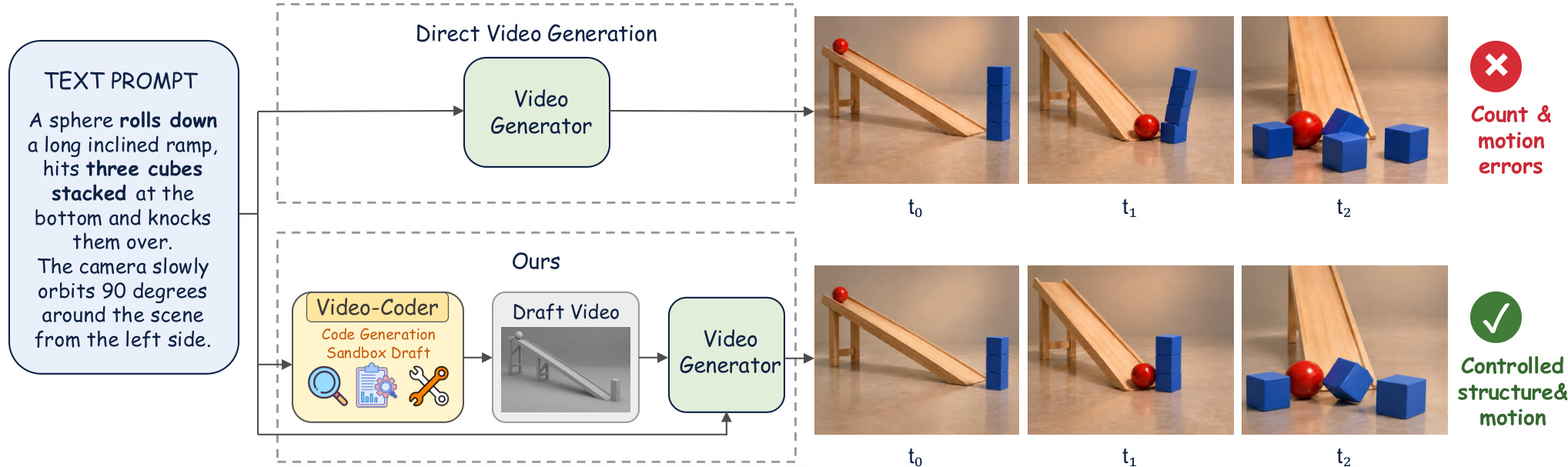
Recent developments in artificial intelligence introduce Video-Coder, a novel approach that leverages a coding agent to translate text prompts into executable 3D scenes before final video generation. By training a coding agent to write and revise Python code for environments like Blender, the system generates draft videos that serve as explicit structure-and-motion guidance for downstream video generators. This intermediate representation bridges the gap between text commands and precise spatial dynamics, offering significant improvements in mechanical accuracy and physical consistency compared to conventional direct text-to-video generation methods.