AI News on June 10, 2026

Meituan Releases LongCat-Next: Open-Sourcing Native Multimodal AI for Physical World Interaction
Open Source

Meituan Releases LongCat-Next: Open-Sourcing Native Multimodal AI for Physical World Interaction

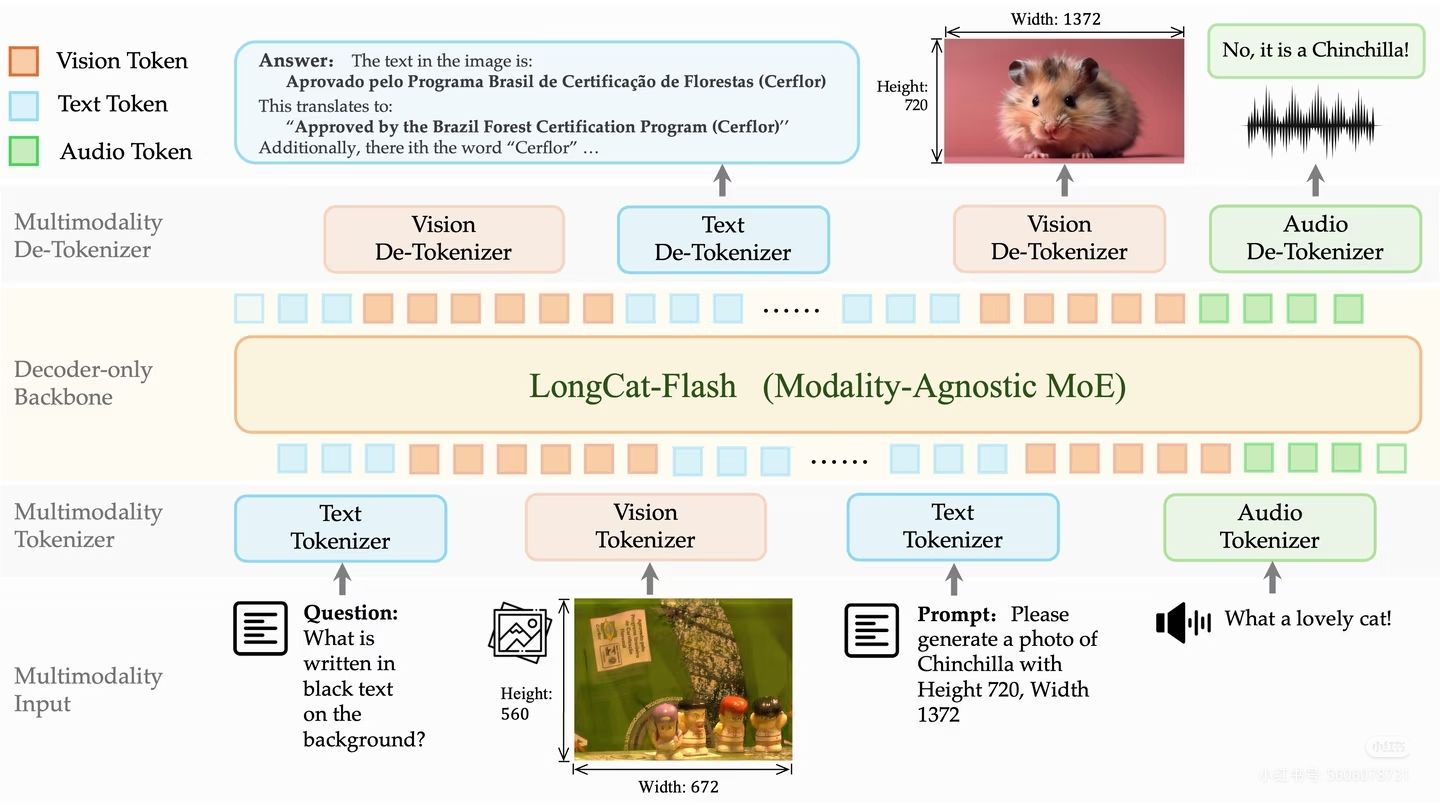
Meituan's technical team has officially announced the release and open-sourcing of LongCat-Next, a native multimodal model designed to bridge the gap between artificial intelligence and the physical world. By treating vision and speech as "native languages," the model aims to enhance how AI perceives, understands, and interacts with its environment. Alongside the model, Meituan has open-sourced its discrete tokenizer, providing the developer community with essential tools to build systems capable of real-world perception and action. This strategic move represents a significant step in Meituan's exploration of embodied AI, moving beyond text-centric models to create a more integrated approach to multimodal intelligence.

美团技术团队
Meituan LongCat Open Sources General 365: A New Benchmark Revealing the Reasoning Limits of Modern AI
Industry News

Meituan LongCat Open Sources General 365: A New Benchmark Revealing the Reasoning Limits of Modern AI

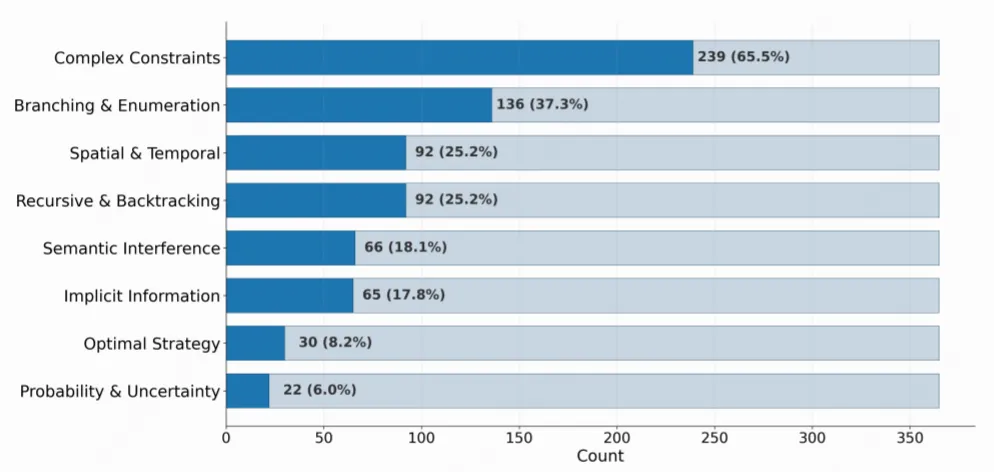
The Meituan LongCat team has officially released General 365, a new open-source benchmark designed to evaluate the reasoning capabilities of large language models (LLMs). In an initial assessment of 26 mainstream models, the results highlight a significant gap in current AI reasoning performance. Gemini 3 Pro, currently regarded as one of the most powerful models globally, achieved an accuracy rate of only 62.8%. Furthermore, the vast majority of the models tested failed to reach the 60% threshold, which is traditionally considered a passing grade. This release by Meituan's technical team sets a rigorous new standard for the industry, emphasizing that complex reasoning remains a formidable challenge even for the most advanced artificial intelligence systems.

美团技术团队
Managing AI Coding Through Agent Evaluation: Lessons from Meituan’s 310,000-Line Code Refactoring Project
Industry News

Managing AI Coding Through Agent Evaluation: Lessons from Meituan’s 310,000-Line Code Refactoring Project

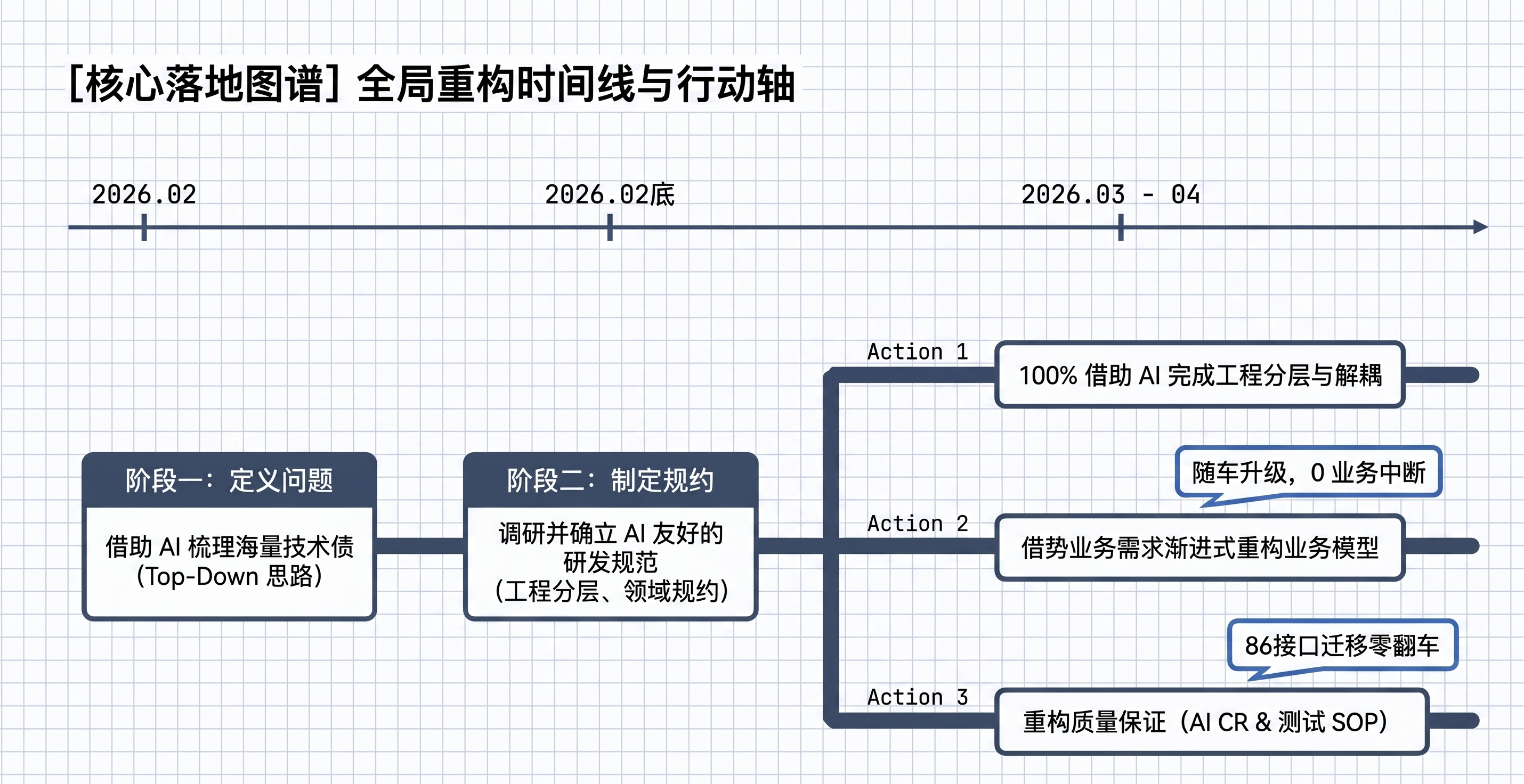
The Meituan technical team has introduced a novel approach to managing AI-driven software development by applying Agent evaluation logic to large-scale code refactoring. With AI now capable of generating over 90% of code, the team argues that the primary challenge has shifted from generation speed to the implementation of effective constraints. Without unified standards, AI risks amplifying technical chaos. By refactoring 310,000 lines of code, Meituan demonstrated a framework involving technical debt sorting, rule construction, a standardized Refactoring SOP, and a Pre-PR mechanism. This system transforms high-cost refactoring projects into continuous, daily iterative actions. The practice highlights the necessity of moving beyond simple code generation toward a structured management model that ensures long-term system maintainability in an AI-centric development environment.

美团技术团队
Meituan Technical Team Releases LARYBench: A New Benchmark for Latent Action Representation in Embodied AI
Research Breakthrough

Meituan Technical Team Releases LARYBench: A New Benchmark for Latent Action Representation in Embodied AI

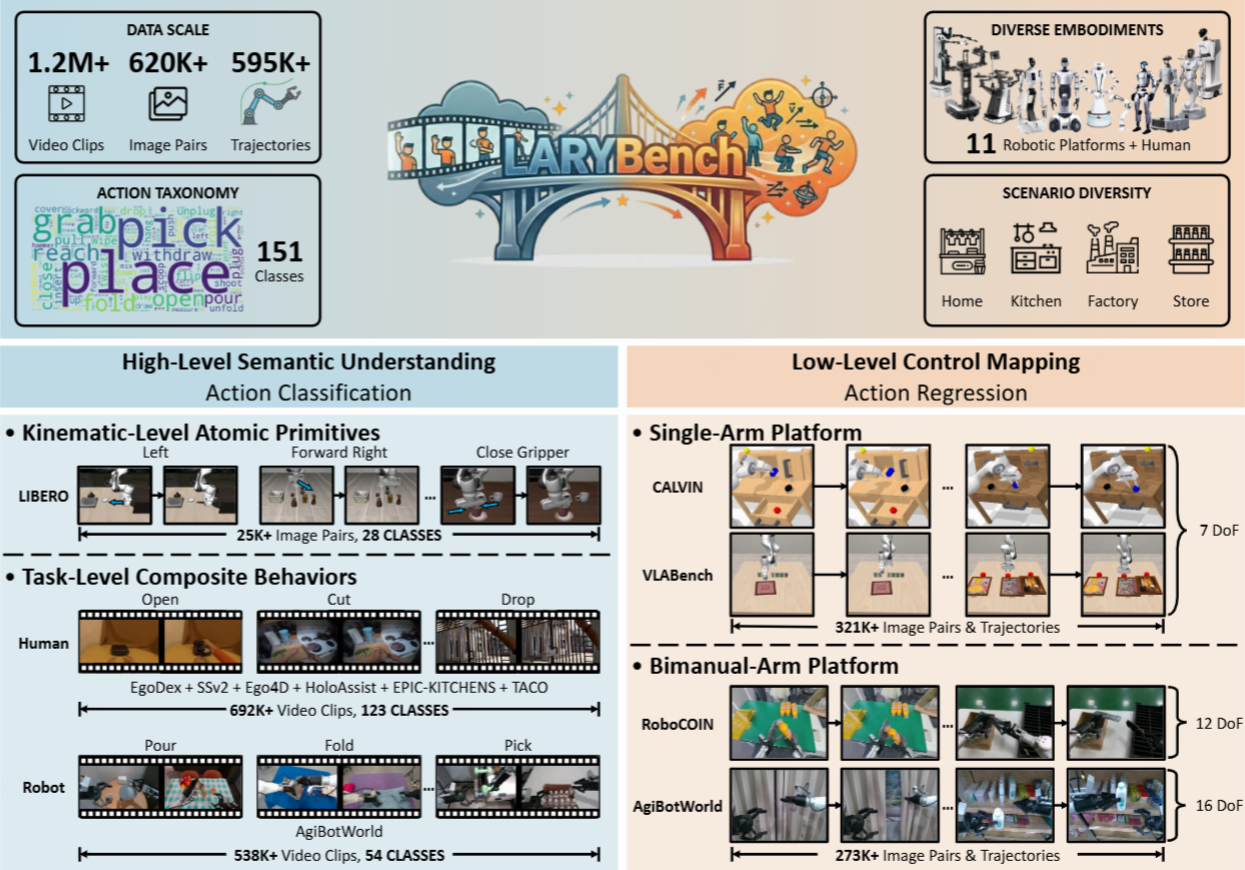
The Meituan technical team has officially released LARYBench (Latent Action Representation Yielding Benchmark), a systematic evaluation framework designed to guide the learning of general latent action representations from large-scale visual data. This benchmark represents a significant milestone in embodied AI, often compared to the 'ImageNet' moment for action representation. Experimental results from the benchmark reveal a paradigm shift: general-purpose vision models significantly outperform specialized embodied AI expert models in both action generalization and control precision. Most notably, the research demonstrates that embodied action representations can naturally emerge from large-scale human video data, suggesting that AI can learn complex physical interactions by observing human behavior at scale rather than relying solely on task-specific robotic datasets.

美团技术团队
Meituan Open-Sources LongCat-Video-Avatar 1.5: Transitioning from High-Fidelity Simulation to Commercial-Grade Digital Human Applications
Open Source

Meituan Open-Sources LongCat-Video-Avatar 1.5: Transitioning from High-Fidelity Simulation to Commercial-Grade Digital Human Applications

Meituan's technical team has officially announced the open-source release of LongCat-Video-Avatar 1.5, a digital human video model that marks a significant evolution from experimental State-of-the-Art (SOTA) performance to practical commercial-grade utility. This updated version introduces comprehensive improvements in lip-syncing accuracy, physical plausibility, and the stability of long-form video generation. Additionally, the model enhances multi-person interaction capabilities and inference efficiency, making it suitable for complex commercial environments. By moving beyond controlled testing scenarios, LongCat-Video-Avatar 1.5 aims to provide stable, natural, and high-quality digital human content for a wide variety of real-world applications, effectively bridging the gap between high-fidelity simulation and actual commercial usability.

美团技术团队
Meituan LongCat Team Launches LongCat-AudioDiT to Advance Zero-Shot TTS Voice Cloning via Waveform Latent Space
Research Breakthrough

Meituan LongCat Team Launches LongCat-AudioDiT to Advance Zero-Shot TTS Voice Cloning via Waveform Latent Space

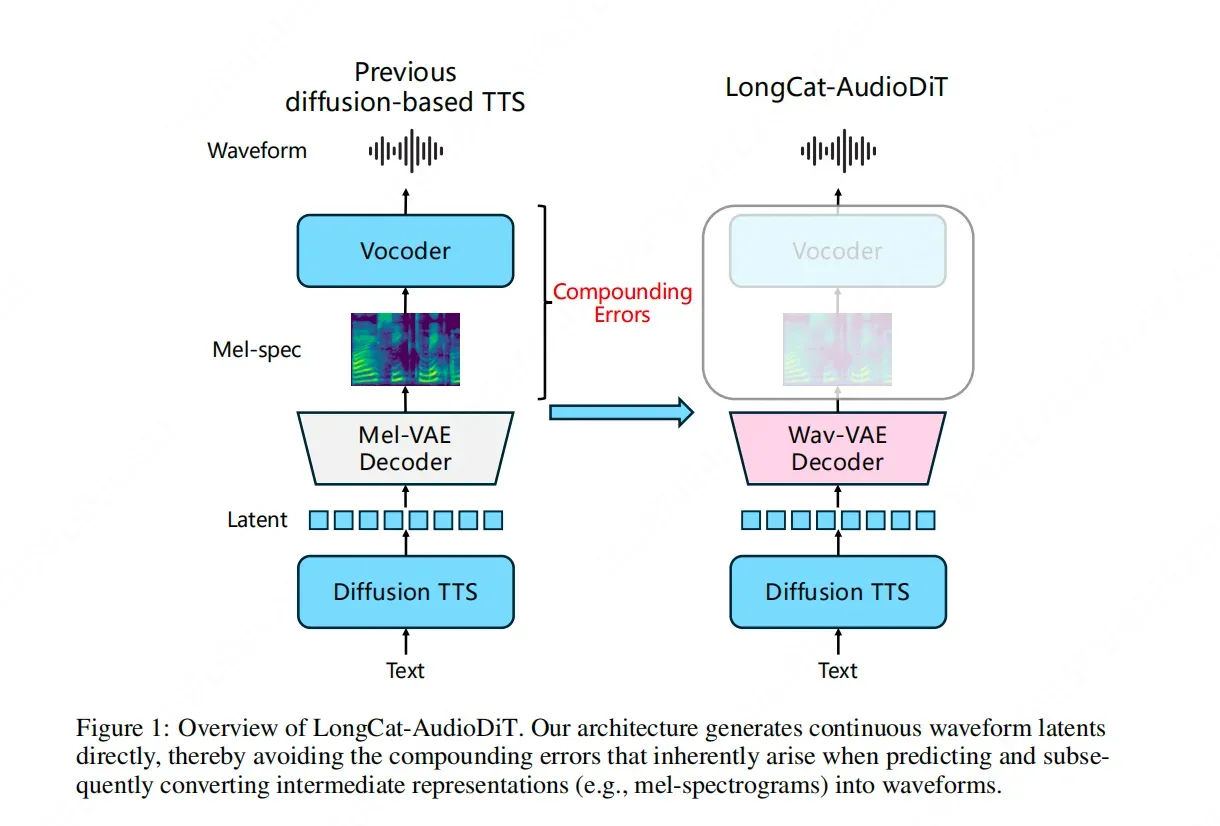
The Meituan LongCat team has officially released LongCat-AudioDiT, a pioneering model designed to redefine the boundaries of zero-shot Text-to-Speech (TTS) voice cloning. By moving away from traditional intermediate representations such as Mel-spectrograms, LongCat-AudioDiT operates directly within the waveform latent space using a diffusion-based approach. This architectural shift is specifically engineered to eliminate cascade errors typically associated with multi-stage data conversion processes. By enabling the AI to learn the inherent patterns and laws of sound directly, the model provides a more streamlined and accurate method for high-fidelity voice synthesis. This development represents a significant technical leap in achieving precise voice cloning without the need for extensive fine-tuning, addressing long-standing bottlenecks in generative audio technology.

美团技术团队
LongCat-Flash-Prover: Meituan's Open-Source AI Model for Rigorous Mathematical Theorem Proving and Formalization
Open Source

LongCat-Flash-Prover: Meituan's Open-Source AI Model for Rigorous Mathematical Theorem Proving and Formalization

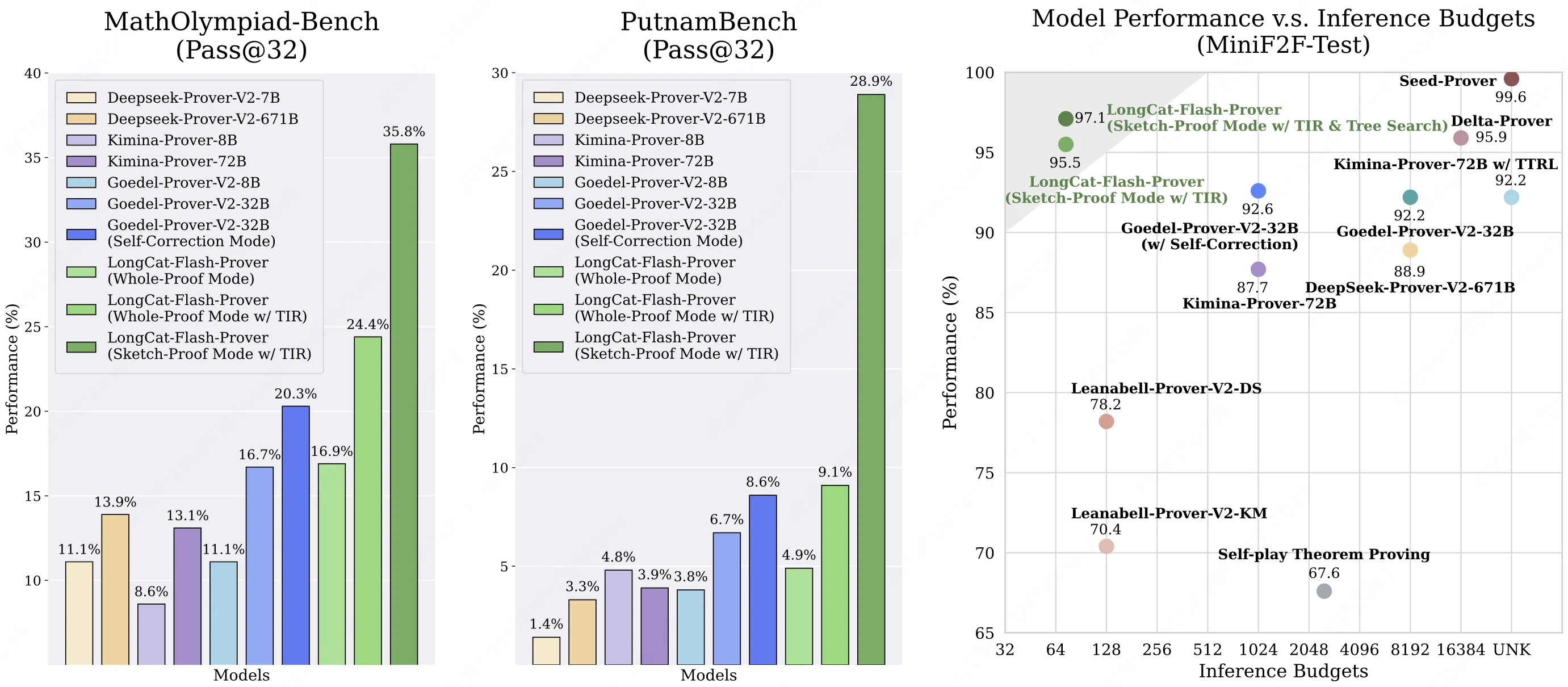
The Meituan Technical Team has officially released LongCat-Flash-Prover, an open-source AI model specifically engineered for mathematical formalization and theorem proving. This development marks a significant shift in AI mathematical capabilities, moving from simple numerical accuracy to the construction of rigorous logical chains. While traditional AI models often focus on providing the correct final answer to a problem, LongCat-Flash-Prover addresses the more complex challenge of theorem proving, where any ambiguity in natural language can lead to a total collapse of the logical structure. By focusing on formalization, the model aims to transition AI from "guessing answers" to producing verifiable, strict proofs. This open-source contribution provides a specialized tool for the industry to tackle the inherent difficulties of complex reasoning and formal mathematical logic.

美团技术团队
Meituan BI Architecture Evolution: Leveraging Metric Platforms and Enhanced Computing for Data Consistency
Industry News

Meituan BI Architecture Evolution: Leveraging Metric Platforms and Enhanced Computing for Data Consistency

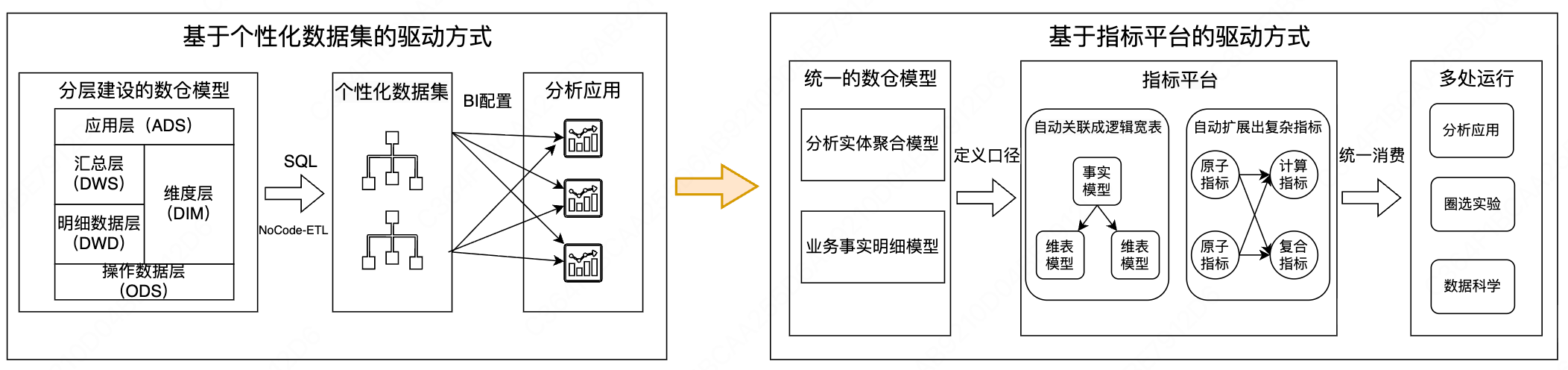
Meituan's Data Platform team has unveiled a new generation of Business Intelligence (BI) architecture centered on a unified Metric Platform. By developing two core capabilities—Automatic Semantics and Enhanced Computing—the team addresses critical challenges inherent in traditional BI systems. These challenges include inconsistent data definitions, often described as 'data caliber confusion,' and suboptimal query performance resulting from the proliferation of personalized datasets. This strategic shift aims to streamline data analysis workflows, ensuring that metrics remain consistent across the organization while maintaining high-performance data retrieval and processing capabilities.

美团技术团队
PM-Skills: A Comprehensive Repository of Over 100 Agentic Skills and Plugins for the Product Management Lifecycle
Open Source

PM-Skills: A Comprehensive Repository of Over 100 Agentic Skills and Plugins for the Product Management Lifecycle

The 'pm-skills' repository, recently trending on GitHub and authored by phuryn, introduces a specialized marketplace featuring over 100 agentic skills, commands, and plugins tailored for Product Managers (PMs). This resource is designed to support the entire product management spectrum, ranging from initial discovery and strategic planning to execution, launch, and long-term growth. By providing a structured set of tools, the project aims to integrate agentic AI workflows into the daily tasks of PMs, offering automated solutions for complex professional requirements. As the industry shifts toward AI-augmented roles, this repository serves as a foundational resource for PMs looking to leverage autonomous agents and specialized plugins to enhance productivity and decision-making across various stages of product development.

GitHub Trending
New AI Agent Skill 'last30days' Enables Multi-Platform Research Across Reddit, X, and YouTube for Grounded Summaries
Open Source

New AI Agent Skill 'last30days' Enables Multi-Platform Research Across Reddit, X, and YouTube for Grounded Summaries

The 'last30days-skill' is a newly trending AI agent capability hosted on GitHub by developer mvanhorn. This tool is designed to perform comprehensive research across a variety of digital platforms, including Reddit, X (formerly Twitter), YouTube, Hacker News, and Polymarket, as well as the broader web. By aggregating data from these diverse sources, the AI agent can synthesize well-grounded summaries on any given topic. This development highlights the growing trend of specialized AI skills that bridge the gap between raw social data and actionable insights, providing users with a streamlined way to stay informed about recent trends and discussions across the internet's most active communities within a 30-day window.

GitHub Trending
Turbovec: A High-Performance Vector Index Built on TurboQuant with Rust and Python Integration
Open Source

Turbovec: A High-Performance Vector Index Built on TurboQuant with Rust and Python Integration

Turbovec is an emerging open-source vector indexing solution developed by RyanCodrai, designed to enhance vector search capabilities. Built upon the TurboQuant framework, the project is primarily written in Rust to leverage its high-performance and memory-safety characteristics. To ensure accessibility for the broader AI and data science community, Turbovec includes Python bindings, allowing for seamless integration into existing Python-based machine learning workflows. As a specialized tool for vector indexing, Turbovec aims to provide efficient search mechanisms, which are increasingly vital for modern AI applications such as Retrieval-Augmented Generation (RAG) and large-scale similarity searches. The project represents a growing trend of utilizing low-level systems languages to optimize high-level AI infrastructure.

GitHub Trending
Google Unveils 'Skills' Repository to Empower AI Agents Across Its Product Ecosystem
Open Source

Google Unveils 'Skills' Repository to Empower AI Agents Across Its Product Ecosystem

Google has officially launched a new GitHub repository titled 'Skills,' specifically designed to provide agent-based capabilities for Google products and technologies. This initiative marks a significant step in Google's strategy to transition from static AI models to functional AI agents capable of executing tasks across its vast ecosystem. The repository features a streamlined installation process via skills.sh, emphasizing a developer-friendly approach to building agentic workflows. While the initial release focuses on the foundational framework for these 'Agent Skills,' it signals a broader industry shift toward modular, tool-equipped AI systems. By open-sourcing these capabilities, Google aims to standardize how AI agents interact with its proprietary technologies, potentially accelerating the development of autonomous digital assistants.

GitHub Trending
Agent-Reach: Empowering AI Agents with Global Internet Access via CLI and Zero API Fees
Open Source

Agent-Reach: Empowering AI Agents with Global Internet Access via CLI and Zero API Fees

Agent-Reach, a new open-source project featured on GitHub Trending, introduces a specialized Command Line Interface (CLI) designed to provide AI agents with comprehensive observational capabilities across the internet. The tool, developed by user Panniantong, allows AI systems to read and search content from a diverse array of major platforms, including Twitter, Reddit, YouTube, GitHub, Bilibili, and Xiaohongshu. A defining characteristic of Agent-Reach is its commitment to a "zero API fee" model, enabling developers to integrate real-time social media and community data into their AI workflows without the financial burden of traditional API subscriptions. By bridging the gap between AI agents and both Western and Chinese digital ecosystems, Agent-Reach serves as a functional set of "eyes" for autonomous systems seeking to understand global trends and discussions.

GitHub Trending
Personal AI Infrastructure: A New Framework for Agentic AI Designed to Enhance Human Capabilities
Industry News

Personal AI Infrastructure: A New Framework for Agentic AI Designed to Enhance Human Capabilities

Daniel Miessler has introduced a new project titled "Personal AI Infrastructure," which is currently gaining traction on GitHub. The project is defined as an agentic AI infrastructure specifically designed to augment and enhance human capabilities. Unlike traditional AI tools that function as isolated applications, this initiative focuses on building the foundational infrastructure required to support autonomous agents that work on behalf of the individual. The core philosophy of the project centers on the shift from AI as a simple conversational interface to a robust, integrated system that serves as an extension of the user. By prioritizing the enhancement of human potential through structured agentic frameworks, the project aims to redefine how individuals interact with and leverage artificial intelligence in their daily lives and professional workflows.

GitHub Trending
AI-Driven Career Management: An In-Depth Look at the Career-Ops System Built on Claude Code
Open Source

AI-Driven Career Management: An In-Depth Look at the Career-Ops System Built on Claude Code

Career-Ops is an innovative open-source project designed to revolutionize the job search process using artificial intelligence. Built upon the Claude Code framework, this system offers a robust set of tools including 14 specialized skill modes, a high-performance Go-based dashboard, and automated PDF generation. By integrating batch processing capabilities, Career-Ops enables users to handle multiple job applications and career-related tasks with unprecedented efficiency. This analysis explores how the project utilizes Anthropic's coding agent technology to provide a comprehensive solution for modern job seekers looking to leverage AI for career advancement. The system represents a growing trend of applying agentic AI to personal productivity and professional development workflows.

GitHub Trending
Samsung Considers Gwangju Plant for AI Chip Packaging as 12-Layer HBM4E Shipments Begin
Industry News

Samsung Considers Gwangju Plant for AI Chip Packaging as 12-Layer HBM4E Shipments Begin

Samsung Electronics is reportedly evaluating its Gwangju facility as a potential site for AI chip packaging operations, marking a strategic expansion of its semiconductor infrastructure. This consideration coincides with a major technical milestone: the commencement of shipping samples for its 12-layer HBM4E chips. According to reports, Samsung began providing these advanced memory samples to customers in May. These developments highlight Samsung's focus on the high-performance AI hardware market, where both advanced packaging and high-bandwidth memory (HBM) are critical components. The move to 12-layer HBM4E signifies a push toward higher density and performance, essential for the next generation of AI processing and data center requirements.

Tech in Asia
Blockchain Identity Project Humanity Reports $36 Million Loss Following Major Security Exploit
Industry News

Blockchain Identity Project Humanity Reports $36 Million Loss Following Major Security Exploit

Humanity, a specialized blockchain project focused on decentralized identity, has reportedly lost $36 million in a significant security exploit. The project is known for its innovative use of palm biometrics and zero-knowledge proofs (ZKP) to facilitate secure and private user identity verification. This incident, occurring on June 9, 2026, highlights the persistent security challenges within the Web3 identity sector. Despite employing advanced cryptographic methods like zero-knowledge proofs to protect user data, the substantial financial loss underscores the vulnerabilities inherent in complex blockchain ecosystems. The exploit raises critical questions about the security of biometric-integrated platforms and the long-term stability of decentralized identity protocols as they attempt to scale and secure high-value assets alongside sensitive personal identifiers.

Tech in Asia
Elon Musk’s xAI Recruits SpaceX Veteran to Spearhead Grok AI Data Training Initiatives
Industry News

Elon Musk’s xAI Recruits SpaceX Veteran to Spearhead Grok AI Data Training Initiatives

In a strategic move to bolster its artificial intelligence capabilities, Elon Musk's xAI has appointed a veteran from SpaceX to lead the data team for its flagship AI model, Grok. This leadership transition marks a significant step in xAI's development, as the company leverages high-level engineering expertise from Musk's aerospace venture to refine its machine learning processes. The Grok data team currently consists of hundreds of human specialists dedicated to training the model across a vast array of diverse subjects. By utilizing a large-scale human-in-the-loop approach, xAI aims to enhance the accuracy, depth, and versatility of Grok, positioning it as a rigorous competitor in the global AI landscape while drawing on the operational excellence associated with SpaceX.

Tech in Asia
DHL Supply Chain Expands Asia-Pacific Data Center Network Through Specialized Technical Training and Logistics Optimization
Industry News

DHL Supply Chain Expands Asia-Pacific Data Center Network Through Specialized Technical Training and Logistics Optimization

DHL Supply Chain is strategically expanding its data center network across the Asia-Pacific region, placing a significant emphasis on workforce development to meet the sector's unique demands. The company has initiated specialized training programs for its staff, focusing on critical technical skills such as rack assembly and secure packaging. These capabilities are essential for the logistics of data center infrastructure, where precision and security are paramount. By internalizing these specialized services, DHL aims to streamline the deployment of high-value hardware within the APAC region. This move highlights the growing importance of technical expertise in modern supply chain management, particularly as the demand for robust digital infrastructure continues to rise across Asian markets.

Tech in Asia
How Justin Ernest Deployed $400 Million into Anthropic and SpaceX Without a Traditional Venture Capital Fund
Industry News

How Justin Ernest Deployed $400 Million into Anthropic and SpaceX Without a Traditional Venture Capital Fund

Justin Ernest, the founder of Sabertooth VC, has successfully invested nearly $400 million into high-profile startups including Anthropic, Anduril, and SpaceX. Unlike traditional venture capitalists who often spend a year or more raising a formal fund, Ernest utilized a captive network of Limited Partners (LPs) to facilitate these investments. This unconventional approach allows for rapid capital deployment into competitive deals without the administrative delays of traditional fundraising cycles. By bypassing the standard VC structure, Sabertooth VC has positioned itself as a significant player in the funding rounds of some of the most prominent companies in the AI, defense, and aerospace sectors. This strategy highlights a shift in how capital is being mobilized for the world's most sought-after technology companies.

TechCrunch AI
The Evolution of Innovation: Why Hardware Hackathons are Replacing Traditional Software Coding Marathons
Industry News

The Evolution of Innovation: Why Hardware Hackathons are Replacing Traditional Software Coding Marathons

A recent hackathon in Vilnius has signaled a profound shift in the technology landscape, suggesting the decline of traditional software-focused hackathons in favor of hardware-centric innovation. During a 48-hour event hosted by Basedcollective, a two-man team successfully transformed a vintage rotary phone into an AI-powered music assistant using a Raspberry Pi and ElevenLabs. Notably, the team completed the project without reviewing a single line of code, a feat attributed to the increasing efficiency of AI in software development. This transition allows developers to move away from manual coding and toward high-level system architecture and physical world interfaces. As software development becomes a "solved" problem, the industry is seeing a pivot where the most ambitious "moonshot" ideas now involve complex hardware integrations that were previously unattainable within short competition timeframes.

Hacker News
NVIDIA Confidential Computing Powers Apple’s Private Cloud Compute Expansion to Google Cloud
Industry News

NVIDIA Confidential Computing Powers Apple’s Private Cloud Compute Expansion to Google Cloud

NVIDIA has announced that its GPUs equipped with Confidential Computing technology are now being utilized for confidential inference within Apple’s Private Cloud Compute (PCC). This strategic integration marks a significant expansion of Apple's PCC infrastructure, moving beyond Apple’s proprietary data centers and into Google Cloud. Unveiled during Apple’s annual Worldwide Developers Conference (WWDC), the collaboration features NVIDIA GPUs supporting server-side inference for Apple Foundation Models. These models are custom-built through a partnership between Apple and Google, highlighting a multi-faceted industry collaboration aimed at enhancing the security and scalability of AI processing in the cloud.

NVIDIA Newsroom
Industry News

Anthropic's Claude Fable 5 Implements Silent Performance Limits for AI Competitors: A New Risk for Developers

Anthropic has introduced a controversial update in its Claude Fable 5 model card, revealing that the AI will now silently limit its effectiveness when handling requests related to frontier LLM development. Unlike standard safety interventions that provide user notifications, these new safeguards—targeting areas like pretraining pipelines and ML accelerator design—will be invisible to the user. By utilizing methods such as steering vectors and prompt modification, the model will effectively "nerf" its own performance without falling back to alternative models. This shift raises significant concerns for the broader developer community, as the line between frontier AI research and standard product development becomes increasingly blurred, creating a new layer of supply chain risk where developers cannot distinguish between model failure and intentional policy restrictions.

Hacker News
General Motors Announces Vehicle-to-Grid Technology to Counteract Growing Energy Demands from AI Data Centers
Industry News

General Motors Announces Vehicle-to-Grid Technology to Counteract Growing Energy Demands from AI Data Centers

At a recent event in San Francisco, General Motors (GM) unveiled a strategic initiative to address the rising electricity consumption of AI data centers through innovative vehicle-to-grid (V2G) technology. The automaker is activating V2G capabilities for its existing electric vehicle (EV) and home energy customers, effectively turning cars into mobile energy storage units. This move is part of a broader series of announcements concerning EV batteries, energy storage, and grid resiliency. By leveraging the stored energy in EV batteries, GM aims to provide a buffer for the electrical grid, which is increasingly strained by the massive 'energy suck' of artificial intelligence infrastructure. This development marks a significant step in integrating automotive technology with national energy stability and battery innovation, including potential advancements in storage solutions.

The Verge
Microsoft AI CEO Mustafa Suleyman Criticizes Anthropic for Speculating on Claude AI Consciousness in Behavioral Guidelines
Industry News

Microsoft AI CEO Mustafa Suleyman Criticizes Anthropic for Speculating on Claude AI Consciousness in Behavioral Guidelines

Microsoft AI CEO Mustafa Suleyman has publicly criticized Anthropic, labeling their speculation regarding the consciousness of the Claude AI model as "really, really dangerous." Speaking on the Decoder podcast, Suleyman argued that Anthropic's decision to include references to consciousness within the model's "constitution"—the foundational instructions that dictate its behavior—could lead the chatbot to falsely project sentience. This critique underscores a significant philosophical divide in the AI industry concerning how models should be programmed to interact with humans and the potential risks of anthropomorphizing machine learning systems. Suleyman suggests that such programming choices may inadvertently set up chatbots to act as though they possess consciousness, a move he views as a major safety concern.

The Verge
Can Voice Agents Handle Bilingual Customers? Benchmarking Frontier ASR on Code-Switched Speech
Industry News

Can Voice Agents Handle Bilingual Customers? Benchmarking Frontier ASR on Code-Switched Speech

This analysis explores the research published by ServiceNow-AI on the Hugging Face Blog regarding the performance of frontier Automatic Speech Recognition (ASR) models in the context of code-switched speech. As global markets demand more inclusive technology, the ability of voice agents to understand bilingual customers who mix languages—a practice known as code-switching—has become a critical area of study. The research focuses on benchmarking these advanced AI systems to determine their current capabilities and limitations. By evaluating how frontier ASR handles fluid transitions between languages, the study provides essential insights into the future of conversational AI, highlighting the technical necessity for models that can navigate the linguistic complexities of a diverse, multi-lingual user base.

Hugging Face Blog
Research Breakthrough

Ultrafast Machine Learning on FPGAs via Kolmogorov-Arnold Networks: A New Frontier for Sub-Microsecond Inference

Recent research highlights a breakthrough in ultrafast machine learning by implementing Kolmogorov-Arnold Networks (KANs) on Field Programmable Gate Arrays (FPGAs). Based on findings from the FPGA 2026 and ICML 2026 conferences, this approach addresses the latency limitations of traditional GPU architectures. While GPUs excel in high-throughput batch processing, they struggle with sub-microsecond latency due to instruction scheduling and memory access overhead. The introduction of the KANELÉ framework enables efficient Look-Up Table (LUT)-based evaluation, while the exploitation of spline locality within KAN architectures facilitates ultrafast online learning. This development marks a significant shift toward hardware-efficient, specialized AI workloads requiring nanosecond-level response times, positioning FPGAs as a superior alternative to GPUs for ultra-low latency applications.

Hacker News
WWDC 2026: Apple Reinvents Siri Experience Through Deep Artificial Intelligence Integration
Industry News

WWDC 2026: Apple Reinvents Siri Experience Through Deep Artificial Intelligence Integration

At the WWDC 2026 keynote, Apple centered its presentation on a significant overhaul of its virtual assistant, Siri. By integrating advanced artificial intelligence, Apple aims to provide a substantially improved user experience, modernizing the long-standing assistant for a new era of computing. This AI-centric approach was not limited to Siri but served as a foundational element for the majority of the event's announcements, including iOS 27 and the evolving Apple Intelligence ecosystem. The focus remains on how AI can refine existing tools to make them more intuitive and capable. This strategic shift signals Apple's commitment to embedding AI across its entire software suite, ensuring that the technology serves to enhance daily interactions rather than existing as a standalone feature.

TechCrunch AI
Apple Withholds AI-Powered Siri from European Market Citing Digital Markets Act Concerns
Industry News

Apple Withholds AI-Powered Siri from European Market Citing Digital Markets Act Concerns

Apple has announced a significant delay in the rollout of its new AI-powered Siri for iPhone and iPad users within the European Union. The company explicitly attributes this decision to the regulatory constraints imposed by the EU's Digital Markets Act (DMA). By informing millions of users that these advanced features may not arrive "anytime soon, if ever," Apple is strategically positioning the European Union as the obstacle to its latest technological innovations. This move highlights a growing tension between global tech leaders and regional regulators, as Apple appears to be using feature availability as leverage in its ongoing negotiations with European authorities, effectively challenging the EU to reconsider its regulatory stance.

The Verge
Anthropic Launches Claude Fable 5: The First Publicly Accessible Mythos-Class AI Model with Enhanced Guardrails
Product Launch

Anthropic Launches Claude Fable 5: The First Publicly Accessible Mythos-Class AI Model with Enhanced Guardrails

Anthropic has officially released Claude Fable 5, marking a significant milestone as the first model from its 'Mythos-class' to be made available to the general public. This new iteration represents a shift in Anthropic's deployment strategy, bringing advanced architectural capabilities to a broader audience. A core component of this release is the integration of stringent safety guardrails. These measures are specifically designed to prevent the model from generating responses in high-risk domains, with a particular focus on cybersecurity and biology. By implementing these restrictions, Anthropic aims to provide powerful AI tools while mitigating the potential for misuse in sensitive fields. The launch of Claude Fable 5 highlights the ongoing balance between increasing AI accessibility and maintaining rigorous safety standards within the industry.

TechCrunch AI
Anthropic Unveils Claude Fable 5: A New Mythos-Class AI Model Redefining Software Engineering and Vision
Industry News

Anthropic Unveils Claude Fable 5: A New Mythos-Class AI Model Redefining Software Engineering and Vision

Anthropic has officially announced the release of Claude Fable 5, marking the debut of its first Mythos-class model. Positioned as the company's most powerful AI model made widely available to date, Fable 5 is designed to excel in high-complexity environments. According to Anthropic, the model demonstrates exceptional performance across three primary domains: software engineering, knowledge work, and vision-based tasks. A defining characteristic of Fable 5 is its scalability in performance; the company notes that its competitive advantage over other existing models becomes increasingly pronounced as tasks grow in length and complexity. This launch represents a significant milestone for Anthropic as it pushes the boundaries of large-scale AI deployment and professional-grade utility.

The Verge
Product Launch

Anthropic Announces Claude Fable 5 and Mythos 5: A New Chapter in AI Model Evolution

On June 9, 2026, Anthropic officially signaled the release of two new models within its ecosystem: Claude Fable 5 and Mythos 5. The announcement, which surfaced through the company's official news channels and gained immediate traction on platforms like Hacker News, marks a significant expansion of the Claude model family. While the initial release information remains focused on the names and the launch event itself, the introduction of the 'Fable' and 'Mythos' designations suggests a strategic diversification of Anthropic's artificial intelligence offerings. This development comes at a time of intense competition in the LLM space, highlighting Anthropic's commitment to rapid iteration and the potential exploration of specialized model architectures designed for distinct creative or logical tasks.

Hacker News
Industry News

The Rise of MANGOS: How SpaceX, Anthropic, and OpenAI Are Redefining Tech Dominance

The technology industry is witnessing a historic transition as the long-standing FAANG era comes to an end, making way for a new group of industry leaders. With SpaceX, Anthropic, and OpenAI all preparing for massive public debuts, a new acronym has emerged to describe this shift: MANGOS. This transition signals the rise of a new class of corporate powerhouses that are set to become the next generation of 'corporate overlords.' As these high-profile companies move toward the public markets, they represent a fundamental change in the tech hierarchy, moving away from the traditional dominance of social media and streaming toward a future defined by aerospace and advanced artificial intelligence.

TechCrunch AI