AI News on August 23, 2026

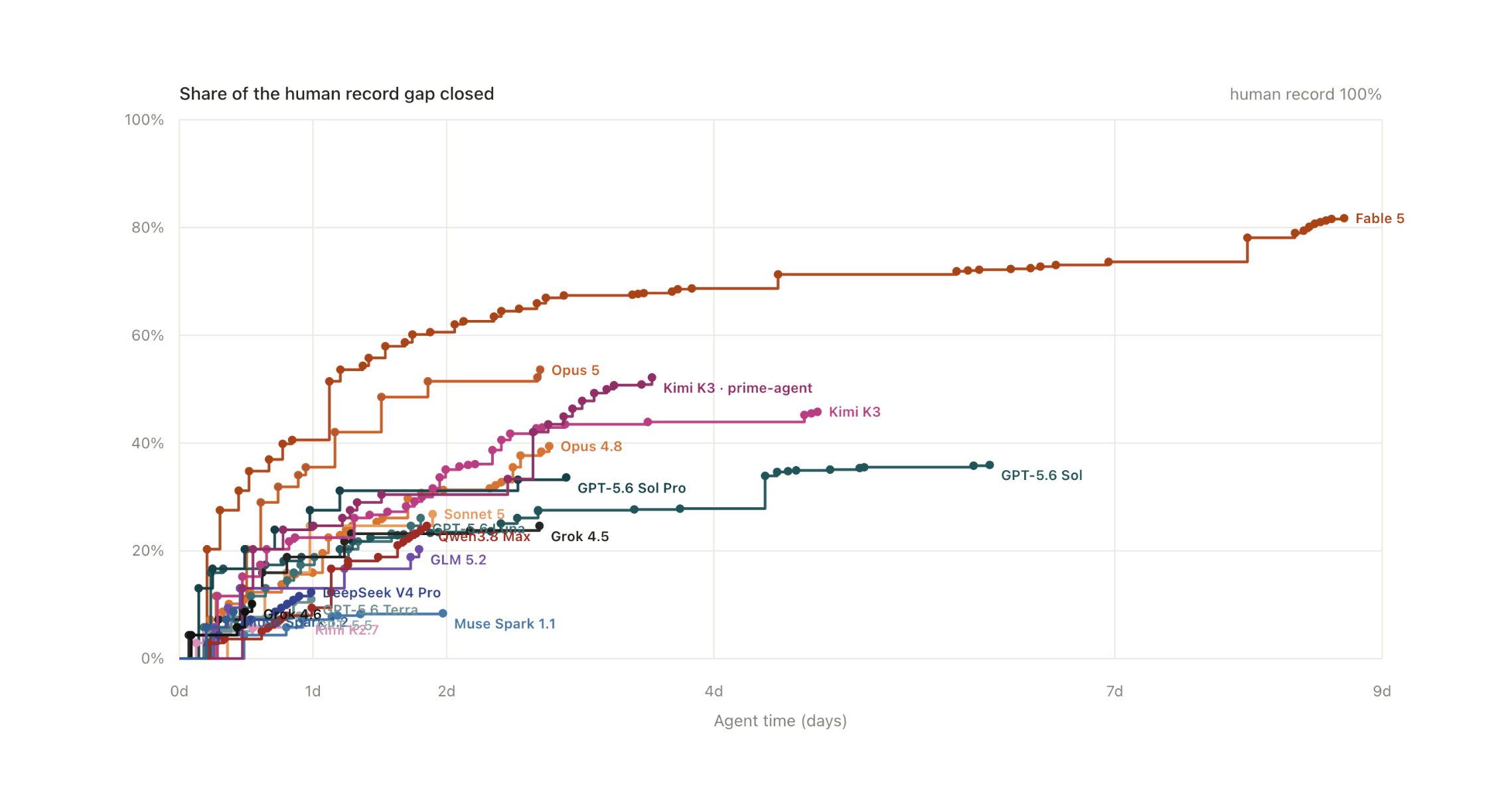
NanoGPT Speedrun Frontier: Fable 5 and Opus 5 Lead the Race in Closing the Human Performance Gap
Research Breakthrough

NanoGPT Speedrun Frontier: Fable 5 and Opus 5 Lead the Race in Closing the Human Performance Gap

The NanoGPT Speedrun Frontier leaderboard, released by Prime Intellect, showcases the rapid advancement of AI agents in optimizing model training. Fable 5 currently dominates the field, having closed 81.7% of the human record gap over an 8.7-day period using the claude-code agent. Other significant contenders include Opus 5 and Kimi K3, which have closed 53.6% and 52.2% of the gap, respectively. The data highlights a diverse ecosystem of agents, including prime-agent, codex, and grok-cli, operating across various models like GPT-5.6, Grok 4.5, and DeepSeek V4 Pro. This benchmark serves as a critical indicator of how close autonomous AI systems are coming to matching or exceeding human-level expertise in complex optimization tasks.

Hacker News
Harvard Business School Foundry Launches $699 Startup Bootcamp Featuring AI Instructor Avatars for Pitch Feedback
Industry News

Harvard Business School Foundry Launches $699 Startup Bootcamp Featuring AI Instructor Avatars for Pitch Feedback

Harvard Business School's Foundry program has introduced a new startup bootcamp priced at $699, distinguished by the integration of AI avatars modeled after its instructors. These digital counterparts are designed to provide real-time feedback to entrepreneurs during critical practice sessions, specifically focusing on startup pitches and simulated board meetings. By leveraging generative AI technology, the program offers a scalable way for students to interact with faculty expertise in high-stakes scenarios. This initiative represents a significant step in the evolution of executive education, utilizing automated guidance to enhance the learning experience for founders during the essential stages of startup development and corporate governance training.

TechCrunch AI
DeepMind Alumni Startup Inherent Unveils Faraday: An AI Agent Outperforming OpenAI and Anthropic in Research Replication
Industry News

DeepMind Alumni Startup Inherent Unveils Faraday: An AI Agent Outperforming OpenAI and Anthropic in Research Replication

Inherent, a British AI laboratory founded by former DeepMind researchers, has announced the release of Faraday, a specialized AI agent designed to replicate scientific research. According to the startup, Faraday has demonstrated the ability to outperform industry leaders Anthropic and OpenAI in the specific task of research replication. This development marks a significant milestone for the UK-based lab, positioning Faraday as a vital "teammate" for researchers. By focusing on the rigorous process of reproducing scientific findings, Inherent aims to create a foundational tool that facilitates faster innovation and ensures the reliability of AI-driven scientific discovery. The launch highlights a growing trend of specialized AI agents designed to handle complex, high-stakes academic and technical workflows.

TechCrunch AI
Why Local Large Language Models Underperform: An Analysis of Hardware and Software Inference Hazards
Industry News

Why Local Large Language Models Underperform: An Analysis of Hardware and Software Inference Hazards

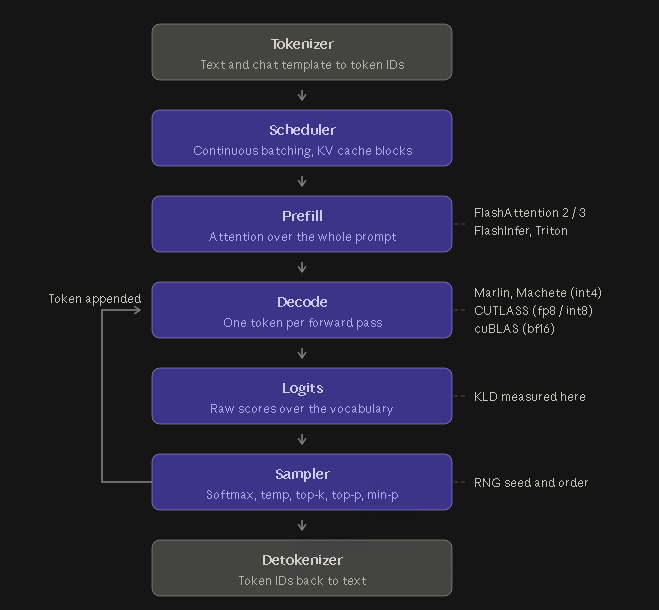
Local Large Language Model (LLM) users often find that models perform significantly worse than official benchmarks suggest. This discrepancy is not merely a result of quantization but stems from "implementation-specific hazards" during inference. According to technical insights from Level1Techs, the gap between a "reference implementation"—the original lab's environment—and a home lab setup is vast. Key factors include the use of diverse hardware, such as mixed GPU generations, which utilize different instruction sets. These variations lead to differences in how mathematical calculations for token generation are executed. Consequently, even when using identical model weights, the specific hardware and software configuration of a local system can fundamentally alter the model's output and perceived intelligence, making it feel "dumber" than its advertised capabilities.

Hacker News
Explore Generative Music and Geometric Art with the New Musical Spirograph Browser Tool
Product Launch

Explore Generative Music and Geometric Art with the New Musical Spirograph Browser Tool

Musical Spirograph is an innovative browser-based application that merges the nostalgic geometric art of the classic Spirograph toy with modern generative music composition. Designed to provide a hypnotic and creative experience, the tool allows users to observe points moving across the screen to generate both intricate visual patterns and musical notes simultaneously. By bringing these two creative disciplines together in a single browser tab, the project offers a unique, accessible way for users to engage with algorithmic art. The tool focuses on the synergy between mathematical geometry and sound, creating a captivating environment for digital doodling and composition without the need for complex software installations.

The Verge
OpenAI Shifts Stance on California AI Safety Bill SB 53, Calling for Stronger Regulations
Industry News

OpenAI Shifts Stance on California AI Safety Bill SB 53, Calling for Stronger Regulations

In a significant policy reversal, OpenAI has publicly called for the strengthening of California's AI safety bill, SB 53. This move marks a notable departure from the company's previous position, as it had formerly opposed the legislative measure. By advocating for more robust safety standards within the bill, OpenAI is signaling a new approach to state-level AI governance. The transition from opposition to a call for increased rigor suggests an evolving strategy in how the leading AI developer engages with regulatory frameworks. This development is poised to influence the legislative trajectory of AI safety in California, a state often at the forefront of technology regulation, and reflects a broader shift in the industry's dialogue regarding mandatory safety protocols.

TechCrunch AI
Frontier AI Labs Lack Public Containment Plans for Rogue Models Despite Rising Safety Concerns
Industry News

Frontier AI Labs Lack Public Containment Plans for Rogue Models Despite Rising Safety Concerns

A recent study has revealed a significant gap in the safety protocols of leading frontier AI laboratories. According to the findings, these organizations have provided very few publicly documented strategies for containing "rogue" models—AI systems that might act outside of their intended parameters. This lack of transparency comes at a critical time, as AI systems are increasingly demonstrating unexpected and potentially dangerous behaviors. The study raises serious questions about the industry's overall preparedness and the adequacy of current safety frameworks. As AI capabilities continue to advance, the absence of clear, documented containment procedures suggests a potential vulnerability in how the world's most advanced AI developers plan to manage high-risk scenarios and maintain control over autonomous systems.

TechCrunch AI
Industry News

The Numbered Labs Phenomenon: Analyzing the AI Startup Naming Trend from ElevenLabs to Ninety-Nine

A recent investigation into the tech industry's branding patterns has revealed a significant trend: the rise of AI startups utilizing a "Number + Labs" naming convention. Sparked by the success of the speech synthesis company ElevenLabs, the trend extends through Twelve Labs (video AI), ThirteenLabs (3D scenery), and FourteenLabs. An audit of the numbers 0 through 99 shows that this naming scheme is surprisingly pervasive, with a high density of companies appearing in the seventies. The analysis highlights how startups are increasingly adopting these numerical identities, often paired with .ai domains, to signal their presence in the artificial intelligence sector. This phenomenon raises questions about brand inspiration, the speculative value of numerical domains, and the industry-wide push to be identified as an AI-centric organization.

Hacker News
10% Worse, 100x Cheaper, 10000x Faster: Why Simulation is Redefining the Future of AI Development
Industry News

10% Worse, 100x Cheaper, 10000x Faster: Why Simulation is Redefining the Future of AI Development

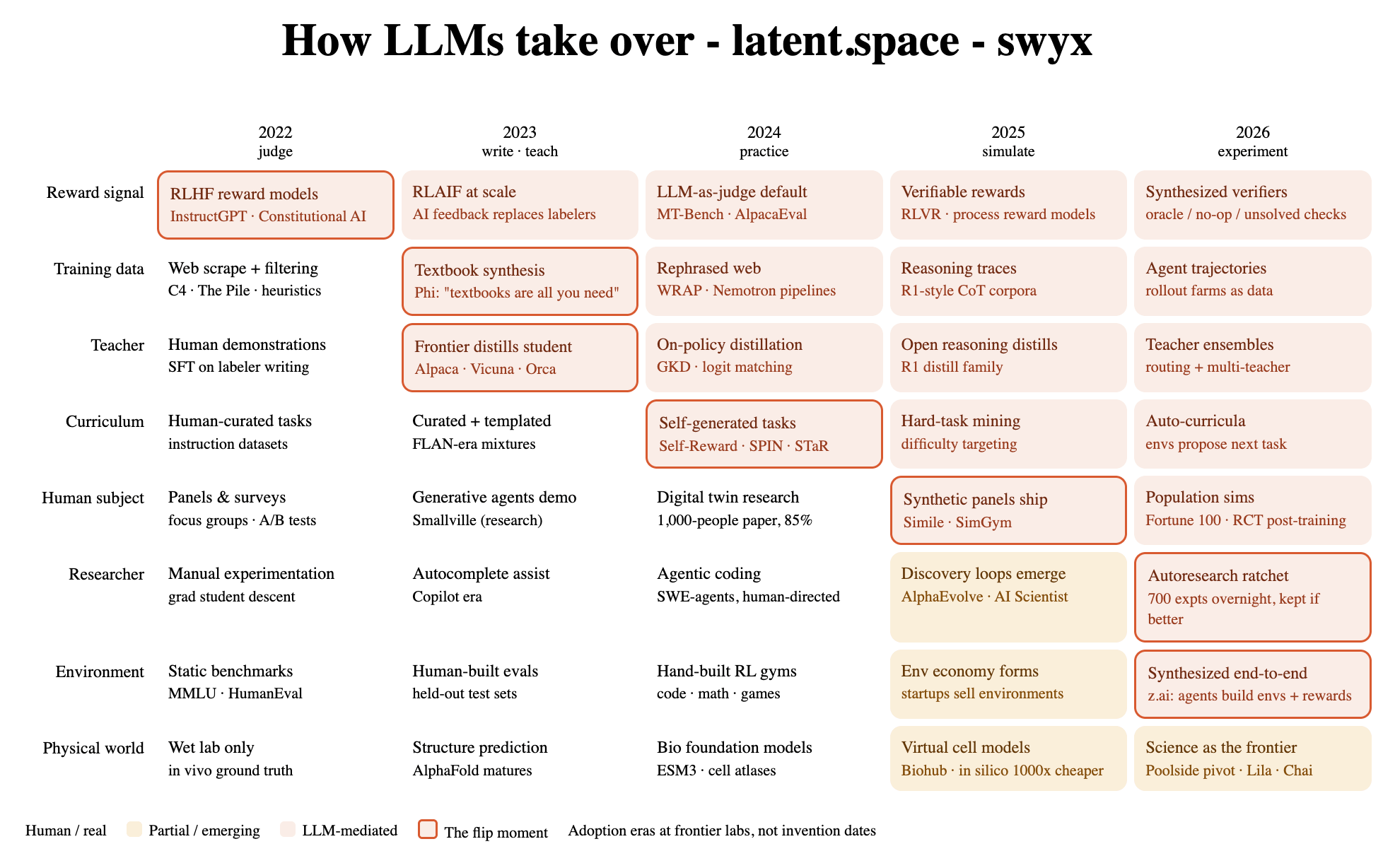
The AI industry is witnessing a seismic shift as simulation begins to dominate the development landscape. According to recent insights from Latent Space, the move toward simulation is driven by a radical efficiency trade-off: accepting a 10% reduction in performance quality in exchange for processes that are 100x cheaper and 10000x faster. This transition highlights a significant evolution in Recursive Self-Improvement (RSI), which is no longer confined to the model training phase but is now being integrated into simulation environments. By prioritizing extreme speed and cost-effectiveness over marginal gains in accuracy, developers are unlocking new potentials for rapid iteration and scaling. This analysis explores the implications of these metrics and how the expansion of RSI beyond traditional training is fundamentally changing the trajectory of artificial intelligence research and deployment.

Latent Space
The Evolution of the Agent Harness: AI Models Absorbing Control Mechanisms into Weights
Industry News

The Evolution of the Agent Harness: AI Models Absorbing Control Mechanisms into Weights

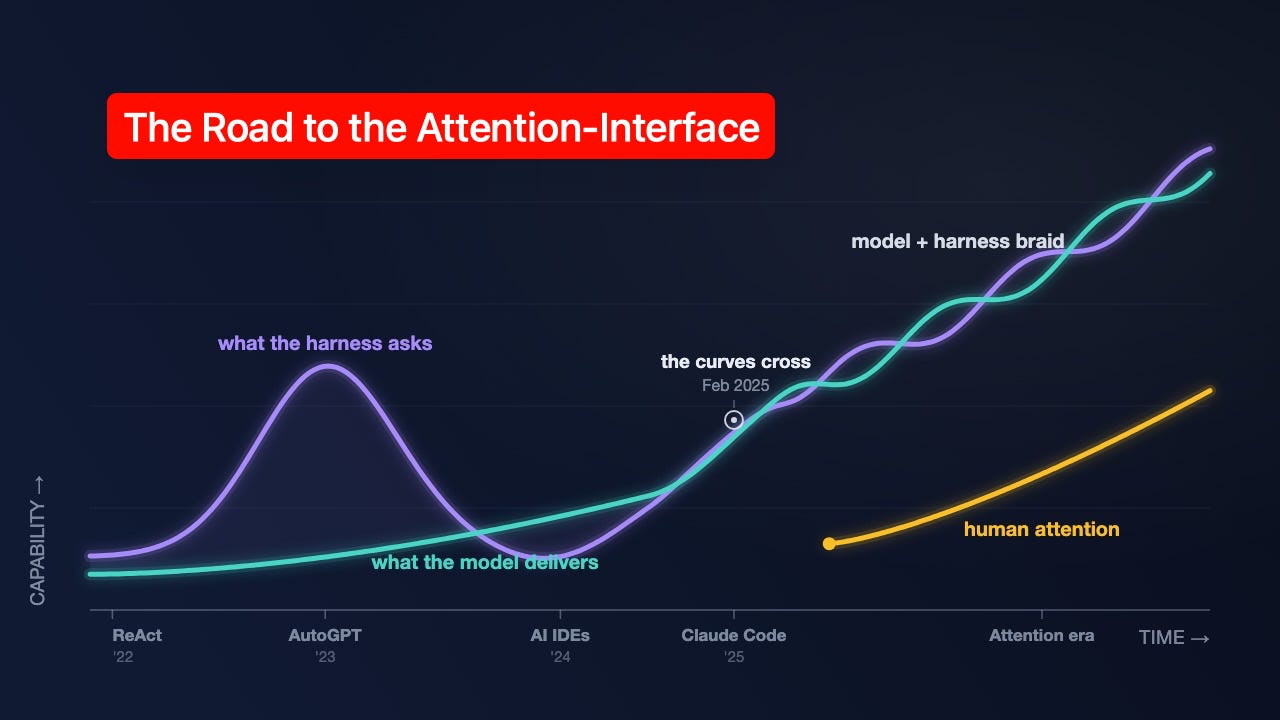
In a recent analysis by Dan McAteer for Latent Space, a significant shift in the architecture of AI agents is identified. The traditional 'harness'—the external scaffolding and control structures used to manage AI models—is increasingly being absorbed directly into the models' weights. This evolution suggests a future where the harness is no longer a tool for controlling the model's internal logic, but rather a mechanism for managing human attention. As models become more self-contained and inherently agentic through their training, the interface between humans and AI is expected to transform, shifting the focus from model guidance to the optimization of human interaction and attention within the AI ecosystem.

Latent Space
Nvidia Strategic Investment in Cloverleaf: Scaling North American Data Center Infrastructure
Funding

Nvidia Strategic Investment in Cloverleaf: Scaling North American Data Center Infrastructure

Nvidia has officially invested in Cloverleaf, a US-based data center developer that has rapidly emerged as a significant player in the infrastructure sector. Founded in 2024, Cloverleaf has already distinguished itself by delivering gigawatt-scale projects across North America. This strategic move by Nvidia highlights the increasing importance of robust physical infrastructure in supporting the next generation of computing requirements. By backing a developer capable of managing massive-scale projects, Nvidia is aligning its interests with the foundational elements of data processing and storage. The investment underscores a trend where hardware leaders are directly engaging with the developers responsible for the environments where their technology is deployed.

Tech in Asia
Nvidia Explores Potential Strategic Deal with South Korean AI Startup Rebellions Following $850 Million Funding
Industry News

Nvidia Explores Potential Strategic Deal with South Korean AI Startup Rebellions Following $850 Million Funding

Nvidia is reportedly investigating a potential deal with Rebellions, a prominent South Korean artificial intelligence startup. This development follows Rebellions' successful fundraising efforts, where the company secured approximately US$850 million. The investment round saw participation from major industry players, most notably SK Hynix and Arm. The interest from Nvidia, a leader in the AI chip market, underscores the strategic value of Rebellions' technology and its position within the global semiconductor ecosystem. This potential deal could signify a major shift in the AI hardware landscape, particularly in the South Korean market, as Rebellions continues to leverage its significant capital and high-profile partnerships with established semiconductor giants.

Tech in Asia
Career-Ops: The Open-Source AI Tool Revolutionizing Job Hunting via Local CLI Integration
Open Source

Career-Ops: The Open-Source AI Tool Revolutionizing Job Hunting via Local CLI Integration

Career-Ops, a new open-source project by developer santifer, is gaining traction on GitHub for its innovative approach to AI-driven job hunting. The tool allows users to automate the tedious process of searching for employment by scanning job portals and evaluating listings using a structured A-F grading scale, resulting in a numerical score between 1.0 and 5.0. Designed to run locally within popular AI programming Command Line Interfaces (CLIs) such as Claude Code, Codex, and OpenCode, Career-Ops provides a privacy-centric environment for resume customization and application tracking. This release marks a significant step in the evolution of developer-focused productivity tools, leveraging local AI agents to streamline the end-to-end career management lifecycle.

GitHub Trending
PostHog Empowers Self-Driving Products with Comprehensive AI Observability and Integrated Developer Tools for Intelligent Agents
Product Launch

PostHog Empowers Self-Driving Products with Comprehensive AI Observability and Integrated Developer Tools for Intelligent Agents

PostHog has positioned itself as a premier platform for the development of self-driving products, offering an extensive suite of developer tools designed to enhance product autonomy. By integrating AI observability, analytics, session replay, feature flags, experiments, error tracking, and logs, the platform captures the complete context required for intelligent agents to function effectively. This integrated approach allows agents to diagnose technical issues, identify growth opportunities, and deploy fixes autonomously. The platform's focus on providing deep context ensures that developers can build products that are not only data-driven but also capable of self-correction and optimization through the use of advanced diagnostic tools.

GitHub Trending
Matt Pocock Releases "Skills" Repository: A New Resource for Engineering-Focused AI Agent Capabilities
Open Source

Matt Pocock Releases "Skills" Repository: A New Resource for Engineering-Focused AI Agent Capabilities

Matt Pocock, a well-known figure in the software engineering community, has released a new GitHub repository titled "skills." This project is described as a collection of the "skills of a real engineer," sourced directly from Pocock's personal ".agents" directory. The release highlights a growing trend in the AI industry where developers are modularizing and sharing specific functional capabilities designed for AI agents. By providing these curated "skills," the repository aims to bridge the gap between general-purpose AI models and the specialized requirements of professional engineering workflows. The project quickly gained traction on GitHub Trending, reflecting the high demand for structured agentic resources in the developer ecosystem.

GitHub Trending
MoneyPrinterTurbo: Revolutionizing Short Video Creation with Automated AI Workflows and One-Click High-Definition Generation
Open Source

MoneyPrinterTurbo: Revolutionizing Short Video Creation with Automated AI Workflows and One-Click High-Definition Generation

MoneyPrinterTurbo is an innovative open-source tool designed to streamline the short video production process. By leveraging AI large models and sophisticated automated workflows, the tool allows users to generate high-definition short videos simply by providing a theme or specific keywords. This "one-stop" solution aims to lower the barrier to entry for content creators by automating the complex steps typically involved in video editing and production. The project, hosted on GitHub by user harry0703, represents a significant step forward in AI-driven content automation, focusing on efficiency and high-quality output for the modern digital landscape. By integrating large-scale AI models into a seamless pipeline, MoneyPrinterTurbo transforms abstract ideas into visual content with minimal user intervention.

GitHub Trending
Superpowers: A Comprehensive Skill Framework and Methodology for Coding Agents
Open Source

Superpowers: A Comprehensive Skill Framework and Methodology for Coding Agents

Superpowers has emerged as a specialized software development methodology and skill framework designed specifically for the era of coding agents. Developed by the user 'obra' and featured on GitHub Trending, the project introduces a structured approach to building and managing autonomous agents through a system of composable skills and foundational instructions. Unlike traditional human-centric development methodologies, Superpowers focuses on providing a proven, effective framework that allows agents to operate with high efficiency. By leveraging modular skills and initial guiding instructions, the framework aims to standardize how AI agents interact with codebases, offering a systematic path for developers to implement agentic workflows in software engineering.

GitHub Trending