
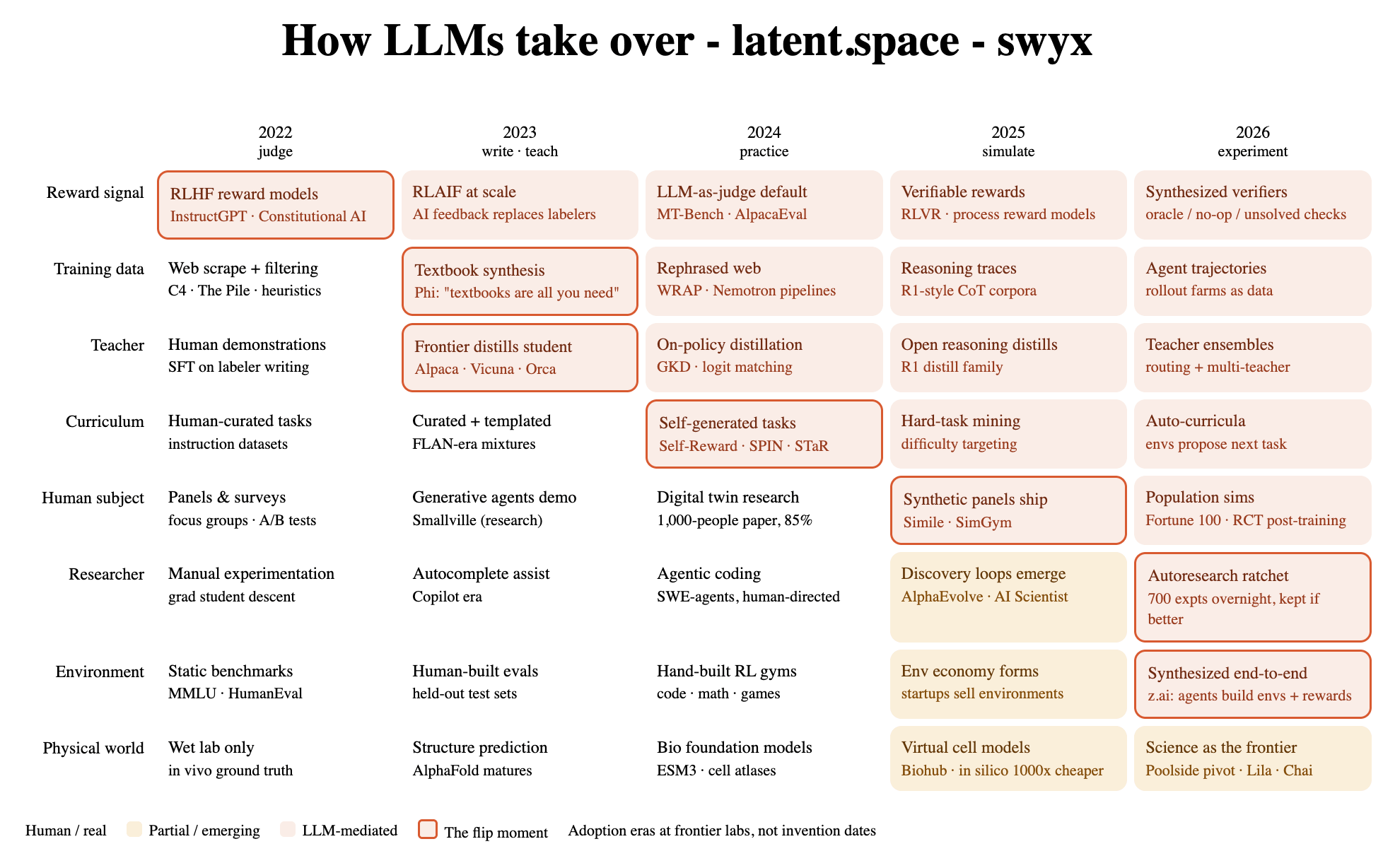
10% Worse, 100x Cheaper, 10000x Faster: Why Simulation is Redefining the Future of AI Development
The AI industry is witnessing a seismic shift as simulation begins to dominate the development landscape. According to recent insights from Latent Space, the move toward simulation is driven by a radical efficiency trade-off: accepting a 10% reduction in performance quality in exchange for processes that are 100x cheaper and 10000x faster. This transition highlights a significant evolution in Recursive Self-Improvement (RSI), which is no longer confined to the model training phase but is now being integrated into simulation environments. By prioritizing extreme speed and cost-effectiveness over marginal gains in accuracy, developers are unlocking new potentials for rapid iteration and scaling. This analysis explores the implications of these metrics and how the expansion of RSI beyond traditional training is fundamentally changing the trajectory of artificial intelligence research and deployment.
Key Takeaways
- The Efficiency Trade-off: Developers are increasingly accepting a 10% decrease in performance to achieve massive gains in speed and cost.
- Massive Scalability: Simulation-based approaches are proving to be 100x cheaper and 10000x faster than traditional methodologies.
- RSI Evolution: Recursive Self-Improvement (RSI) is expanding its reach, moving beyond the model training phase into the realm of simulation.
- Paradigm Shift: Simulation is "taking over" as the primary driver of AI progress, prioritizing iteration speed over absolute peak precision.
In-Depth Analysis
The Economics of the 10/100/10000 Rule
The current landscape of AI development is being reshaped by a specific set of metrics: 10% worse, 100x cheaper, and 10000x faster. This formula represents a strategic pivot in how AI systems are built and optimized. For years, the industry focus was on achieving the highest possible accuracy, often at the cost of exponential increases in compute and financial investment. However, the rise of simulation suggests that the value proposition has shifted.
A "10% worse" model or process might seem like a step backward, but when viewed through the lens of a "100x cheaper" cost structure, the economic logic becomes clear. Reducing costs by two orders of magnitude allows for the democratization of high-level AI development, enabling smaller teams or more frequent experiments that were previously cost-prohibitive. The most staggering figure, however, is the "10000x faster" metric. In the world of AI, speed is the ultimate currency. A process that is four orders of magnitude faster transforms the development cycle from months to minutes. This speed allows for a level of trial and error that makes the 10% quality gap negligible, as the system can iterate through thousands of versions to find the most effective path forward.
Beyond Training: The New Frontier of RSI
The question posed by Latent Space—"Did you think RSI stopped at model training?"—points to a fundamental change in the application of Recursive Self-Improvement. Traditionally, RSI has been understood as a mechanism where an AI model uses its own capabilities to improve its training data, architecture, or parameters. This has largely been a phenomenon of the training stage.
By suggesting that RSI is now moving into simulation, the industry is acknowledging that the environment in which AI operates is just as critical as the model itself. When RSI is applied to simulation, the AI isn't just learning a task; it is participating in the creation and refinement of the simulated worlds it inhabits. This creates a recursive loop where the simulation improves the model's performance, and the model's insights are used to make the simulation more accurate, faster, or more efficient. This expansion means that the self-improvement cycle is no longer a linear path during training but a continuous, multi-dimensional process that leverages the 10000x speed of simulated environments to accelerate progress at an unprecedented rate.
The Dominance of Simulation in AI Strategy
The assertion that simulation is "taking over" implies that the traditional reliance on real-world data and slow, expensive training runs is being superseded. Simulation provides a controlled, hyper-accelerated laboratory where the constraints of physics, time, and budget are significantly loosened. The 10/100/10000 trade-off is the engine driving this takeover.
In this new paradigm, the goal is no longer to build the perfect model in one go, but to build a system capable of simulating its own evolution. The 10% performance hit is a temporary state in a system that can improve itself 10000 times faster than its predecessors. This shift suggests that the future of AI will be defined by those who can most effectively harness simulated environments to run RSI loops, rather than those who simply have the most raw compute for traditional training. The focus is moving toward the infrastructure of simulation as the primary site of intelligence emergence.
Industry Impact
The significance of simulation taking over the AI industry cannot be overstated. By moving RSI beyond model training and into high-speed, low-cost simulations, the industry is effectively shortening the distance between hypothesis and realization. The 100x cost reduction lowers the barrier to entry, potentially leading to a surge in innovation from non-traditional players. Meanwhile, the 10000x speed increase suggests that the rate of AI advancement could move from a linear or even exponential curve to something much more vertical. This shift forces a re-evaluation of development priorities, where the ability to build and manage complex simulations becomes the most valuable skill set in the AI workforce. The industry is moving toward a future where the "best" AI is the one that can simulate and improve itself the fastest, not necessarily the one that starts with the highest accuracy.
Frequently Asked Questions
Question: What does it mean for a model to be "10% worse" in this context?
It refers to a marginal decrease in the initial quality or accuracy of the AI's output. This is a strategic trade-off made to gain massive advantages in the speed of iteration and the reduction of operational costs.
Question: Why is the 10000x speed increase so important for RSI?
Recursive Self-Improvement (RSI) relies on feedback loops. When these loops occur in a simulation that is 10000x faster than traditional training, the AI can complete thousands of cycles of self-improvement in the time it would normally take to complete one, drastically accelerating its evolution.
Question: Is RSI no longer used in model training?
RSI is still used in model training, but the key takeaway is that it is no longer limited to training. It is now being applied to the simulation phase, allowing for a more comprehensive and continuous self-improvement process across the entire AI development lifecycle.

