
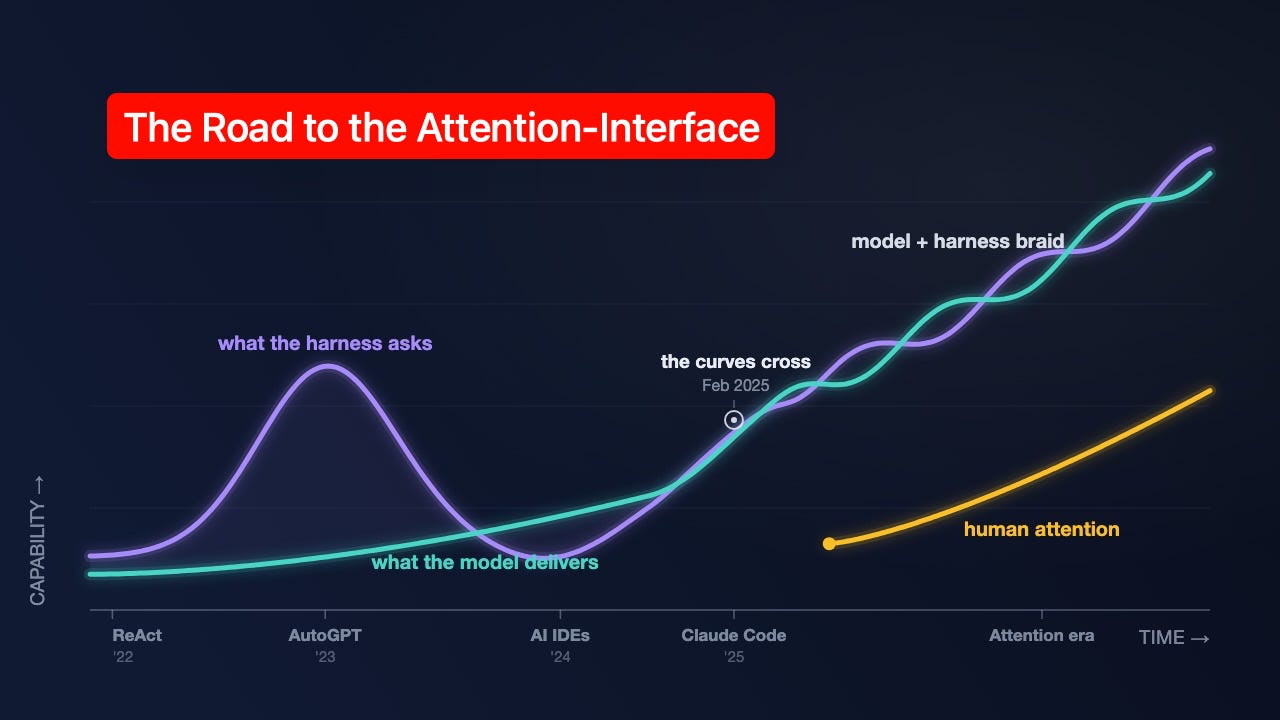
The Evolution of the Agent Harness: AI Models Absorbing Control Mechanisms into Weights
In a recent analysis by Dan McAteer for Latent Space, a significant shift in the architecture of AI agents is identified. The traditional 'harness'—the external scaffolding and control structures used to manage AI models—is increasingly being absorbed directly into the models' weights. This evolution suggests a future where the harness is no longer a tool for controlling the model's internal logic, but rather a mechanism for managing human attention. As models become more self-contained and inherently agentic through their training, the interface between humans and AI is expected to transform, shifting the focus from model guidance to the optimization of human interaction and attention within the AI ecosystem.
Key Takeaways
- Internalization of Control: AI models are progressively absorbing the external 'harness'—the scaffolding and constraints—directly into their internal weights.
- Shift in Purpose: The role of the harness is evolving from a model-control mechanism to a tool for managing human attention.
- Architectural Evolution: This transition represents a fundamental change in how AI agents are built, moving away from external prompting and toward inherent model capabilities.
- Human-Centric Focus: As models become more autonomous, the primary interface challenge shifts toward how these systems interact with and direct human focus.
In-Depth Analysis
The Absorption of the Harness into Model Weights
The concept of the "agent harness" has traditionally referred to the external frameworks, prompt engineering, and operational constraints that developers wrap around a Large Language Model (LLM) to make it function as an effective agent. According to the insights provided by Dan McAteer, we are witnessing a phase where these external structures are being "absorbed" into the model's weights.
This absorption implies that the behaviors previously forced upon a model through external scaffolding—such as tool use, step-by-step reasoning, or specific formatting—are becoming native to the model's internal parameters. As models are trained on more agentic data and refined through advanced fine-tuning processes, the need for an external harness to guide their basic operational logic diminishes. The model itself becomes the harness, possessing the inherent ability to navigate complex tasks without the need for extensive external intervention. This represents a move toward more streamlined, efficient, and robust AI systems where the boundary between the model and its operational framework is blurred.
From Model Control to Human Attention Management
As the model internalizes the mechanisms of its own control, the focus of the "harness" undergoes a radical transformation. The original news content suggests that soon, the harness will serve human attention rather than the model itself. This indicates a shift in the AI development paradigm: the primary challenge is no longer making the model follow instructions or use tools correctly, but rather managing how the human user interacts with the increasingly autonomous system.
In this new context, the "attention interface" becomes the critical layer. If the model is already capable of managing its own logic and execution through its weights, the remaining external structure must focus on the human element. This involves filtering information, presenting insights at the right time, and ensuring that the human's cognitive load is optimized. The harness becomes a bridge that directs human attention to the most relevant aspects of the AI's output or the task at hand, effectively acting as a curator for human focus in an era of automated intelligence.
Industry Impact
The evolution of the agent harness has profound implications for the AI industry. For developers, it suggests a shift away from building complex external "wrappers" and toward focusing on the data and training methods that allow models to internalize these capabilities. The value proposition of AI companies may move from providing the best "scaffolding" to providing the most sophisticated "attention interfaces."
Furthermore, this shift highlights the growing importance of the user experience (UX) in AI. As models become more self-sufficient, the competitive advantage will likely lie in how well a system can integrate into a human's workflow without being intrusive. The transition toward a harness for human attention suggests that the next frontier of AI development is not just about smarter models, but about more intuitive and attention-aware interfaces that respect and enhance human cognitive capacity.
Frequently Asked Questions
Question: What is an "agent harness" in the context of AI?
An agent harness refers to the external code, prompts, and frameworks used to control an AI model and enable it to perform tasks as an agent. It typically includes the logic for tool use, memory management, and task planning that exists outside the model's core weights.
Question: What does it mean for a model to "absorb the harness into its weights"?
This means that the capabilities and constraints previously managed by external code are being integrated into the model during the training or fine-tuning process. The model learns to perform these agentic functions natively, reducing the need for external scaffolding.
Question: Why is the harness shifting toward human attention?
As models become more autonomous and capable of managing their own tasks, the primary bottleneck becomes the human-AI interaction. The "harness" then evolves into an interface designed to manage and optimize how humans perceive and interact with the AI's work, focusing on attention rather than model control.

