AI News on August 6, 2026

Monolith Management Targets $500 Million Fund to Accelerate China's Artificial Intelligence Sector
Funding

Monolith Management Targets $500 Million Fund to Accelerate China's Artificial Intelligence Sector

Monolith Management, a venture capital firm recognized for its early backing of Moonshot AI, is reportedly seeking to raise $500 million for a new fund dedicated to the Chinese artificial intelligence market. This ambitious target follows a successful fundraising effort last year, where the firm secured $289 million for a previous investment vehicle. The move signals a significant scaling of Monolith's investment capacity and a continued focus on high-growth AI opportunities within China. By nearly doubling its previous fund size, Monolith underscores the growing capital requirements and investor appetite for the evolving AI landscape in the region.

Tech in Asia
Microsoft Reports $24.1 Billion in OpenAI-Linked Revenue, Dominating Over Half of Its AI Business
Industry News

Microsoft Reports $24.1 Billion in OpenAI-Linked Revenue, Dominating Over Half of Its AI Business

Microsoft has disclosed a significant financial milestone, reporting $24.1 billion in revenue directly linked to its partnership with OpenAI. This figure represents a pivotal shift in the company's financial structure, as OpenAI-related contributions now account for more than half of Microsoft's total AI-driven business for the period. The data underscores the immense commercial success of the Microsoft-OpenAI alliance and highlights the rapid enterprise adoption of generative AI technologies. As this partnership becomes the primary engine for Microsoft's AI growth, it sets a new benchmark for the industry regarding the monetization of advanced artificial intelligence models and the strategic value of deep-tech collaborations.

Tech in Asia
Indosat Ooredoo Hutchison Seeks $2 Billion Loan for Advanced Chip Procurement Following Fitch Investment-Grade Upgrade
Funding

Indosat Ooredoo Hutchison Seeks $2 Billion Loan for Advanced Chip Procurement Following Fitch Investment-Grade Upgrade

Indosat is reportedly seeking $2 billion in loan financing to fund the acquisition of advanced chips, marking a significant capital investment in its technological infrastructure. This financial move follows a key credit milestone in February 2025, when Fitch Ratings upgraded Indosat’s Long-Term Issuer Default Rating to an investment-grade BBB with a stable outlook. The pursuit of such a substantial loan indicates a strategic shift toward high-performance hardware, facilitated by the company's improved creditworthiness. The alignment between the 2025 rating upgrade and the 2026 loan seeking highlights a calculated approach to leveraging financial stability for large-scale technological advancement in the semiconductor space.

Tech in Asia
The Paradox of Typography: Analyzing the Emotional Impact of Fixed-Width Fonts and Blade Runner Title Cards
Industry News

The Paradox of Typography: Analyzing the Emotional Impact of Fixed-Width Fonts and Blade Runner Title Cards

This analysis explores the intricate relationship between functional design and emotional resonance in typography, as discussed in the context of developer environments and cinematic history. The article examines the 'typography paradox'—the idea that while well-designed type should be invisible to the reader, it inevitably conveys a specific 'feeling.' By looking at the author's experience using Claude Code within the Ghostty terminal on macOS, the piece highlights the importance of fixed-width typefaces like Apple's SF Mono. It further bridges the gap between technical utility and artistic expression by referencing the iconic title cards of Blade Runner, suggesting that even in data-heavy or structural environments, the visual form of letters builds a personal and emotional impression that transcends mere information delivery.

Hacker News
NVIDIA Vera Whitepaper Analysis: Examining the Olympus Core Architecture and Marketing Claims Against x86 Standards
Industry News

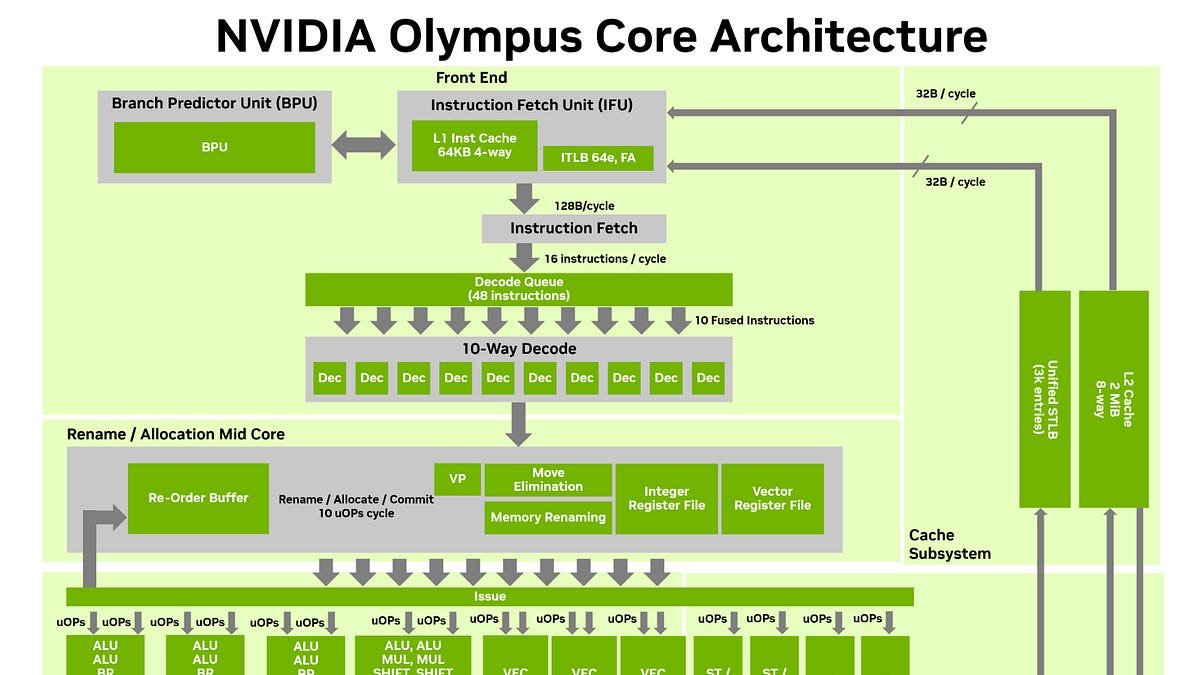
NVIDIA Vera Whitepaper Analysis: Examining the Olympus Core Architecture and Marketing Claims Against x86 Standards

NVIDIA has released a detailed 45-page whitepaper for Vera, its inaugural server CPU powered by the custom-designed Olympus core. The technical specifications reveal a formidable 88-core monolithic compute die utilizing the Arm v9.2 architecture, featuring a 10-wide decode front end, value prediction, and a substantial cache hierarchy. Despite the impressive hardware—which includes a 1.2 TB/s memory interface and a 3.4 TB/s coherency fabric—the whitepaper has drawn criticism for its marketing narrative. Analysts point out that NVIDIA's documentation mischaracterizes established x86 technologies, such as simultaneous multithreading and NUMA topologies, while employing unconventional metrics like "agentic benchmarks." This analysis explores the tension between Vera's genuine architectural innovations and the controversial storytelling used to promote it.

Hacker News
Meta Unveils Muse Code: A New AI Agent Designed to Manage and Navigate Large-Scale Software Codebases
Product Launch

Meta Unveils Muse Code: A New AI Agent Designed to Manage and Navigate Large-Scale Software Codebases

Meta has officially expanded its portfolio of artificial intelligence tools for developers with the launch of Muse Code, a specialized AI agent engineered for large-scale codebases. According to the announcement, this new agent is designed to handle complex tasks within sophisticated software environments, marking a significant step forward in Meta's AI coding offerings. Muse Code aims to address the inherent difficulties of working with massive and intricate software systems, promising a level of capability that can manage high-level complexity. This launch underscores Meta's commitment to evolving its AI ecosystem, moving beyond basic coding assistants toward more autonomous agents capable of navigating the nuances of enterprise-level software development. The introduction of Muse Code represents a strategic move to empower developers dealing with the scale and density of modern software architectures.

TechCrunch AI
Klaviyo Acquires Agency as Serial Entrepreneur Elias Torres Joins as CPO to Lead AI Agent Development
Industry News

Klaviyo Acquires Agency as Serial Entrepreneur Elias Torres Joins as CPO to Lead AI Agent Development

Klaviyo has announced the acquisition of Agency, a startup founded by serial entrepreneur Elias Torres. This move marks a significant "full-circle reunion" for the tech founders involved. As part of the acquisition, Torres will join Klaviyo’s executive leadership team as the Chief Product Officer (CPO). In his new role, Torres is tasked with leading the company's initiatives regarding AI agents, signaling Klaviyo's strategic focus on integrating advanced artificial intelligence into its e-commerce solutions. The acquisition highlights a pivotal moment for the company as it seeks to leverage Torres's entrepreneurial expertise to drive innovation in AI-driven automation within the digital commerce landscape.

TechCrunch AI
Jeff Dean and Senior Google Researchers Depart to Launch AI Startup Focused on Scientific Discovery
Industry News

Jeff Dean and Senior Google Researchers Depart to Launch AI Startup Focused on Scientific Discovery

In a significant shift for the technology sector, legendary Google executive Jeff Dean has announced his departure from the company. He is not leaving alone; a group of other high-level Google executives is joining him in a new entrepreneurial venture. The primary objective of this startup is to utilize artificial intelligence as a catalyst for scientific discovery. This move represents a major transition of top-tier talent from an established tech giant to a focused startup environment. By centering their mission on the advancement of science through AI, Dean and his colleagues aim to redefine how research and discovery are conducted. The departure of such a prominent figure marks a pivotal moment for Google and the broader AI industry, highlighting a growing trend of veteran researchers seeking to apply AI to specialized, high-impact fields.

TechCrunch AI
Zed DeltaDB: Transforming Version Control with Real-Time Agent Integration and Granular History
Product Launch

Zed DeltaDB: Transforming Version Control with Real-Time Agent Integration and Granular History

Zed has unveiled DeltaDB, an early-access version control system designed to capture the nuances of software development that occur between traditional commits. Unlike standard systems, DeltaDB records every operation as it unfolds, assigning a stable identity to each change. This allows developers to rewind to any specific edit in the code's evolution. A standout feature is its deep integration with AI agents, where every code change is bi-directionally linked to the conversation that generated it. By virtualizing the worktree, DeltaDB enables instantaneous branching at any point in history and fosters a collaborative environment where teammates can join ongoing tasks, interact with agents, and annotate code in real-time. This shift moves the focus from static Pull Requests to dynamic, shared development threads within the Zed editor.

Hacker News
Castform and Neon Outperform GPT-5.6 Sol in Retrieval Accuracy at 100x Lower Cost
Industry News

Castform and Neon Outperform GPT-5.6 Sol in Retrieval Accuracy at 100x Lower Cost

A breakthrough collaboration between Castform and Neon has demonstrated that a 4B open-source model, post-trained with Reinforcement Learning (RL), can match the retrieval accuracy of frontier models like GPT-5.6 Sol. This approach addresses the primary challenges of modern AI agents: providing the right context and enabling intelligent search decisions. By leveraging Neon’s Lakebase Postgres and Castform’s specialized post-training, the solution achieves a 100x cost reduction compared to frontier models. While multi-turn search requests using GPT-5.6 Sol typically cost $0.03 and take over 10 seconds, the Castform-Neon synergy offers a significantly more efficient and scalable alternative for agentic retrieval, marking a shift from traditional RAG pipelines to complex, multi-hop search workflows.

Hacker News
Uber CEO Dara Khosrowshahi Reaffirms Strong Waymo Partnership Amid Speculation Over Phoenix Collaboration Exit
Industry News

Uber CEO Dara Khosrowshahi Reaffirms Strong Waymo Partnership Amid Speculation Over Phoenix Collaboration Exit

Uber CEO Dara Khosrowshahi has officially dismissed reports suggesting a "break-up" between Uber and the autonomous driving company Waymo. Despite the conclusion of their partnership in Phoenix earlier this year—a move that sparked industry-wide speculation regarding the future of their collaboration—Khosrowshahi maintains that the relationship remains "very strong." Speaking during a recent update, the CEO emphasized that the two companies are fully committed to continuing their joint efforts in other major markets, specifically Atlanta and Austin. This clarification aims to reassure stakeholders and industry watchers that the strategic alliance between the ride-sharing platform and the robotaxi leader continues to be a core component of their operational strategy in the autonomous vehicle sector.

The Verge
MiniMax H3: The Emergence of Omni-Modal Video and Audio Generation Technology
Product Launch

MiniMax H3: The Emergence of Omni-Modal Video and Audio Generation Technology

The AI industry has seen the introduction of MiniMax H3, a new model highlighted for its capabilities as an omni-modal video and audio generator. Unlike traditional models that often focus on a single medium, MiniMax H3 is designed to bridge the gap between visual and auditory synthesis. This development marks a significant step in the evolution of generative AI, moving toward 'omni-modal' systems that can handle multiple forms of media simultaneously. The announcement positions MiniMax H3 as a key highlight in the current landscape of AI models, emphasizing a unified approach to content creation where video and audio are generated in tandem rather than as separate, disconnected processes.

AIModels.fyi
Fenix Flexin’s 'Rubberz' Linked to AI Music Generator Treblo Following New Detection Tool Release
Industry News

Fenix Flexin’s 'Rubberz' Linked to AI Music Generator Treblo Following New Detection Tool Release

The music industry is buzzing with the revelation that rapper Fenix Flexin likely utilized the AI music generator Treblo to create his track "Rubberz." While initial suspicions were voiced by the community and specifically highlighted by musician Medasin, the confirmation comes alongside a significant technological milestone: the release of the Treblo AI Music Classifier. This open-source tool, launched by Treblo, is designed to detect when a song has been generated using artificial intelligence. The intersection of Fenix Flexin's creative output and Treblo's new detection capabilities marks a pivotal moment in the transparency of AI-assisted music production, highlighting the growing tension between synthetic creation and traditional artistry in the modern digital landscape.

The Verge
Google Announces Major AI Leadership Shakeup: Demis Hassabis Appointed Alphabet Chief Scientist and DeepMind Chair
Industry News

Google Announces Major AI Leadership Shakeup: Demis Hassabis Appointed Alphabet Chief Scientist and DeepMind Chair

Google has officially announced a significant restructuring of its artificial intelligence leadership, marking a pivotal shift for the company's strategic direction. Demis Hassabis, the prominent leader of Google DeepMind, has been appointed as the Chair of Google DeepMind and the Chief Scientist at Alphabet, the parent company of Google. This dual appointment, announced by CEO Sundar Pichai, places Hassabis at the helm of Alphabet's broader scientific vision while maintaining his influence over the DeepMind division. Furthermore, Hassabis will continue his work as the leader of Isomorphic Labs, an Alphabet venture dedicated to leveraging AI for drug discovery. This leadership transition signals a consolidation of AI expertise at the highest levels of Alphabet's corporate structure.

The Verge
SpaceX Financial Shift: How xAI Acquisition and Compute Rentals are Redefining the Aerospace Giant
Industry News

SpaceX Financial Shift: How xAI Acquisition and Compute Rentals are Redefining the Aerospace Giant

A recent analysis of SpaceX's first quarterly earnings statement reveals a significant transformation in the company's core business model. Despite its reputation as a premier aerospace entity, the data suggests that SpaceX is increasingly operating as a telecommunications provider and a compute-rental service. This shift is largely attributed to the acquisition of xAI, a move that integrated Elon Musk's struggling AI venture into his most successful company. The earnings report highlights a pivot where revenue is now primarily driven by telecom services and the leasing of computational power rather than traditional space exploration. This evolution raises critical questions regarding the company's identity and its future trajectory as it balances high-stakes aerospace missions with the demands of the burgeoning AI and data infrastructure markets.

The Verge
Industry News

Discovery Loop Launches AI-Driven Platform to Automate Scientific Discovery and Solve Engineering Grand Challenges

Discovery Loop has announced a transformative approach to scientific and engineering research by automating the traditional experimental loop. Recognizing that manual, sequential iterations—proposing, implementing, running, and examining experiments—create a significant bottleneck in progress, the company is leveraging frontier AI models and large-scale computational infrastructure to streamline these processes. By executing thousands of experiments in parallel, Discovery Loop aims to drastically compress iteration times and enhance the quality of scientific output. The company will initially focus on automating machine learning research and engineering, using its own technology to optimize its internal stack before expanding to address National Academy of Engineering (NAE) Grand Challenges. These goals include advancing health informatics, engineering better medicines, making solar energy economical, and securing cyberspace, marking a major shift toward AI-led discovery.

Hacker News
Google DeepMind Leadership Shift: Demis Hassabis Named Alphabet Chief Scientist as Jeff Dean Departs
Industry News

Google DeepMind Leadership Shift: Demis Hassabis Named Alphabet Chief Scientist as Jeff Dean Departs

Google and Alphabet CEO Sundar Pichai has announced a significant leadership restructuring within Google DeepMind to accelerate the company’s AI momentum. Demis Hassabis, the long-time CEO of Google DeepMind, is transitioning to the roles of Chair of Google DeepMind and Chief Scientist of Alphabet. This shift is designed to allow Hassabis to focus on the future of Artificial General Intelligence (AGI) and science, which Pichai describes as vital to Alphabet and humanity. The announcement also confirms the departure of Jeff Dean and a new role for Koray Kavukcuoglu. Amidst these changes, Google reports massive growth for its AI ecosystem, with the Gemini app surpassing 950 million monthly users and continued breakthroughs in Gemini Robotics.

Hacker News
Reddit Introduces LLM-Powered AI Moderation Tools to Assist Subreddit Communities and Enhance Content Management
Industry News

Reddit Introduces LLM-Powered AI Moderation Tools to Assist Subreddit Communities and Enhance Content Management

Reddit has announced the introduction of a new suite of automated moderation tools powered by Large Language Models (LLMs). Initially targeting new subreddits before a planned site-wide rollout later this year, these tools are designed to assist human moderators in managing their communities more effectively. By leveraging advanced AI, Reddit aims to streamline the enforcement of rules and improve the overall user experience. The company is currently expanding access to these tools to a broader group of users as part of a phased deployment strategy. This move represents a significant shift in how the platform handles content governance, moving toward a hybrid model that combines human oversight with machine learning capabilities to address the growing complexities of online community management while supporting the platform's volunteer moderator base.

The Verge