NVIDIA Vera Whitepaper Analysis: Examining the Olympus Core Architecture and Marketing Claims Against x86 Standards
NVIDIA has released a detailed 45-page whitepaper for Vera, its inaugural server CPU powered by the custom-designed Olympus core. The technical specifications reveal a formidable 88-core monolithic compute die utilizing the Arm v9.2 architecture, featuring a 10-wide decode front end, value prediction, and a substantial cache hierarchy. Despite the impressive hardware—which includes a 1.2 TB/s memory interface and a 3.4 TB/s coherency fabric—the whitepaper has drawn criticism for its marketing narrative. Analysts point out that NVIDIA's documentation mischaracterizes established x86 technologies, such as simultaneous multithreading and NUMA topologies, while employing unconventional metrics like "agentic benchmarks." This analysis explores the tension between Vera's genuine architectural innovations and the controversial storytelling used to promote it.
Key Takeaways
- High-Performance Architecture: Vera features the Olympus core, a 10-wide Arm v9.2 design with 88 cores on a monolithic compute die.
- Advanced Memory and Cache: The chip integrates eight LPDDR5X memory interfaces providing 1.2 TB/s bandwidth, supported by a 164 MB shared last-level cache and 2 MB of private L2 per core.
- Unique Hardware Features: Olympus introduces value prediction and a graph prefetcher, alongside a 3.4 TB/s coherency fabric.
- Marketing Controversy: The official whitepaper is criticized for misrepresenting x86 technologies (SMT and NUMA) and using undefined performance metrics to frame its competitive narrative.
- Formidable Performance Potential: Early independent testing suggests the hardware is highly capable, potentially rendering the aggressive marketing tactics unnecessary.
In-Depth Analysis
The Architectural Strength of the Olympus Core
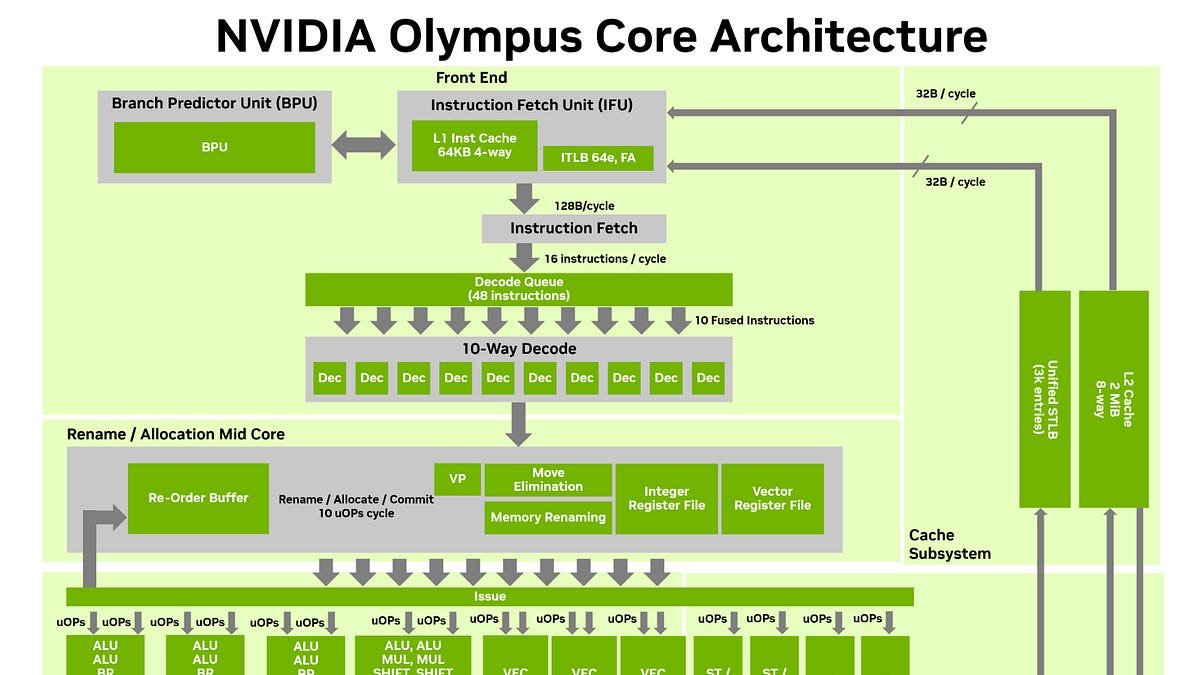
NVIDIA's Vera represents a significant milestone as the company's first server CPU built around the proprietary Olympus core. The architecture is built on the Arm v9.2 instruction set and is designed for extreme width and throughput. The front end of the Olympus core is particularly notable, capable of decoding ten instructions per cycle and handling up to two taken branches per cycle. This 10-wide out-of-order design is supported by a neural branch predictor and a large instruction window, indicating a focus on maximizing instruction-level parallelism.
Beyond the front end, the execution engine is robust, featuring six 128-bit SVE (Scalable Vector Extension) pipes, four load pipes, and two store pipes. One of the most distinctive additions to the Olympus core is value prediction, a feature rarely seen in commercial server CPUs, which aims to reduce data dependency bottlenecks. The memory subsystem is equally aggressive, with a 96 KB L1 data cache and a 2 MB private L2 cache per core offering approximately 10-cycle access latency. These 88 cores are interconnected via a 3.4 TB/s coherency fabric, ensuring high-speed communication across the monolithic die.
The Disconnect Between Hardware and Marketing Narrative
While the hardware specifications of Vera are technically impressive, the accompanying 45-page whitepaper has come under scrutiny for its rhetorical approach toward competing x86 architectures. The documentation attempts to frame NVIDIA's design choices through a "morality play" that may obscure technical reality. For instance, traditional simultaneous multithreading (SMT), a staple of x86 performance, is characterized in the paper as mere "time-slicing." Furthermore, the whitepaper presents configurable NUMA (Non-Uniform Memory Access) topologies—often used for flexibility in server environments—as an "unavoidable 32-node maze."
This narrative extension reaches into benchmarking as well. The paper introduces the term "agentic benchmarks" to describe four specific SPEC components, a move that critics argue lacks standard industry definition. Additionally, the whitepaper relies on undefined performance-counter ratios as causal proof of superiority and utilizes unlabeled pictograms to claim a 1.8x reinforcement-learning result. The technical community suggests that these marketing strategies are frustrating because the Olympus core appears to be a genuinely formidable product that does not require such embellishment to prove its value.
Industry Impact
The introduction of Vera and the Olympus core signals NVIDIA's intent to become a primary contender in the high-performance server CPU market, moving beyond its dominance in GPUs. By delivering 1.2 TB/s of memory bandwidth via LPDDR5X and a massive 164 MB system-level cache, NVIDIA is targeting data center workloads that are increasingly bottlenecked by memory access rather than raw compute.
However, the controversy surrounding the whitepaper highlights a growing tension in the industry between transparent technical documentation and aggressive competitive positioning. As NVIDIA moves deeper into the CPU space, its ability to provide clear, verifiable data will be crucial for gaining the trust of enterprise architects. Despite the marketing "loose threads," the sheer scale of the 88-core monolithic design and the inclusion of advanced features like value prediction suggest that NVIDIA is pushing the boundaries of what is possible with the Arm architecture in the data center.
Frequently Asked Questions
Question: What are the primary technical specifications of the NVIDIA Vera CPU?
Answer: Vera is an 88-core monolithic server CPU featuring the Olympus core (Arm v9.2). It includes a 10-wide decode front end, 2 MB of private L2 cache per core, a 164 MB shared last-level cache, and a 3.4 TB/s coherency fabric. It supports eight LPDDR5X memory interfaces, delivering 1.2 TB/s of bandwidth.
Question: Why is the NVIDIA Vera whitepaper being criticized?
Answer: Critics argue that the whitepaper misrepresents standard industry technologies to favor NVIDIA's design. Specifically, it portrays x86 SMT as simple time-slicing and NUMA as an overly complex maze. It also uses non-standard terms like "agentic benchmarks" and provides performance claims based on unlabeled data and undefined ratios.
Question: What is "value prediction" in the context of the Olympus core?
Answer: Value prediction is a unique hardware feature in the Olympus core designed to predict the results of instructions before they are actually executed. This allows the processor to bypass certain data dependencies and improve execution speed, making it one of the more innovative aspects of NVIDIA's new CPU architecture.