Solid
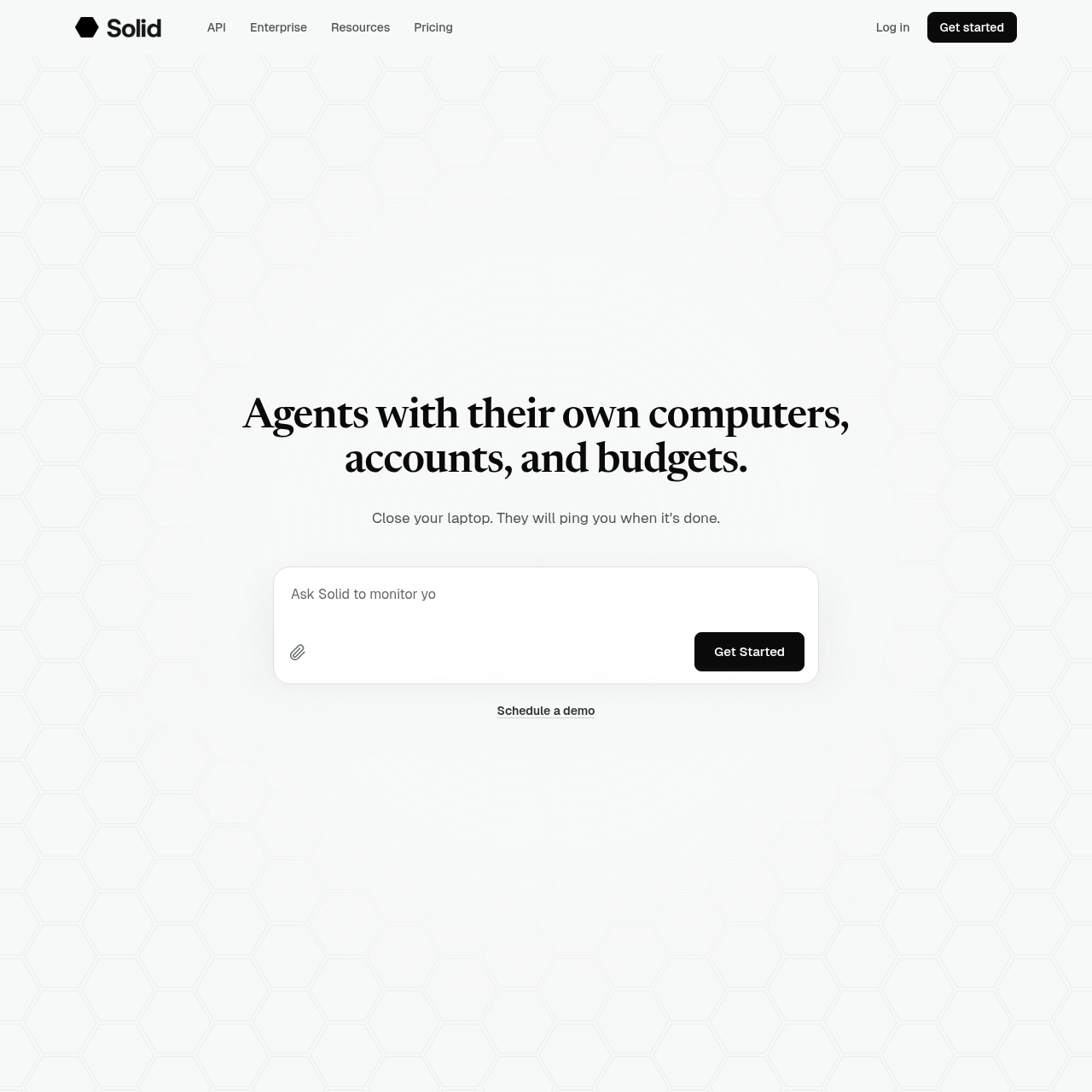
Solid provides autonomous AI agents equipped with their own operating environments, accounts, and budgets to execute long-running digital tasks without requiring prebuilt connectors.
What the product does and how it is positioned
Solid develops autonomous digital agents capable of carrying out complex operational workflows from plain-language instructions. Rather than depending on pre-engineered API integrations, the system equips agents with dedicated desktop and mobile operating systems, Google and Apple accounts, and discretionary spending limits to interact with software like human operators.
The platform features self-healing capabilities to diagnose and resolve execution bottlenecks, learns from user corrections over time, and can spawn auxiliary agents to scale workloads. Teams can access agents directly, deploy them within enterprise environments such as private VPCs, or integrate them into products using the Solid API.
Source-supported ways to use the product
Agents analyze meeting notes, map prospective buyer workflows, assemble prototypes with sample data, and provide hosted review links.
Agents navigate platforms like LinkedIn to discover prospects, extract relevant contact data, and update sales databases.
Agents analyze reported production bugs, execute evaluation suites on AI products, and test fixes across connected environments.
The documented workflow, where available
The user outlines project requirements, ground rules, and spending boundaries through text instructions or attached documents.
Agents select suitable tools, set up required software across their operating systems, and register accounts without prebuilt connectors.
Agents carry out the planned steps, coordinate sub-agents when necessary, and autonomously diagnose and fix runtime errors.
Agents verify the resulting data or application and ping the user with completion details, hosted links, or test reports.
Solid equips each agent with distinct execution environments, encompassing Windows, macOS, Linux, iOS, and Android. By operating native device instances alongside Google and Apple user accounts, agents interact directly with graphical interfaces and web services, bypassing the constraints of purpose-built API connectors.
To complete workflows without constant supervision, the platform implements autonomous error recovery and coordination mechanisms. When an operation breaks, agents investigate the failure, test a fix, and store the successful strategy for subsequent runs, escalating to human operators only when progress is fully blocked.
Checks to run with your own material and workflow
What was checked and when
Answers based on the source-checked product record
Solid agents run on their own Windows, macOS, Linux, iOS, or Android environments and use Google or Apple accounts to set up and interact with tools directly.
The agent investigates the failure, attempts an automated repair, verifies that the task runs again, and notifies the user with details if progress remains blocked.
Agents can sign up for tools and make purchases, provided those actions strictly adhere to the budget limits and approval rules configured by the user.
Solid can run as a managed service on Solid Cloud, directly inside a customer's virtual private cloud (VPC), or in on-premises infrastructure depending on the setup.
Yes, Solid agents can coordinate multiple sub-agents or bring in external agents such as Codex and Claude Code to distribute tasks and deliver a single verified outcome.