Rezonant
Rezonant: The AI-Powered Product Workspace for Transforming Ideas into Shippable Work
Rezonant is a comprehensive product workspace designed for product teams to bridge the gap between messy inspiration and execution. By syncing with your product stack—including Jira, Linear, and GitHub—Rezonant helps you shape ideas, generate structured tickets, and utilize an autonomous coding agent for implementation. It acts as an AI thinking partner that understands your strategy, refines concepts, and automates task creation to accelerate your development lifecycle.
2026-05-29
3.0K
Rezonant Product Information
Rezonant: The Ultimate Product Workspace for Shaping and Shipping Big Ideas
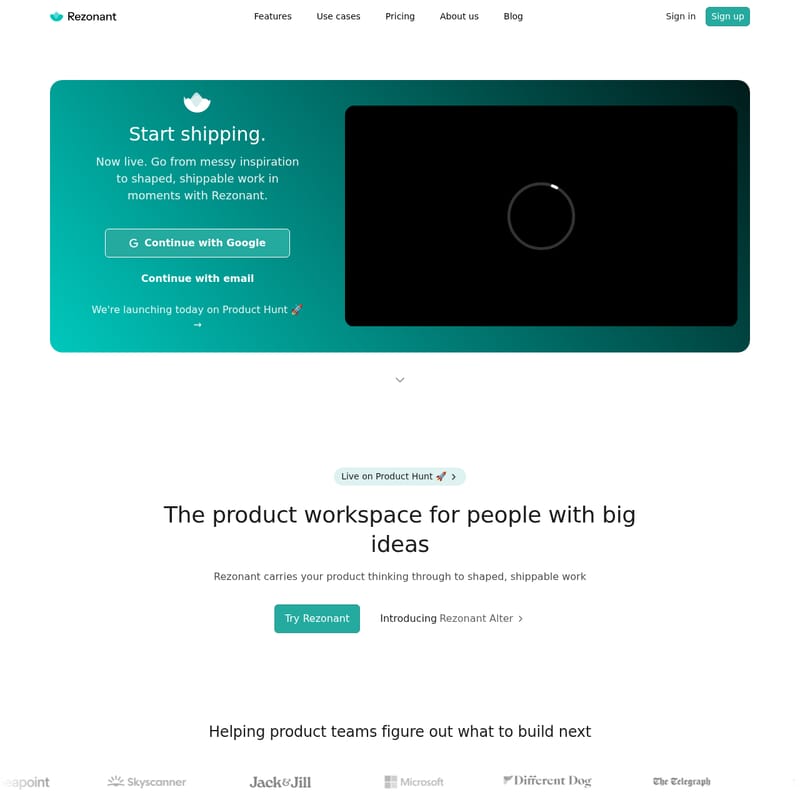
In the fast-paced world of software development, the journey from a visionary idea to a functional feature is often cluttered with manual overhead, fragmented documentation, and lost context. Rezonant emerges as the premier product workspace specifically designed for people with big ideas, providing a seamless bridge between high-level inspiration and shaped, shippable work.
By serving as a sophisticated thinking partner, Rezonant ensures that your product strategy is never lost in translation. Whether you are managing a SaaS product, tackling tech debt, or optimizing complex onboarding flows, Rezonant carries your product thinking through every stage of the lifecycle.
What is Rezonant?
Rezonant is an AI-integrated product workspace that transforms the way product teams operate. It is designed to take you from "messy inspiration" to organized, actionable tasks in moments. Unlike traditional project management tools that act as static repositories, Rezonant is a dynamic environment that understands your product's architecture, your company's strategy, and your team's existing workflow.
At its core, Rezonant acts as a collaborative partner. It doesn't just store information; it refines half-baked ideas, challenges your assumptions, and ensures that every piece of work produced is aligned with your overarching product vision. With the introduction of Rezonant Alter, teams can now leverage AI to figure out exactly what to build next based on real-time data from their existing product stack.
Key Features of Rezonant
Rezonant is packed with features that empower product teams to move faster without sacrificing quality. Here are the core capabilities that define this innovative product workspace:
Rezonant Alter
Rezonant Alter is the intelligence engine of the platform. It is specifically built to help product teams navigate the complexity of product roadmapping. By analyzing your current goals and existing codebase, Rezonant Alter helps you determine the most impactful features or fixes to prioritize next.
Seamless Product Stack Integration
One of the strongest advantages of Rezonant is its ability to stay connected to your product stack. It offers deep synchronization with the tools your team already uses, including:
- Jira
- Linear
- Document Repositories
- Code Repositories (GitHub, etc.)
By syncing with these tools, Rezonant can provide answers and create artifacts based on your real product data, ensuring that every ticket generated is grounded in technical reality.
Automatic Task and Ticket Generation
Rezonant eliminates the tedious manual work of ticket writing. The platform provides automatic task generation, creating structured tickets that include complete context. These tasks are ready for coding agents or can be pushed directly to Jira or Linear. This ensures that developers have everything they need to begin implementation without back-and-forth clarification.
Advanced Coding Agent
For teams looking to accelerate their build phase, Rezonant features a dedicated coding agent. Users can send tickets directly to this agent, which can explore your codebase and begin implementation within a secure, isolated environment. This feature turns Rezonant from a planning tool into a powerful execution engine.
AI Thinking Partner
Rezonant functions as a thinking partner that truly "gets" your product. It can help you:
- Create tasks from vague ideas.
- Understand a flow within your existing application.
- Validate a PRD (Product Requirements Document).
- Troubleshoot complex user experience issues.
Use Cases for Rezonant
Rezonant is versatile enough to handle a wide range of product management challenges. Here are a few ways teams are currently using the platform:
1. Optimizing User Onboarding
If users are dropping off at a specific stage—such as a "connect" screen—Rezonant can analyze the issue. For instance, in an onboarding flow requiring integration with Jira or GitHub, Rezonant can suggest improvements like:
- Designing clearer UI guidance.
- Implementing telemetry for better tracking.
- Standardizing OAuth error handling.
- Adding "skip" options to reduce friction.
2. Managing Tech Debt
Teams use Rezonant to identify and categorize technical debt. By connecting to your repository, Rezonant can help create a structured plan to address legacy code while balancing new feature development.
3. Rapid Feature Refinement
When a new idea strikes, you can use Rezonant to quickly "refine" the concept. The AI will prompt you with questions regarding scope, such as whether optional onboarding steps should count toward completion progress, and then generate the necessary UI, logic, and analytics tickets instantly.
How to Use Rezonant
Getting started with Rezonant is straightforward, designed to move you into productive work as quickly as possible.
- Connect Your Stack: Begin by syncing Rezonant with your Jira, Linear, or code repositories. This allows the AI to understand your real product environment.
- Input Your Inspiration: Whether it is a messy note or a structured idea, enter it into the workspace. You can use the prompt to "Validate an idea," "Create a ticket," or "Ask a question."
- Refine with Alter: Use Rezonant Alter to challenge the thinking. The AI will provide feedback and help you shape the scope of the project.
- Generate and Group Tickets: Once the scope is clear, Rezonant will generate structured tickets (e.g., REZ-01, REZ-02). You can group these into a new project or publish them without a project.
- Ship to Development: Push your tickets directly to Jira or Linear, or send them to the Rezonant coding agent to begin the implementation process.
Frequently Asked Questions (FAQ)
Q: Does Rezonant replace Jira or Linear? A: No, Rezonant integrates with them. It acts as the "shaping" layer where ideas are refined and tickets are perfectly formatted before being pushed to your existing project management tools.
Q: How does the coding agent access my codebase? A: The coding agent explores your codebase in a secure, isolated environment. It is designed to assist with implementation by understanding the existing architecture of your product stack.
Q: Can Rezonant help with troubleshooting existing UX issues? A: Yes. As seen in our onboarding use case, Rezonant can provide structured playbooks to identify why users are dropping off, suggesting everything from copy changes to technical friction fixes.
Q: Is there a free version available? A: You can start shipping by trying Rezonant for free. This allows you to experience the power of the AI thinking partner before committing your entire team.
Q: What platforms does Rezonant support for integration? A: Rezonant currently supports major product stack tools including Jira, Linear, GitHub, and various document repositories.