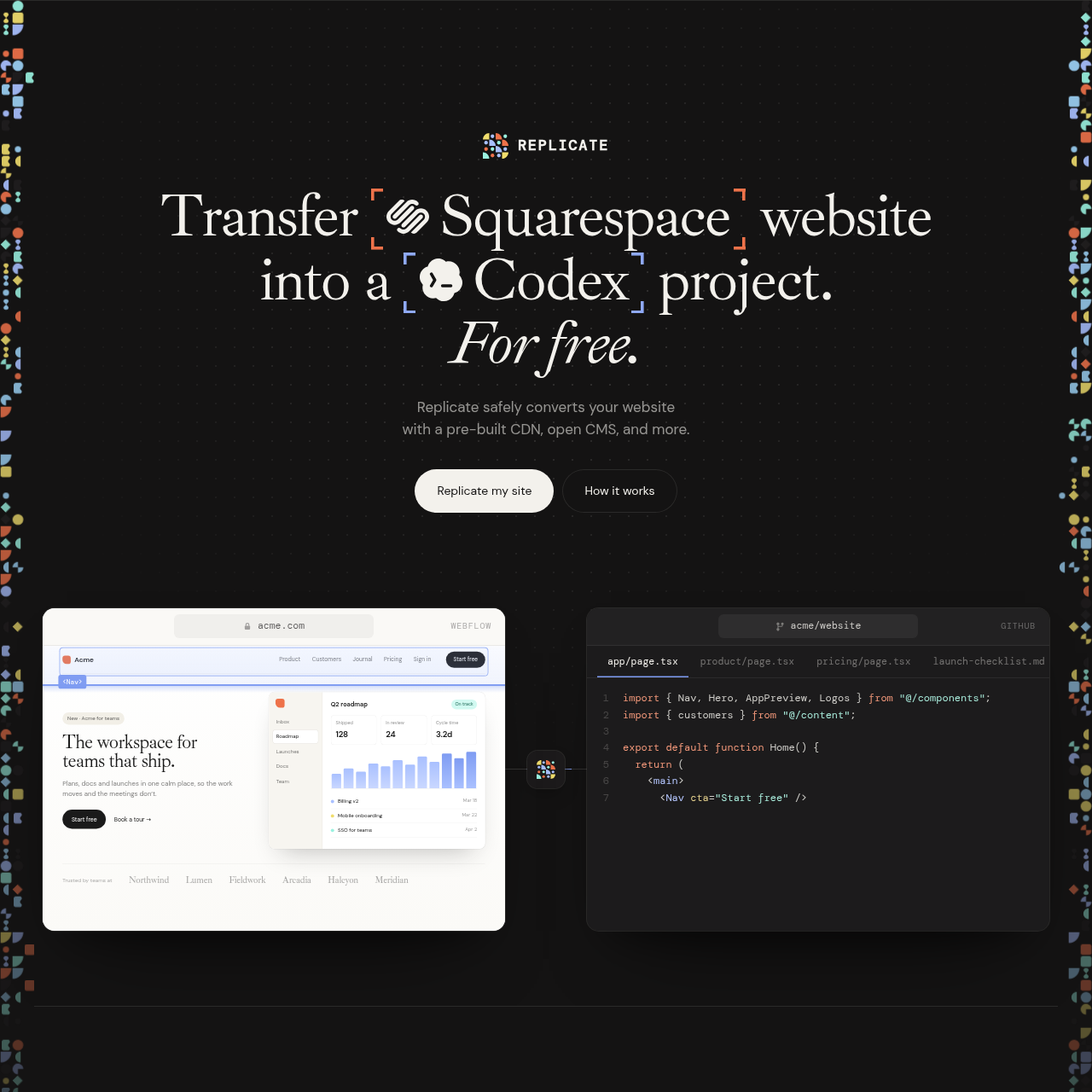
Replicate is an automated migration service designed to transfer websites from proprietary builders into code repositories compatible with developer tools like Claude Code and Codex.
Code & ITAutonomous migration pipelineVisual comparison and verificationRebuilding of animation codeAutonomous Website Conversion
Listed on AIToolly
What Is Replicate? Product Overview
What the product does and how it is positioned
Replicate serves as an automated bridge between visual website builders and modern development workflows by converting live sites into standard code projects.
The service systematically processes website content, including images and blog posts, and utilizes current frameworks such as Next.js or Astro to reconstruct site architecture.
What Can You Use Replicate For?
Source-supported ways to use the product
Transitioning to Code-First Development
Enables the transfer of websites from proprietary builders into GitHub repositories for use in developer environments.
Content and Asset Migration
Automates the conversion of blog content into Markdown or JSON and manages image assets via an open CDN.
How to Use Replicate
The documented workflow, where available
1
Capture
Every page of the live site is read at desktop and phone widths to gather content.
2
Compile
The builder runtime is removed; shared chrome becomes components and repeated pages are converted to Markdown.
3
Compare
Each page is built and checked pixel by pixel against the original site until a match is confirmed.
4
Commit
The resulting codebase is committed to a GitHub repository, prepared for development tools.
The Migration Pipeline
Replicate utilizes an autonomous pipeline to transform websites from proprietary builders into accessible code structures. This process involves capturing live site data, compiling content into reusable formats, and verifying the output against the original visuals.
Removes proprietary builder runtimes during the compilation process.
Converts shared page elements into components and transforms repeated pages into Markdown.
What to Test Before Choosing Replicate
Checks to run with your own material and workflow
Verify that the migrated codebase correctly represents the original site architecture.
Ensure pixel-perfect matching is achieved through the automated comparison process.