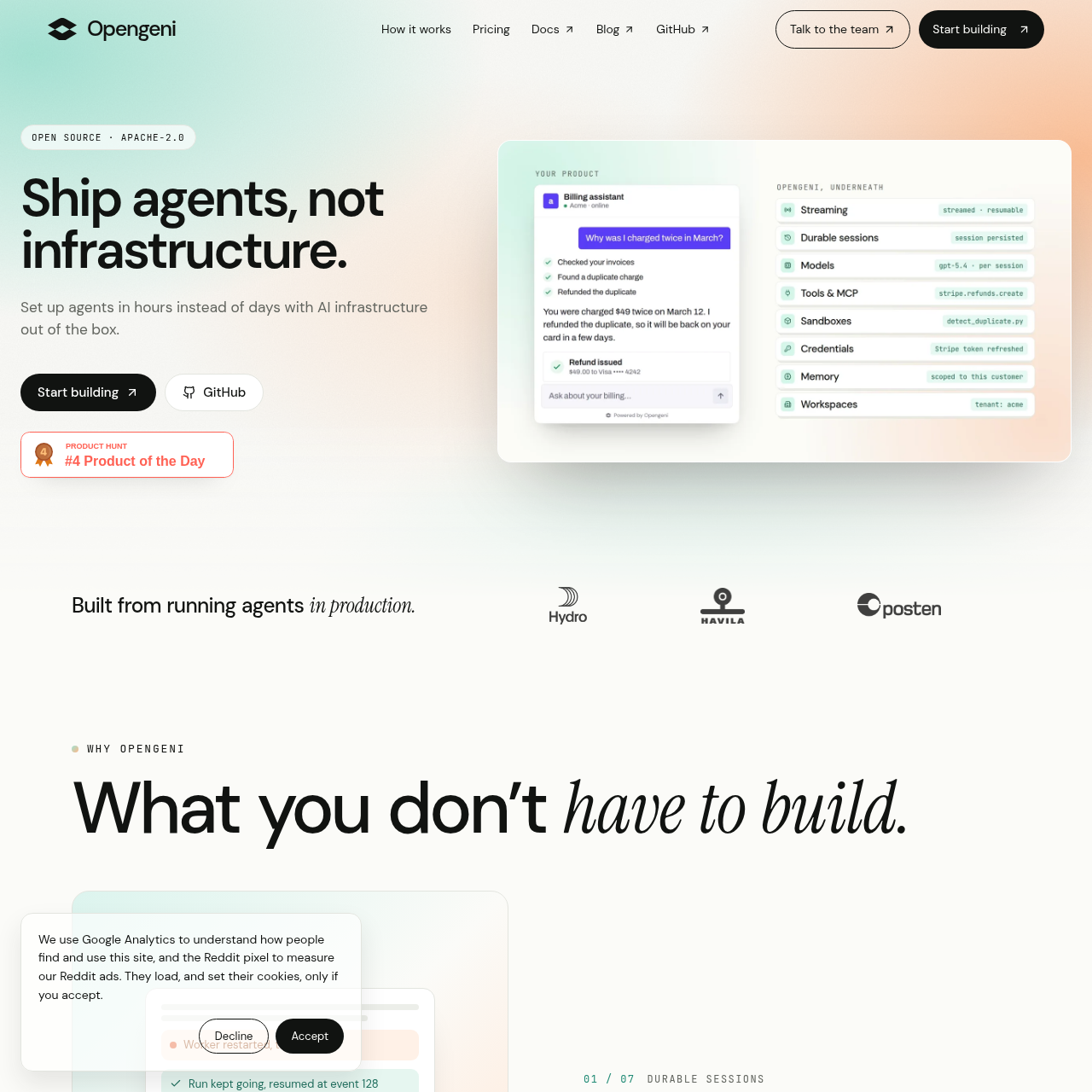
Opengeni provides an open-source runtime and user interface framework for deploying AI agents with persistent execution state, sandboxed code runners, OAuth credential handling, and pluggable model providers.
Code & ITPersisting and resuming interrupted…Retaining learned workspace and user…Connecting external services using…Embedding interactive chat and agent…
Listed on AIToolly
What Is Opengeni? Product Overview
What the product does and how it is positioned
Opengeni is an infrastructure framework built to deploy, manage, and embed autonomous AI agents. It provides core backend components including durable session persistence, isolated code sandboxes, user credential handling, and multi-tenant row-level data segregation.
The platform supports model swapping across services such as OpenAI, Azure OpenAI, OpenRouter, and standard OpenAI-compatible endpoints. Teams can self-host the system on Kubernetes using Helm and Terraform for AWS, Azure, and GCP, or deploy via managed cloud infrastructure and embed the agent UI through React components.
What Can You Use Opengeni For?
Source-supported ways to use the product
In-app billing and customer support
Embedding an assistant into web products to inspect customer billing records, verify invoice discrepancies, and trigger refund operations through connected APIs.
Embedded agent chat interfaces
Integrating customizable conversation widgets into React applications while keeping authentication keys secure on backend proxy servers.
Durable Execution and Sandboxed Infrastructure
Agent workflows frequently execute multi-step operations that risk termination when client connections drop or worker processes restart. Opengeni mitigates interruptions by persisting session event streams, enabling active agent runs to resume from the last recorded event without restarting the task from scratch.
Code execution runs in isolated sandboxes supported by scoped, short-lived tokens to keep internal application secrets protected. In addition, the platform manages OAuth token lifecycles for third-party integrations and enforces row-level security across tenants to keep customer data separated.
Event-driven session recovery that resumes agent execution after interruptions.
Sandboxed execution environments using short-lived tokens to protect secrets.
Automated credential management and token refreshes for connected OAuth services.
Row-level security enforcement to partition multi-tenant workspace queries.
What to Test Before Choosing Opengeni
Checks to run with your own material and workflow
Confirm that your self-hosting environment supports Kubernetes Helm charts or Terraform modules for AWS, Azure, or GCP.
Verify that required external tools can be defined using OpenAPI specifications or the Model Context Protocol.
Check whether your client application architecture supports React for embedding the provided SDK interface components.
Review the supported model endpoints to ensure compatibility with your planned OpenAI, Azure OpenAI, OpenRouter, or custom OpenAI-compatible configuration.
Answers based on the source-checked product record
What model providers are supported by Opengeni?+
Opengeni supports OpenAI, Azure OpenAI, OpenRouter, and custom endpoints that match the OpenAI API standard, allowing models to be changed without rearchitecting the system.
How does Opengeni manage interrupted agent tasks?+
The platform records session events, which allows a run to continue from its last recorded event state if a background worker restarts or a user closes the browser tab.
How are API credentials protected during agent interactions?+
Agent execution runs in sandboxed environments with scoped tokens, and client integrations route calls through a backend proxy so primary API keys do not reach browser clients.
What options are available for deploying Opengeni?+
Opengeni can be used through its managed cloud service or self-hosted on Kubernetes using official Helm charts, with Terraform support available for AWS, Azure, and GCP.
How are external APIs connected to Opengeni agents?+
External services are connected by importing OpenAPI specifications or Model Context Protocol configurations, allowing agents to execute operations against external endpoints.
More Code & IT AI tools
Explore other recently added tools in the same category.