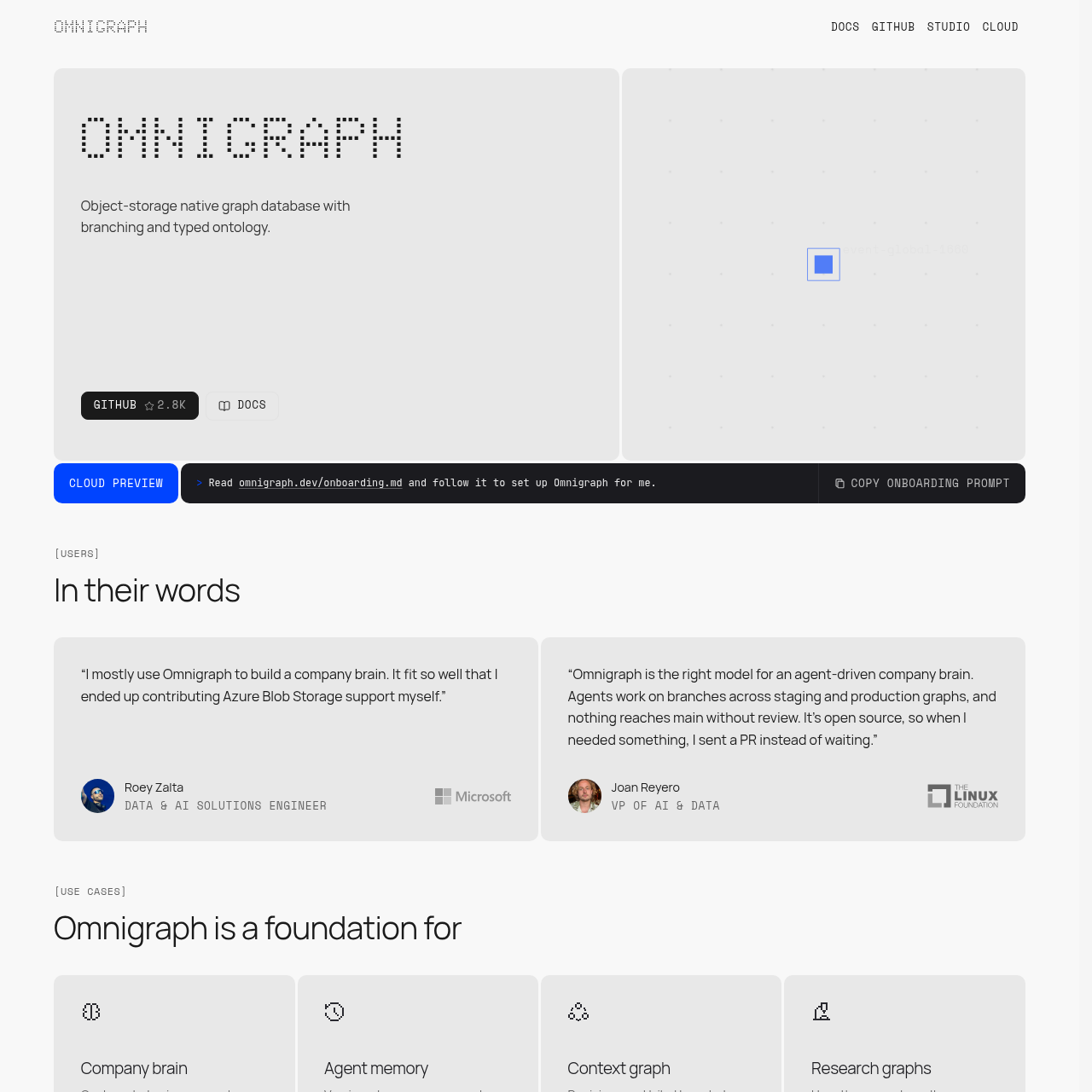
Omnigraph is a typed, versioned graph database for agent memory, organizational knowledge, and hybrid retrieval.
Code & ITEnforces a typed schema on graph writes.Supports branch, commit, diff, merge,…Provides graph, vector, full-text, and…Supports Cedar policies enforced inside…
Listed on AIToolly
What Is Omnigraph? Product Overview
What the product does and how it is positioned
Omnigraph combines a typed ontology with object-storage-backed graph data and Git-style branching, review, and merge workflows.
Its documented retrieval model combines graph traversal with vector, full-text, or hybrid ranking, and it can run embedded, in a user's cloud account, or on-premises.
What Can You Use Omnigraph For?
Source-supported ways to use the product
Company brain
Organize company knowledge, claims, decisions, and action items in one typed graph.
Agent memory
Maintain versioned memory for agents or tasks with branch-based writes and review before merging.
Context graph
Connect people, projects, decisions, documents, and related organizational knowledge.
Research graphs
Represent hypotheses and results in a graph with changes available for review.
How to Use Omnigraph
The documented workflow, where available
1
Define the schema
Describe typed nodes, edges, fields, constraints, and optional embeddings in the graph schema.
2
Create a branch
Create an agent or task branch so proposed writes do not directly modify the main graph.
3
Write graph data
Apply mutations on the branch, where each write has an author and is checked against the schema.
4
Review the diff
Inspect additions, changes, removals, and conflicts before accepting the branch.
5
Merge approved changes
Merge the reviewed branch into main, while retaining readable graph history and snapshots.
Versioned agent memory
Omnigraph documents a branch-based model for agent memory: agents write to separate branches, schema and policy checks apply during writes, and changes can be diffed before merging into main.
Branch writes keep proposed changes separate from main.
Cedar policies run inside the engine.
Historical graph snapshots remain queryable.
What to Test Before Choosing Omnigraph
Checks to run with your own material and workflow
Confirm that the selected storage option matches the required environment and deployment model.
Verify that the intended schema can express the required nodes, edges, constraints, and embeddings.
Check whether the branch review and merge workflow fits the team's approval process.
Review whether the documented SDK, CLI, or MCP client supports the planned integration.
Answers based on the source-checked product record
What is Omnigraph designed to store?+
It is described as a versioned graph database for typed organizational knowledge, agent memory, context graphs, and research graphs.
How does Omnigraph handle retrieval?+
It supports graph traversal, vector search, full-text search, and hybrid ranking in queries over the same typed graph data.
Where can Omnigraph store graph data?+
The documented storage options include S3-compatible storage, Azure Blob in preview, and local disk, with embedded, cloud-account, and on-premises deployments.
Can Omnigraph connect to MCP clients?+
Yes. The documented MCP server exposes an MCP endpoint, and the MCP integration can let clients read schemas, run queries, and write where policy permits.
How are graph changes reviewed?+
Changes can be made on branches, inspected through diffs, reviewed for conflicts, and merged into main after approval.
More Code & IT AI tools
Explore other recently added tools in the same category.