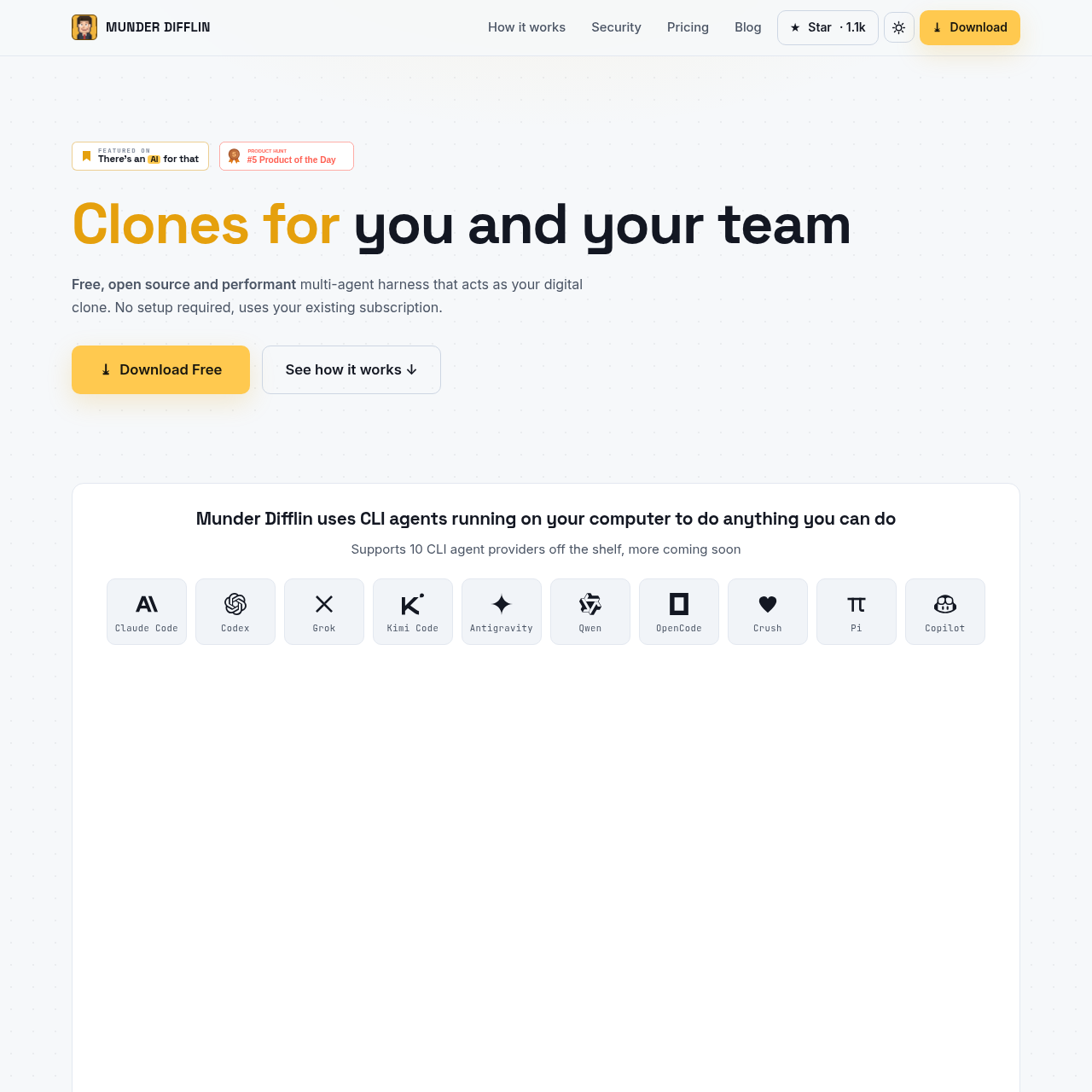
Munder Difflin is an open-source multi-agent harness that creates digital clones of team members to automate workflows, coordinate tasks, and maintain productivity 24/7.
Organization & AutomationReviewing pull requestsDrafting specifications and outreachTriaging issuesManaging files and spreadsheets
Estimated monthly visits
4K
Data period:
Listed on AIToolly
What Is Munder Difflin? Product Overview
What the product does and how it is positioned
Munder Difflin provides a framework for deploying digital clones that operate on a user's local machine or within a dedicated sandbox environment. By wrapping existing CLI agent providers, these clones can perform tasks such as reviewing code, drafting documentation, and managing project boards.
The platform emphasizes security through a local-first architecture and end-to-end encrypted communication between clones. This allows teams to share organizational context while keeping personal data and API keys within their own controlled environments.
What Can You Use Munder Difflin For?
Source-supported ways to use the product
Software Development Automation
Developers use clones to automatically review pull requests, fix bugs, and keep documentation updated while they are away from their desks.
Cross-Functional Team Coordination
Teams utilize clone-to-clone messaging to hand off work, sync project context, and unblock teammates across different roles like sales, design, and product management.
How to Use Munder Difflin
The documented workflow, where available
1
Node Installation
Users install a node that wraps their preferred agent CLI, allowing it to run locally or on a dedicated virtual machine.
2
Context Capture
The clone learns the user's specific workflows, tooling, and organizational context to act as a digital extension of the individual.
3
Autonomous Execution
Clones work continuously, communicating with other team clones to complete tasks, resolve dependencies, and escalate only necessary decisions to humans.
Security and Architecture
Munder Difflin is designed with a local-first philosophy, so that sensitive information such as code, API keys, and personal context remain on the user's machine. The system utilizes end-to-end encryption for all clone-to-clone interactions, meaning that even the service providers cannot access the content of these messages.
Local-first execution at 127.0.0.1
X25519 / AES-256-GCM encryption for clone messaging
Open-source protocol available for public audit
What to Test Before Choosing Munder Difflin
Checks to run with your own material and workflow
Confirm that the chosen CLI agent provider is among the supported list, such as Claude Code, Codex, or Grok.
Review the organization's security requirements to determine if a local-only deployment or a dedicated sandbox VM is appropriate for the team's needs.
Answers based on the source-checked product record
Does my code ever leave my laptop?+
In the local-first configuration, your code, API keys, and personal context remain entirely on your machine and are never transmitted externally.
What actually powers my clone?+
Your clone is powered by the CLI agent providers you already use, which the Munder Difflin node wraps to execute tasks and interact with your machine.
Does my laptop need to stay on?+
If you use the local-only mode, your laptop must remain on; however, the Cloud license provides a dedicated sandbox VM that allows your clone to work 24/7.
How do clones share team knowledge?+
Clones share organizational context through a provisioned and versioned knowledge base that is inherited by every new clone within the team.
What does it cost?+
The core application is free and open source; additional services for cloud-based hosting and team networking are available as separate paid offerings.
More Organization & Automation AI tools
Explore other recently added tools in the same category.