Claude Opus 4.6
Claude Opus 4.6: Anthropic's Smartest AI Model for Agentic Coding, Reasoning, and Work Tasks
Claude Opus 4.6 is Anthropic's upgraded flagship AI model, designed for state-of-the-art performance in coding, complex reasoning, and professional knowledge work. Featuring a 1M token context window and improved agentic capabilities, Opus 4.6 excels at planning, debugging, and executing multi-step tasks autonomously. It outperforms competitors like GPT-5.2 in economically valuable work and leads on benchmarks like Terminal-Bench 2.0 and Humanity's Last Exam. With features like adaptive thinking, effort controls, and context compaction, it provides developers and enterprises with unparalleled control and intelligence for large-scale codebase migrations, financial analysis, and legal reasoning.
2026-02-08
13800.0K
Claude Opus 4.6 Product Information
Introducing Claude Opus 4.6: The New Frontier in Intelligent AI
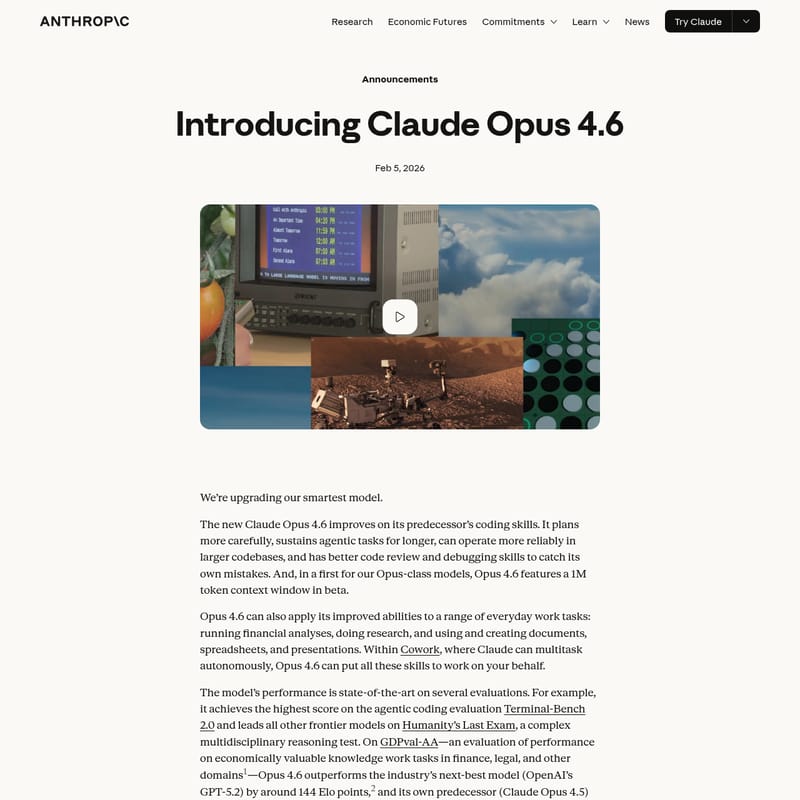
Anthropic has officially launched Claude Opus 4.6, an upgrade to its smartest AI model designed to redefine the boundaries of coding, reasoning, and autonomous agentic tasks. As the strongest model in the Claude family, Claude Opus 4.6 brings substantial improvements to planning, long-context retrieval, and professional work integration, making it the premier choice for developers and enterprises alike.
What's Claude Opus 4.6?
Claude Opus 4.6 is the latest high-intelligence model from Anthropic, representing a qualitative shift in AI capabilities. It is specifically engineered to handle the most challenging parts of a task with deep focus and minimal guidance. Whether it is navigating a multi-million-line codebase or conducting complex multidisciplinary reasoning, Claude Opus 4.6 acts less like a simple tool and more like a capable collaborator.
This model is available today on claude.ai, the Claude API, and all major cloud platforms. It maintains the same pricing structure as previous Opus-class models while delivering significantly higher performance across the board.
Key Features of Claude Opus 4.6
1. State-of-the-Art Coding and Debugging
Claude Opus 4.6 significantly improves upon its predecessor's coding skills. It plans more carefully, sustains agentic tasks for longer durations, and operates reliably within larger codebases. Its advanced code review and debugging skills allow it to catch mistakes that other models miss, making it a powerful asset for software engineering.
2. Massive 1M Token Context Window
In a first for Opus-class models, Claude Opus 4.6 features a 1M token context window in beta. This allows the model to process vast amounts of information—such as entire libraries of documentation or complex legal archives—without the "context rot" or performance degradation typically seen in other frontier models.
3. Industry-Leading Reasoning
On Humanity’s Last Exam, a complex multidisciplinary reasoning test, Claude Opus 4.6 leads all other frontier models. It also dominates in the GDPval-AA evaluation, outperforming the next-best industry model (GPT-5.2) by approximately 144 Elo points in domains like finance and legal work.
4. Advanced Developer Controls
- Adaptive Thinking: The model can now pick up on contextual clues to decide when to use extended thinking for deeper reasoning.
- Effort Controls: Developers can toggle between four effort levels—low, medium, high (default), and max—to balance intelligence, speed, and cost.
- Context Compaction: This beta feature automatically summarizes older context in long conversations to prevent hitting token limits.
- 128k Output Tokens: Supports massive single-request outputs for large-scale tasks.
5. Enhanced Safety Profile
Despite its increased intelligence, Claude Opus 4.6 maintains a safety profile as good as or better than any other frontier model. It shows low rates of misaligned behavior and the lowest rate of over-refusals for benign queries.
Use Cases for Claude Opus 4.6
Software Engineering and Agentic Coding
With the integration of Claude Code, developers can use Claude Opus 4.6 to assemble agent teams that work on tasks together. It is ideal for long-horizon tasks like migrating large codebases, root cause analysis, and navigating unfamiliar repositories.
Financial and Legal Analysis
Claude Opus 4.6 excels at multi-source analysis. It can run financial analyses, perform research, and handle legal reasoning with high precision. On the BigLaw Bench, it achieved a record-breaking score of 90.2%.
Enterprise Productivity
Through Cowork, Claude Opus 4.6 can multitask autonomously. It is integrated with everyday tools:
- Claude in Excel: Handles unstructured data, infers structure, and executes multi-step changes.
- Claude in PowerPoint: Generates full slide decks while respecting brand layouts and fonts.
Cybersecurity
In blind rankings across dozens of cybersecurity investigations, Claude Opus 4.6 consistently produced the best results. It is also being used for cyberdefensive purposes, such as patching vulnerabilities in open-source software.
How to Use Claude Opus 4.6
For Individual Users
Access the model directly on claude.ai. For everyday work, you can use the default settings or adjust the reasoning depth using the new effort parameters.
For Developers
Developers can implement Claude Opus 4.6 via the Claude API using the model name claude-opus-4-6.
- Adjusting Effort: Use the
/effortparameter to switch between low, medium, high, and max. - Managing Context: Enable context compaction for long-running agentic tasks to stay within the 1M token window.
- Tool Integration: Use the model within Claude Code to spin up parallel subagents for read-heavy codebase reviews.
FAQ
Q: What is the pricing for Claude Opus 4.6? A: Pricing remains consistent at $5 per million input tokens and $25 per million output tokens. For prompts exceeding 200k tokens, premium pricing applies ($10/$37.50).
Q: How does it compare to GPT-5.2? A: In economically valuable work evaluations (GDPval-AA), Claude Opus 4.6 outperforms GPT-5.2 by around 144 Elo points.
Q: Does it support images? A: Based on current release information, the model focuses on state-of-the-art text, code, and reasoning performance.
Q: Can it browse the web? A: Yes, it performs better than any other model on BrowseComp, which measures the ability to locate hard-to-find information online.
Q: Is it available on cloud platforms? A: Yes, Claude Opus 4.6 is available on the Claude API and all major cloud platforms including Amazon Bedrock and Google Cloud’s Vertex AI.