Codex by OpenAI
Codex app: A powerful command center for macOS to manage multi-agent workflows and automated software development.
The Codex app for macOS is an innovative desktop interface designed to revolutionize how software is built. Acting as a command center for AI agents, it allows developers to manage multiple agents in parallel, orchestrate complex tasks across the full software lifecycle, and utilize specialized 'skills' for tasks beyond coding. With features like built-in worktrees, customizable personalities, and background automations, Codex empowers teams to delegate long-running projects—ranging from game development to project management—while maintaining human supervision and security via system-level sandboxing. Integrated with the Codex CLI and IDE extensions, it provides a seamless, multi-threaded environment for modern developers.
2026-02-05
190300.0K
Codex by OpenAI Product Information
Introducing the Codex App: The Command Center for AI Agents
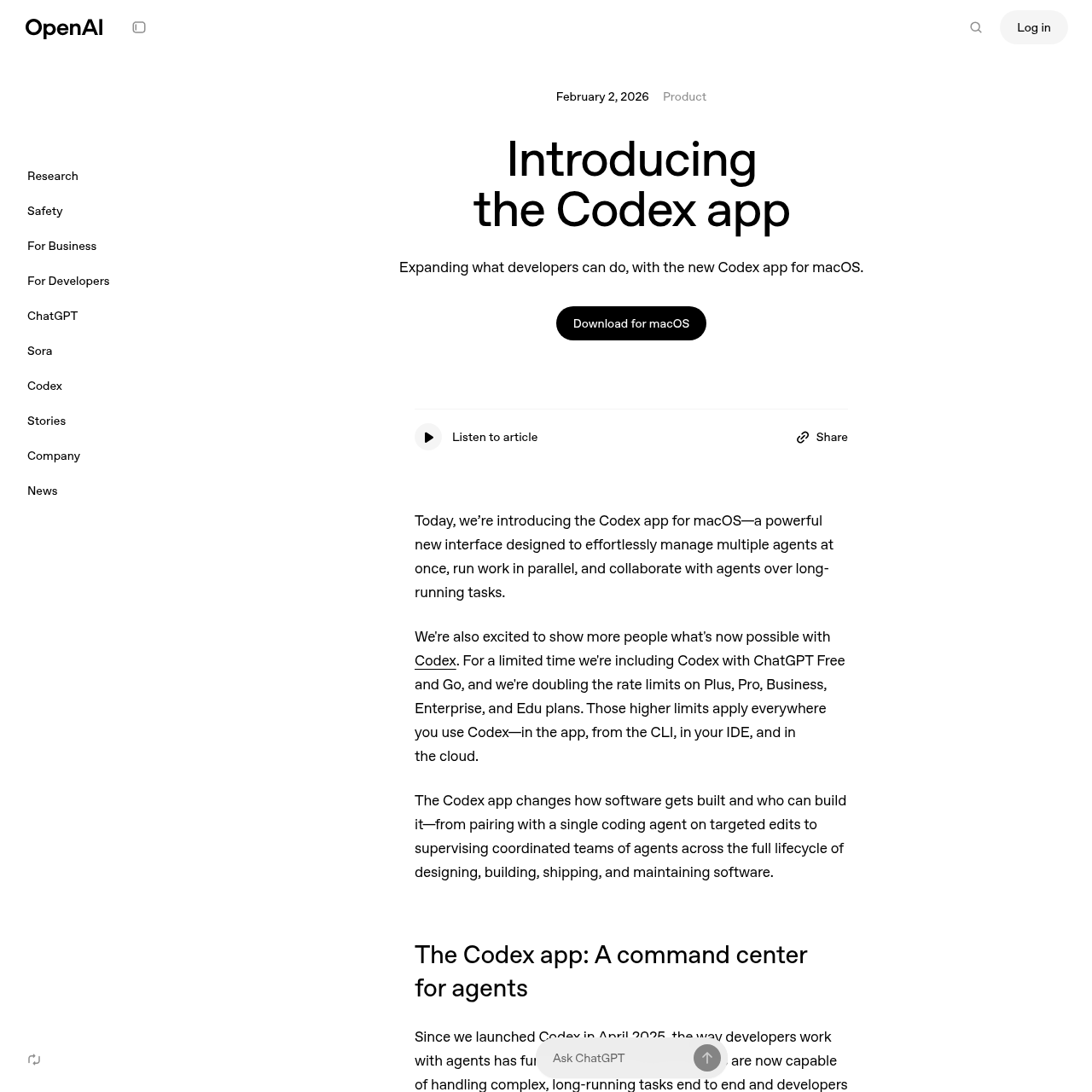
Software development is undergoing a fundamental shift. As AI models become capable of handling complex, long-running tasks end-to-end, the challenge for developers has moved from basic code generation to the orchestration of multiple agents. To meet this demand, OpenAI has introduced the Codex app for macOS, a powerful new interface designed to help you manage, supervise, and collaborate with agents at scale.
What’s Codex?
Codex is an advanced AI agent that has evolved from a simple code generator into a comprehensive tool that uses code to execute work on your computer. Since its initial launch in April 2025, Codex has become a staple for over a million developers.
The Codex app is a dedicated desktop command center that allows users to move beyond single-threaded interactions. It provides a focused space for multi-tasking, where agents run in separate threads organized by projects. This enables developers to delegate work, run tasks in parallel, and trust the Codex agent to handle substantial projects that span hours or even weeks.
Features of the Codex App
Multi-Agent Parallelism
The Codex app allows you to work with multiple agents simultaneously. Because agents operate in isolated threads, you can switch between different tasks without losing context. You can review changes directly in the thread, comment on diffs, or open them in your preferred editor.
Built-in Worktrees
To prevent conflicts during collaboration, the Codex app includes support for worktrees. This allows multiple agents to work on the same repository in isolated copies of the code. You can check out changes locally or let the agent progress without affecting your local git state.
Skills: Extending Capabilities
Codex is not limited to writing code. Through "skills," you can extend its functionality to gather information, solve problems, and run workflows. Key available skills include:
- Implement Designs: Translate Figma designs into production-ready UI code.
- Manage Projects: Triage bugs and track releases in Linear.
- Deploy to the Cloud: Deploy creations to Vercel, Cloudflare, Netlify, and Render.
- Generate Images: Create UI mockups and assets via GPT Image.
- Document Creation: Read and edit PDF, spreadsheet, and docx files.
Automations
With the Codex app, you can set up Automations that run on a schedule. This is ideal for repetitive tasks like daily issue triage or generating release briefs. Results land in a review queue for human supervision.
Customizable Personalities
Developers can choose how they interact with the Codex agent using the /personality command. Options include:
- Terse and Pragmatic: An execution-focused partner.
- Conversational and Empathetic: A more communicative interaction style.
Security by Design
The Codex app utilizes native, open-source system-level sandboxing. By default, agents are restricted to specific folders and must ask for permission to access network resources or execute elevated commands.
Use Case: Building a Full 3D Game
To demonstrate the power of Codex, OpenAI used it to create "Voxel Velocity," a 3D voxel kart racer. By utilizing the web game development skill and the image generation skill, Codex acted as the designer, developer, and QA tester.
Using over 7 million tokens from a single initial prompt, Codex built the game independently, implemented an arcade driving model, authored AI racing splines, and even validated the work by playing the game to identify bugs.
This use case highlights how the Codex app enables the transition from writing snippets to shipping entire products through agent orchestration.
How to Use the Codex App
- Download and Install: Download the Codex app for macOS and log in with your ChatGPT credentials.
- Sync Your Environment: The app automatically picks up session history and configurations from your Codex CLI and IDE extensions.
- Start a Project: Create a project thread to begin working with an agent.
- Assign Skills: Use the dedicated interface to manage skills or explicitly ask Codex to use a specific skill (e.g., "Use the Figma skill to update the landing page").
- Review and Edit: Review the agent's code diffs within the app, comment on them, or make manual adjustments in your editor.
- Set Personalities: Use the
/personalitycommand to toggle between terse or conversational styles.
FAQ
Q: Who can access the Codex app? A: The app is available for macOS users. It is included for users with ChatGPT Plus, Pro, Business, Enterprise, and Edu subscriptions. For a limited time, it is also available to Free and Go users.
Q: Does Codex work with my existing tools? A: Yes, Codex integrates with your CLI, IDE extensions, and cloud environments. It syncs session history across all these platforms.
Q: What are the rate limits for Codex? A: OpenAI has doubled the rate limits for all paid plans (Plus, Pro, Business, Enterprise, and Edu) across the app, CLI, and IDE.
Q: Is there a Windows version available? A: Currently, the app is available on macOS, but plans to expand to Windows have been announced.
Q: How does the app handle security? A: It uses open-source system-level sandboxing, limiting agents to specific folders and requiring user permission for network access or elevated commands.