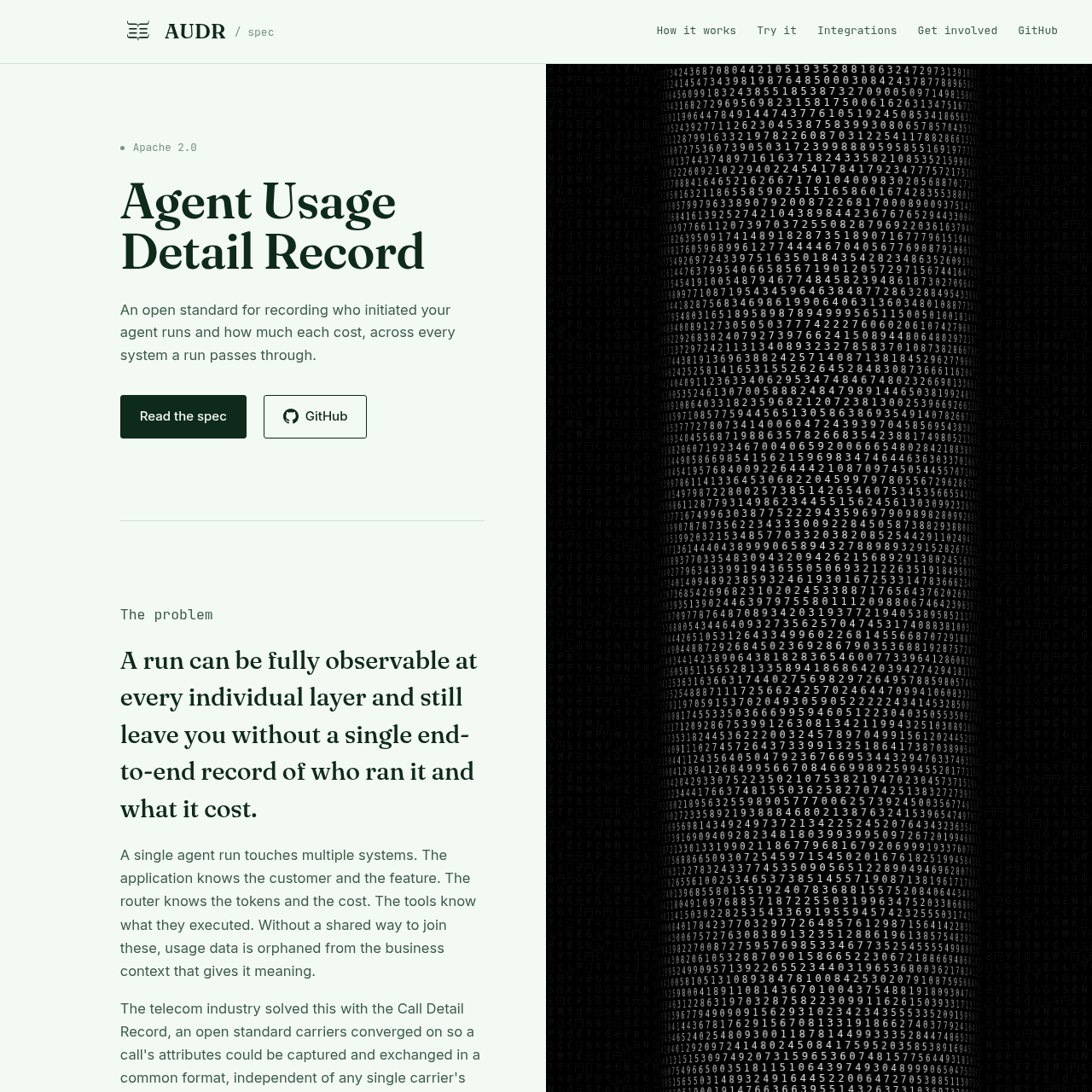
AUDR by Chargebee is an open specification and instrumentation toolkit that records agent usage, raw cost drivers, and business attribution across distributed runtimes.
Code & ITRecords raw execution driversEmits usage records asynchronously and…Builds on OpenTelemetry GenAI semantic…Operates locally or in custom pipelines…
Listed on AIToolly
What Is AUDR by Chargebee? Product Overview
What the product does and how it is positioned
AUDR, short for Agent Usage Detail Record, is an open standard designed to capture end-to-end telemetry and cost attribution for AI agent workflows across distributed execution layers. When an agent touches application harnesses, model routers, and tool execution environments, AUDR links raw computational consumption—such as token counts, tool calls, and compute duration—directly to business metadata including customer accounts, features, and operational environments.
The standard operates on three core rules: minting a shared run identifier across every participating layer, maintaining clear authority per field so each fact originates from one authoritative source, and enforcing strict merge rules at the destination sink. Supported by core libraries in Python and TypeScript, AUDR emits records asynchronously and out of band, without inspecting prompt text or generated outputs.
What Can You Use AUDR by Chargebee For?
Source-supported ways to use the product
Multi-layer Agent Usage Attribution
Correlates resource consumption across routers and external tool executions with customer and feature identifiers supplied by the application harness.
Decoupled Billing and Ledger Ingestion
Delivers structured usage records directly into local storage, data warehouses, or billing endpoints without imposing predefined pricing logic.
How to Use AUDR by Chargebee
The documented workflow, where available
1
Instrument the Execution Runtime
Install an ecosystem adapter or initialize the core SDK to monitor model completions, embeddings, tool scopes, and rerank calls.
2
Propagate Attribution and Run Identifiers
Mint a shared run ID in the harness and attach runtime metadata such as customer identifiers and environment tags to outbound requests.
3
Capture Usage Across Components
Allow routers and intermediate execution layers to measure token counts and compute duration while preserving the shared run ID.
4
Assemble Records at the Sink
Merge matching run and span data at the designated sink destination, enforcing field authority rules and delivering output to files or ingestion endpoints.
Core Architectural Principles and Delivery Semantics
AUDR adapts the concept of telecommunication Call Detail Records to address data fragmentation in multi-tier AI agent architectures. An application harness creates a shared run identifier and passes it downstream in request metadata. Because intermediate routers and tools echo the identifier back, independent components can report operational metrics without losing the root context of the execution.
Data integrity is maintained through unambiguous field ownership and strict merge behavior. The application harness holds exclusive authority over attribution fields such as customer IDs and environments, while routing layers hold exclusive authority over token counts and provider metrics. Sinks assemble these records based on run and span IDs, rejecting conflicting submissions and treating any updates as separate correction records rather than in-place mutations.
Preserves a single shared run ID across all harness, routing, and tool interactions
Designates harness components as authorities for attribution and routers as authorities for usage
Rejects conflicting attribute updates while requiring amendments to be submitted as new records
Captures runtime metadata and timings without reading prompts or model completion contents
What to Test Before Choosing AUDR by Chargebee
Checks to run with your own material and workflow
Confirm compatibility with supported runtime adapters including LiteLLM, Vercel AI SDK, Mastra, NVIDIA NeMo Relay, and Merge Gateway.
Verify that application harnesses can mint and pass the shared run ID through router request metadata.
Check that downstream sinks and ingest destinations conform to the strict merge and non-mutation requirements.
Review whether telemetry pipelines can ingest records formatted according to OpenTelemetry GenAI semantic conventions.
Answers based on the source-checked product record
What is the primary function of AUDR?+
AUDR standardizes how agent execution metrics and attribution metadata are recorded across multiple application layers, routers, and tools.
How does AUDR interact with OpenTelemetry conventions?+
AUDR builds on OpenTelemetry GenAI semantic conventions and can emit spans directly to OpenTelemetry collectors while adding durable record delivery semantics.
Does using AUDR require an external billing platform?+
No external billing platform or hosted backend is required, as records can be saved to local files, warehouses, or observability systems.
How does AUDR instrumentation impact inference latency?+
AUDR emits records asynchronously and out of band, avoiding added synchronous latency on the request path unless optional pre-flight budget gating is enabled.
What data is collected by AUDR runtime adapters?+
Adapters capture execution identifiers, token usage, tool calls, and operational timings, and they do not record prompt inputs or generated outputs.
More Code & IT AI tools
Explore other recently added tools in the same category.