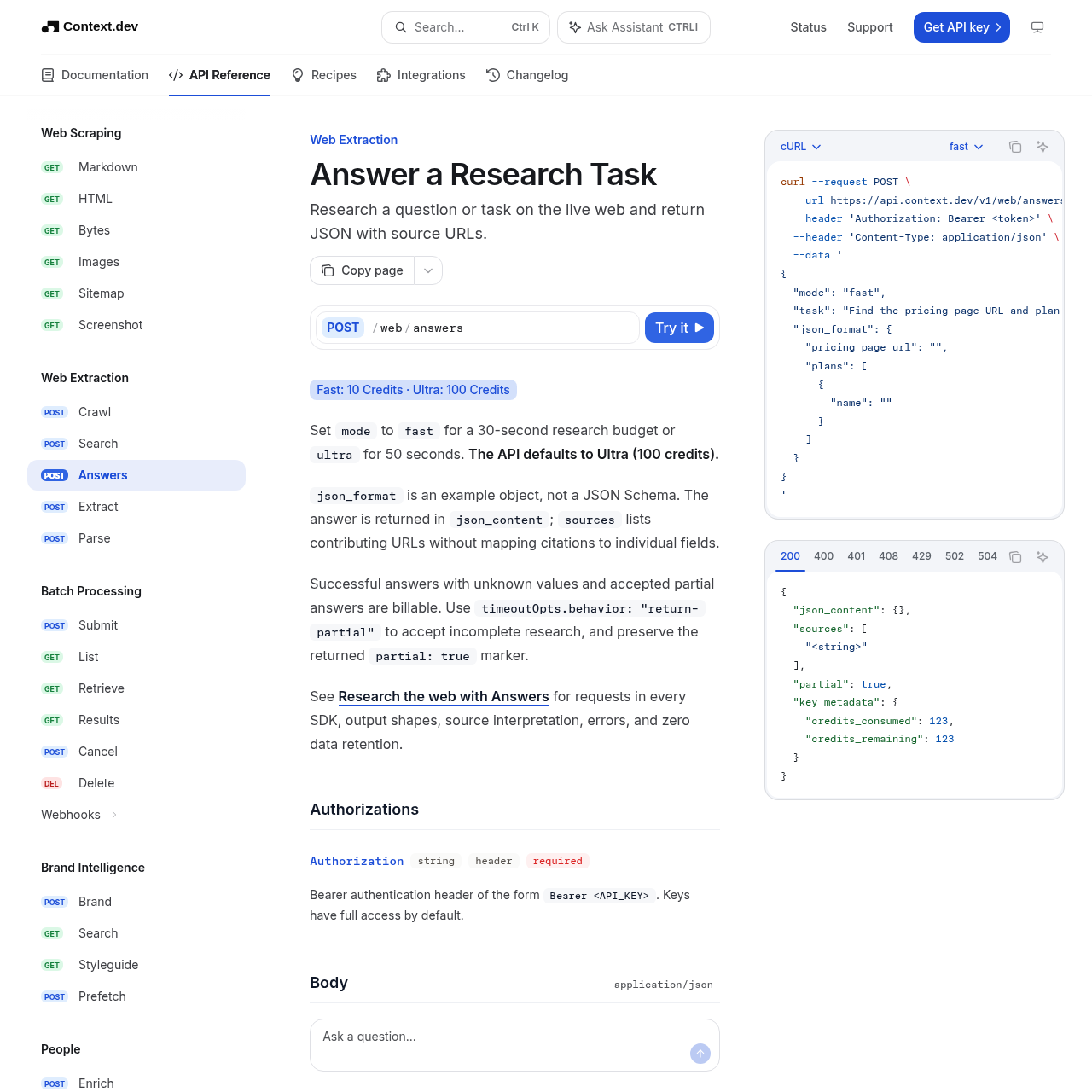
Answers by Context.dev is an API that conducts live web research and returns structured JSON responses matched to user-defined example objects alongside contributing source URLs.
Research AssistantConducts live web research based on…Structures extracted data into JSON…Returns contributing source URLs in…Delivers partial answers collected…
Estimated monthly visits
182K
Data period:
Listed on AIToolly
What Is Answers by Context.dev? Product Overview
What the product does and how it is positioned
Answers by Context.dev is a web extraction API designed to execute plain-language research tasks across the live web and assemble the findings into structured JSON output. Users provide a natural language prompt alongside an optional template object that establishes the output structure, keys, and expected value types.
The service supports fast and ultra research modes with distinct time allocations, compiles source URLs in first-seen order, and offers optional configurations for zero data retention, usage tagging, and timeout behavior that can return partial data when deadlines expire.
What Can You Use Answers by Context.dev For?
Source-supported ways to use the product
Structured Web Research
Extracting targeted facts and data points from the web into predefined JSON templates based on natural language prompts.
Targeted Domain Inspection
Guiding research to inspect a specific website first before expanding searches across the general web.
JSON Formatting and Timeout Management
Answers by Context.dev shapes its findings using an example JSON object rather than a formal schema definition. The service maintains the keys and data types supplied in the template, returning unknown values as null and allowing empty arrays to hold arbitrary JSON items.
When tasks must complete within strict time boundaries, timeout options can be configured to accept incomplete research rather than failing. Under this configuration, the response marks the partial flag as true and presents the data gathered up to the deadline.
Accepts example objects up to 8 levels deep, 500 values, and 16,000 characters
Defaults to a single result key when no template object is provided
Supports timeout configuration to return partial findings when deadlines are reached
What to Test Before Choosing Answers by Context.dev
Checks to run with your own material and workflow
Verify that json_format templates stay within the limits of 8 nesting levels, 500 values, and 16,000 characters.
Confirm whether zero data retention permissions are active for your organization before setting the zdr parameter to enabled.
Check whether your downstream processing can accommodate a general list of source URLs rather than per-field citation mappings.
Answers based on the source-checked product record
What research modes does Answers by Context.dev provide?+
The API offers two research modes: fast, which uses a smaller model and a 30-second budget, and ultra, which uses deeper reasoning with a 50-second budget and acts as the default.
How is the response format defined in a request?+
Response structure is defined by providing an example object with placeholder values in the json_format field, which preserves specified keys and value types.
Does Answers by Context.dev link sources to specific fields?+
No, contributing URLs are returned in first-seen order within a single sources array, without mapping individual citations to specific JSON fields.
How can an agent be directed to read a specific website first?+
Specifying a domain name directly within the plain-language task prompt instructs the agent to read that site before initiating broader web searches.
What happens when zero data retention is activated?+
Setting the zdr parameter to enabled bypasses shared caches, omits request and response content from retained logs, and skips asset uploads.
More Research Assistant AI tools
Explore other recently added tools in the same category.