Meituan LongCat Team Unveils WBench: A Diagnostic 'CT Scanner' for Interactive Video World Models
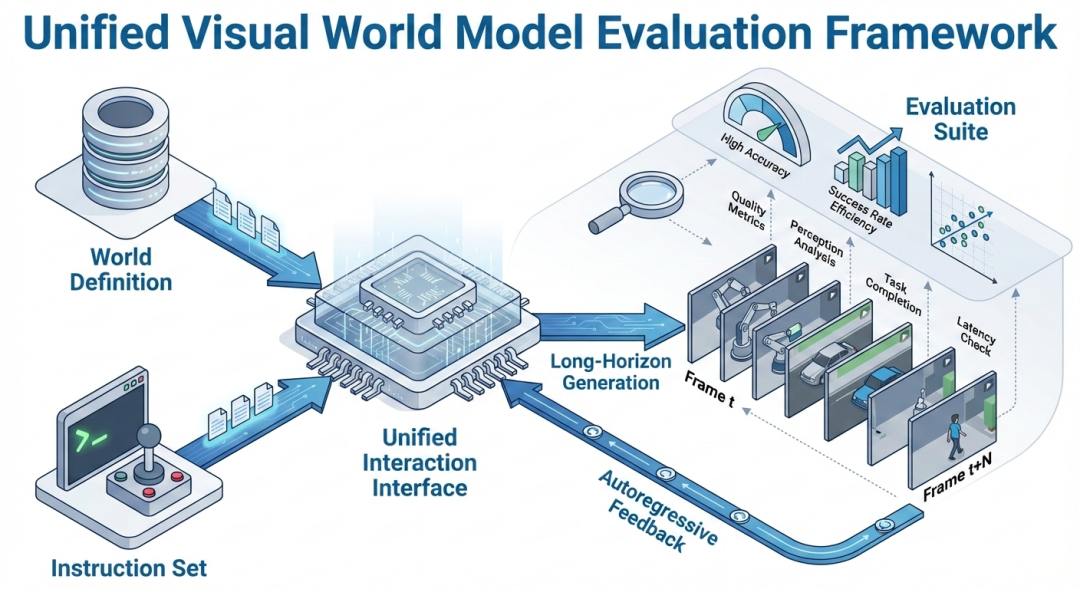
The Meituan LongCat team has officially introduced and open-sourced WBench, the industry's first systematic multi-round evaluation benchmark specifically designed for interactive video world models. Functioning as a diagnostic 'CT scanner,' WBench is engineered to identify the precise technical limitations of AI models as they transition from passive video generation to active, user-driven interaction. By testing models across diverse environments—ranging from lunar simulations to futuristic cyber cities—the benchmark provides a rigorous framework for measuring the boundaries of AI-generated worlds. This tool aims to help researchers pinpoint exactly where models struggle with consistency and logic during complex, multi-stage interactions, marking a significant step forward in the development of robust, interactive AI environments.
Key Takeaways
- Pioneering Benchmark: Meituan's LongCat team has open-sourced WBench, the first systematic framework for evaluating interactive video world models through multi-round testing.
- Diagnostic Precision: The tool acts as a "CT scanner" for AI, allowing developers to pinpoint specific failure points in a model's logic and interactive capabilities.
- Focus on Interaction: WBench specifically measures the transition from "passive viewing" (simple video generation) to "active interaction" (user-driven environmental changes).
- Diverse Testing Scenarios: The benchmark evaluates models across a wide spectrum of environments, including scientific simulations like moonwalks and imaginative settings like cyber cities.
In-Depth Analysis
The Diagnostic Power of the "CT Scanner" Metaphor
The Meituan LongCat team describes WBench as a "CT scanner" for world models, a metaphor that underscores the benchmark's primary objective: precision diagnostics. In the current landscape of artificial intelligence, many video generation models appear visually impressive but often lack a deep understanding of the worlds they create. WBench is designed to look beneath the surface of these outputs. By systematically testing how a model handles various interactive prompts over multiple stages, WBench can identify exactly where the internal logic of the world model breaks down. Whether the failure is a lapse in spatial consistency, a violation of physical laws, or an inability to maintain temporal coherence, WBench provides the granular data necessary for researchers to understand the specific "bottlenecks" hindering their models.
Bridging the Gap Between Passive Viewing and Active Interaction
A critical challenge in modern AI development is moving beyond "passive viewing." Most current video models are sophisticated generators that produce a sequence of frames based on a static prompt, where the viewer remains a mere observer. However, a true "world model" must support "active interaction," where the environment responds dynamically to user inputs while maintaining a persistent and logical state. WBench is the first benchmark to address this complexity through a multi-round evaluation system. In this framework, a model is not judged on a single output but on its ability to sustain a coherent reality across several rounds of interaction. For instance, if an action is taken in an early round, the model must accurately reflect the consequences of that action in all subsequent rounds. WBench measures these boundaries, revealing how well a model can simulate a truly interactive and persistent digital world.
Measuring Boundaries Across Diverse Environments
The scope of WBench is intentionally broad, testing the limits of AI across vastly different scenarios. By including environments such as "moonwalks," the benchmark evaluates a model's ability to adhere to specific, grounded physical constraints, such as low-gravity movement and unique lighting conditions. Conversely, scenarios like "cyber cities" challenge the model's capacity for handling high-density visual information, complex urban architectures, and stylized aesthetics. This range ensures that the benchmark is not merely testing a model's ability to recall training data, but its ability to generalize and apply "world rules" to any given context. By measuring these boundaries, WBench provides a clear picture of whether a model truly understands the fundamental principles of the environment it is simulating or if it is simply performing pattern recognition.
Industry Impact
The release of WBench as an open-source tool is a significant contribution to the AI research community, providing a standardized language for evaluating the next generation of world models. As the industry moves toward more complex applications—such as autonomous robotics, high-fidelity simulators, and immersive gaming—the ability to accurately measure interactive performance becomes paramount. WBench fills a critical gap by offering a systematic way to compare different models on a level playing field. By focusing on the transition to active interaction, Meituan is pushing the industry to move beyond simple video synthesis and toward the creation of robust, interactive digital ecosystems. This benchmark will likely serve as a vital tool for developers seeking to refine the reliability and sophistication of their AI world models.
Frequently Asked Questions
Question: What makes WBench different from existing video generation benchmarks?
Answer: Unlike traditional benchmarks that focus on passive, single-round video generation, WBench is the first systematic benchmark designed for multi-round evaluation of interactive video world models, focusing on how models respond to active user input over time.
Question: Why is the "multi-round" aspect of WBench important?
Answer: Multi-round evaluation is crucial because it tests a model's ability to maintain consistency and logic throughout a series of interactions. It ensures that the model can remember and build upon previous states, which is essential for creating a believable and functional world model.
Question: How does WBench help AI developers?
Answer: WBench acts as a diagnostic tool that helps developers identify the specific technical boundaries and failure points of their models. By pinpointing where a model fails during the transition from passive to active interaction, developers can more effectively target their improvements.