Google Research Explores the Algorithmic Foundations and Creativity of Diffusion Models
Google Research has released a new publication titled "Towards demystifying the creativity of diffusion models," categorized under the domain of Algorithms & Theory. This research initiative focuses on providing a deeper, more theoretical understanding of how diffusion models—a cornerstone of modern generative AI—achieve creative outputs. By situating the study within algorithmic theory, Google Research aims to move beyond empirical observations of AI performance toward a robust mathematical framework. The goal is to demystify the complex processes that allow these models to generate novel and high-quality content, bridging the gap between technical execution and the perceived creativity of artificial intelligence. This work represents a significant step in the ongoing effort to understand the internal logic of generative systems.
Key Takeaways
- Theoretical Focus: The research is centered within the "Algorithms & Theory" framework, emphasizing a mathematical approach to understanding AI.
- Demystification Goal: A primary objective is to clarify the mechanisms behind the creative outputs of diffusion models, which are often viewed as "black boxes."
- Algorithmic Rigor: The study seeks to establish a formal understanding of how generative processes translate into what humans perceive as creativity.
- Foundational Research: This work contributes to the broader field of AI by focusing on the underlying principles rather than just practical applications.
In-Depth Analysis
The Objective of Demystifying AI Creativity
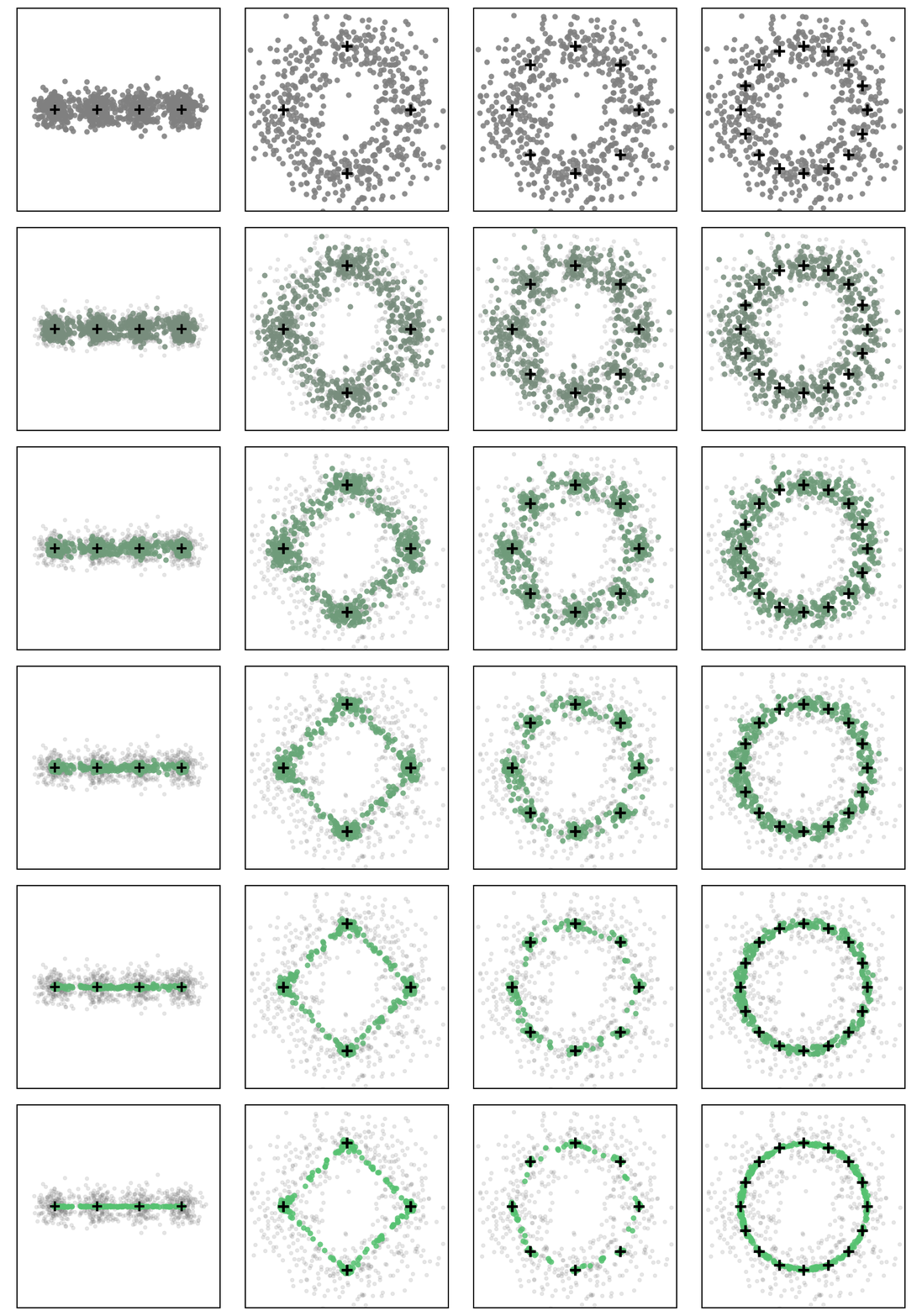
The title of the research, "Towards demystifying the creativity of diffusion models," suggests a concentrated effort by Google Research to unpack the complex layers of generative artificial intelligence. In the current landscape of AI development, diffusion models have demonstrated an extraordinary ability to generate images, videos, and other media that exhibit high levels of novelty and aesthetic quality. However, the "creativity" displayed by these models is often discussed in subjective terms. By using the word "demystifying," Google Research indicates a shift toward transparency and clarity. The research aims to identify the specific algorithmic drivers that allow a model to transition from noise to a coherent, creative structure. This involves analyzing how the reverse diffusion process—where noise is systematically removed to reveal an image—can be understood not just as a statistical probability, but as a structured creative act governed by algorithmic rules.
Theoretical Frameworks in Algorithms and Theory
Categorized under "Algorithms & Theory," this publication highlights the importance of foundational science in the evolution of AI. While much of the industry focuses on scaling models and increasing computational power, this specific area of research looks at the "why" and "how" from a theoretical perspective. The study of algorithms and theory in the context of diffusion models involves examining the convergence properties, the sampling efficiency, and the manifold learning that occurs during training. By focusing on these theoretical aspects, the research attempts to provide a roadmap for how creativity emerges from mathematical constraints. This approach is essential for moving the field forward, as it allows researchers to predict model behavior and optimize creative output based on theoretical certainty rather than trial-and-error experimentation. The emphasis on theory suggests that the "creativity" of these models is not an accidental byproduct but a result of specific, identifiable algorithmic patterns.
Bridging the Gap Between Logic and Generative Art
A significant portion of the analysis involves understanding the intersection of rigid algorithmic logic and the fluid nature of generative art. Diffusion models operate by learning the distribution of data and then generating new samples from that distribution. The "creativity" aspect arises when the model generates something that is not a mere copy of its training data but a novel synthesis. The research aims to define the boundaries of this synthesis. By demystifying this process, Google Research provides insights into how the mathematical objective functions of a model correlate with the creative quality of the output. This bridge is crucial for developers who seek to fine-tune models for specific creative tasks, ensuring that the algorithmic foundations are aligned with the desired artistic or functional results.
Industry Impact
The implications of demystifying the creativity of diffusion models are profound for the AI industry. First, a stronger theoretical understanding leads to increased model interpretability. As industries ranging from healthcare to design begin to rely on generative AI, understanding the logic behind the output becomes a matter of safety and reliability. If the "creativity" of a model can be demystified, it becomes easier to audit and control.
Second, this research influences future model architecture. By identifying the algorithmic components that contribute most effectively to creative synthesis, engineers can design more efficient and specialized diffusion models. This could lead to a reduction in the computational resources required to achieve high-quality results, making advanced generative AI more accessible.
Finally, the focus on "Algorithms & Theory" encourages a scientific standard for evaluating AI creativity. Instead of relying on human intuition to judge whether an AI is creative, the industry can move toward objective metrics based on the theoretical frameworks established by researchers at institutions like Google. This sets a benchmark for how generative models are developed and validated in the years to come.
Frequently Asked Questions
Question: What is the primary focus of the Google Research post "Towards demystifying the creativity of diffusion models"?
The research focuses on understanding the theoretical and algorithmic foundations that enable diffusion models to produce creative and novel outputs. It aims to move away from viewing AI as a "black box" and toward a clear, mathematical explanation of its generative capabilities.
Question: Why is this research categorized under "Algorithms & Theory"?
This categorization indicates that the work is focused on the fundamental mathematical principles and logic of AI rather than just its application. It involves studying the underlying algorithms to explain how they function and why they produce specific results in the context of diffusion processes.
Question: How does "demystifying" creativity benefit the AI community?
Demystifying the process allows for better control, transparency, and optimization of generative models. It helps researchers understand how to improve model performance and ensures that the creative outputs are grounded in a predictable and interpretable algorithmic framework.