
Google Research Introduces AgentHands: Generating Interactive Hand Gestures for Spatially Grounded AI Conversations in XR
Google Research has announced AgentHands, a novel framework designed to generate interactive hand gestures for AI agents operating within Extended Reality (XR) environments. The research focuses on "spatially grounded" conversations, a method that ensures an agent's physical movements and gestures are contextually and physically aligned with the surrounding digital or physical space. By integrating advanced Human-Computer Interaction (HCI) and visualization techniques, AgentHands aims to make interactions with digital agents more natural and intuitive. This development addresses a critical challenge in immersive technology: the need for AI avatars to communicate not just through voice, but through coordinated, environment-aware physical actions. The project represents a significant step forward in creating lifelike virtual assistants that can effectively navigate and interact within XR landscapes.
Key Takeaways
- AgentHands Framework: A new system developed by Google Research to automate the generation of interactive hand gestures for AI agents.
- Spatial Grounding: The technology emphasizes spatially grounded conversations, allowing agents to interact accurately with their environment in XR.
- HCI Advancement: The project falls under Human-Computer Interaction and Visualization, focusing on improving the realism of digital entities.
- XR Integration: Designed specifically for Extended Reality, bridging the gap between virtual agents and physical-spatial awareness.
In-Depth Analysis
The Concept of AgentHands in Extended Reality
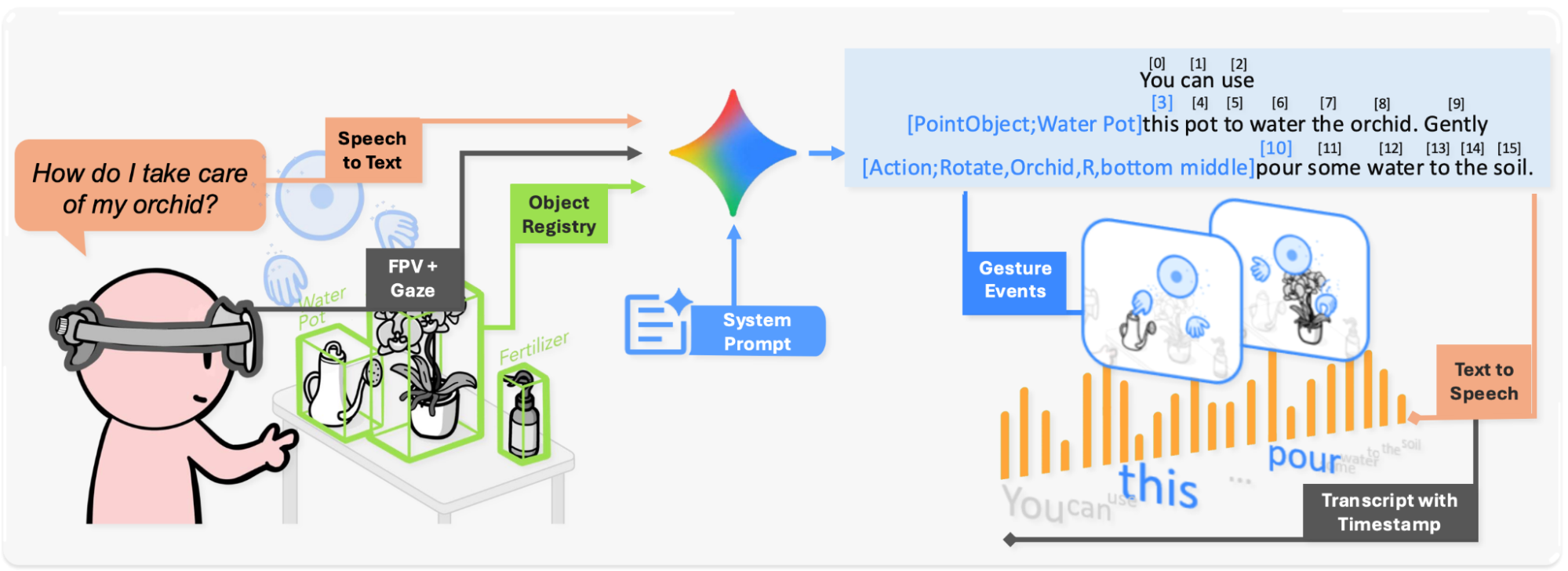
AgentHands represents a specialized approach to the problem of non-verbal communication in digital environments. In the context of Extended Reality (XR), which encompasses Augmented, Virtual, and Mixed Reality, the presence of an AI agent often feels disconnected if its physical movements do not match its verbal output or the environment it inhabits. AgentHands seeks to solve this by generating hand gestures that are not merely decorative but are "interactive" and "spatially grounded."
This means that when an agent speaks or interacts, its hand movements are calculated to correspond with the spatial coordinates of the XR scene. Whether the agent is pointing to a virtual object or gesturing during a conversation, the system ensures that these movements feel anchored to the world. This level of synchronization is a core component of modern Human-Computer Interaction (HCI), as it reduces the cognitive load on the user and increases the sense of "presence" within the virtual space.
Spatially Grounded Conversations and Visualization
One of the primary focuses of the AgentHands research is the concept of spatially grounded conversations. In traditional AI interactions, agents are often static or use pre-recorded animations that do not account for the user's specific environment. AgentHands moves beyond this by utilizing visualization techniques to map gestures to the spatial context of the conversation.
By grounding gestures in space, the AI can provide more effective cues during a dialogue. For example, if an agent is explaining a complex task in a 3D environment, its ability to use precise hand gestures to reference specific areas or objects becomes vital. This research highlights the intersection of visualization and AI, where the visual representation of the agent's "body language" is treated with the same importance as the underlying language model. The result is a more cohesive communication experience where the agent's physical actions reinforce its spoken words.
Industry Impact
The introduction of AgentHands has significant implications for the AI and XR industries. As companies move toward more immersive "metaverse" or spatial computing platforms, the demand for realistic AI avatars is increasing. AgentHands provides a blueprint for how these avatars can behave more like humans by mastering the nuances of hand gestures.
For the AI industry, this shifts the focus from purely text-based or voice-based agents to multi-modal agents that understand and inhabit physical space. For developers in the XR field, this technology could simplify the process of creating interactive NPCs (non-player characters) or virtual assistants, as the system automates the complex task of gesture generation. Ultimately, this research paves the way for more sophisticated human-AI collaboration in professional, educational, and social XR settings.
Frequently Asked Questions
Question: What is the primary goal of AgentHands?
AgentHands is designed to generate interactive and realistic hand gestures for AI agents in Extended Reality (XR) to make conversations feel more spatially grounded and natural.
Question: Why is "spatial grounding" important for AI agents?
Spatial grounding ensures that an agent's gestures and movements are accurately aligned with the objects and environment around them. This is crucial for maintaining immersion and clarity in XR conversations.
Question: Which field of research does AgentHands belong to?
According to Google Research, this project is categorized under Human-Computer Interaction (HCI) and Visualization.

