LongCat Unveils VitaBench 2.0: A New Benchmark for Long-Term Dynamic User Modeling in AI Agents
LongCat, a research initiative by the Meituan Technical Team, has officially released VitaBench 2.0, a pioneering benchmark designed to evaluate AI agents in real-life scenarios. This benchmark distinguishes itself as the first of its kind to focus specifically on long-term dynamic user modeling. VitaBench 2.0 provides a systematic framework for assessing Large Language Models (LLMs) based on their ability to maintain personalization and demonstrate proactivity during extended, evolving interactions with users. By simulating authentic and dynamic environments, the benchmark addresses the critical need for AI systems that can adapt to changing user needs over time, moving beyond static task completion toward more sophisticated, long-term digital companionship and assistance.
Key Takeaways
- First-of-its-Kind Benchmark: VitaBench 2.0 is the industry's first evaluation tool focused on long-term dynamic user modeling within real-life scenarios.
- Focus on Personalization: The framework specifically measures how well Large Language Models (LLMs) can tailor their responses to individual users over extended periods.
- Proactivity Assessment: A core component of the benchmark is evaluating the 'proactivity' of AI agents, moving beyond simple reactive command-following.
- Dynamic Interaction Modeling: Unlike static benchmarks, VitaBench 2.0 simulates evolving user-agent relationships to test the adaptability of AI systems.
- Developed by LongCat: The project is a significant contribution from the Meituan Technical Team to the open-source AI community.
In-Depth Analysis
Redefining AI Evaluation through Long-Term Dynamics
The release of VitaBench 2.0 by LongCat represents a fundamental shift in how the industry evaluates the capabilities of AI agents. Traditional benchmarks often focus on 'single-turn' or 'short-context' tasks, where an AI is judged on its ability to answer a specific question or solve a localized problem. However, as AI agents integrate more deeply into daily life, the ability to maintain a coherent, evolving understanding of a user—referred to as long-term dynamic user modeling—becomes essential.
VitaBench 2.0 addresses this by creating a systematic evaluation process for long-term interactions. By focusing on 'dynamic' modeling, the benchmark recognizes that user preferences, contexts, and needs are not static; they change over time. An agent's success is therefore measured by its capacity to track these changes and maintain a consistent yet flexible persona that aligns with the user's life journey. This approach moves the goalposts from mere accuracy to the quality of the long-term relationship between the human and the machine.
The Pillars of Modern Agents: Personalization and Proactivity
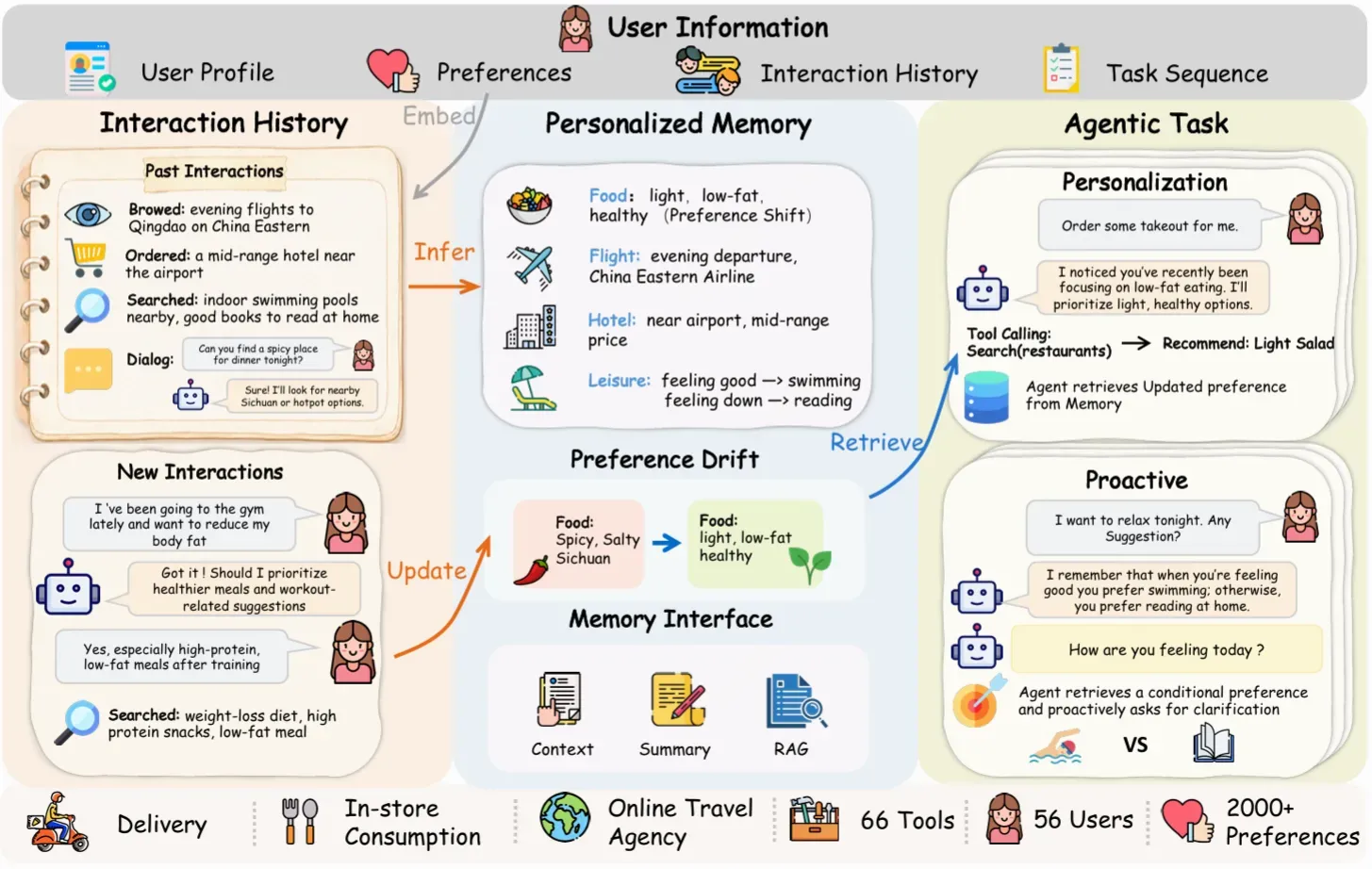
At the heart of VitaBench 2.0 are two critical metrics: personalization and proactivity. In the context of this benchmark, personalization is not just about remembering a user's name; it involves a deep, systematic understanding of user behavior and preferences across multiple interactions in real-life scenarios. The benchmark tests whether an LLM can leverage historical data to provide contextually relevant and highly individualized support.
Proactivity, the second pillar, marks a transition from AI as a tool to AI as an assistant. VitaBench 2.0 evaluates whether an agent can anticipate user needs or initiate relevant actions without being explicitly prompted for every step. In a real-life dynamic environment, a proactive agent might suggest a reminder based on a previous conversation or adjust its tone based on the user's evolving state. By quantifying these traits, VitaBench 2.0 provides a roadmap for developers to build agents that are more intuitive and helpful in everyday life.
Simulating Real-Life Complexity
One of the most significant aspects of VitaBench 2.0 is its emphasis on 'real-life scenarios.' Many existing AI tests rely on synthetic datasets that may not reflect the messiness and unpredictability of human life. VitaBench 2.0 aims to bridge this gap by providing a benchmark that mirrors the complexity of authentic user interactions. This focus ensures that models performing well on the benchmark are more likely to succeed when deployed in consumer-facing applications, such as personal assistants, lifestyle services, or long-term educational tutors. The systematic nature of this evaluation allows researchers to identify specific weaknesses in how LLMs handle temporal consistency and proactive engagement.
Industry Impact
The introduction of VitaBench 2.0 is poised to have a significant impact on the development of AI agents. By providing a standardized way to measure long-term personalization and proactivity, it encourages the AI research community to move beyond optimizing for short-term performance. This benchmark is particularly relevant for companies developing 'Personal AI'—systems intended to act as lifelong assistants.
Furthermore, as an open-source contribution from the Meituan Technical Team, VitaBench 2.0 sets a new standard for transparency and rigor in agent evaluation. It provides a common language for developers to discuss 'agentic' behavior, potentially accelerating the transition from simple chatbots to sophisticated, proactive digital entities. As the industry moves toward more autonomous systems, benchmarks that can capture the nuances of dynamic, long-term human-AI interaction will be vital for ensuring these systems remain aligned with user expectations and real-world utility.
Frequently Asked Questions
Question: What is the primary goal of VitaBench 2.0?
VitaBench 2.0 aims to provide a systematic evaluation of AI agents' ability to perform long-term dynamic user modeling. It specifically focuses on measuring how well Large Language Models can handle personalization and proactivity in real-life, evolving scenarios over an extended period.
Question: Who developed VitaBench 2.0 and why is it significant?
VitaBench 2.0 was developed by LongCat, a team within the Meituan Technical Team. It is significant because it is the first benchmark to focus on the long-term, dynamic aspects of user-agent interaction, filling a gap in current AI evaluation methods that typically focus on short-term or static tasks.
Question: How does VitaBench 2.0 define 'proactivity' in AI agents?
In the context of VitaBench 2.0, proactivity refers to the agent's ability to take initiative and anticipate user needs within a dynamic interaction, rather than simply reacting to direct commands. This is evaluated alongside personalization to determine how effectively an agent can function as a helpful, long-term assistant.