Meituan LongCat Team Unveils WBench: The First Systematic Multi-Round Benchmark for Interactive Video World Models
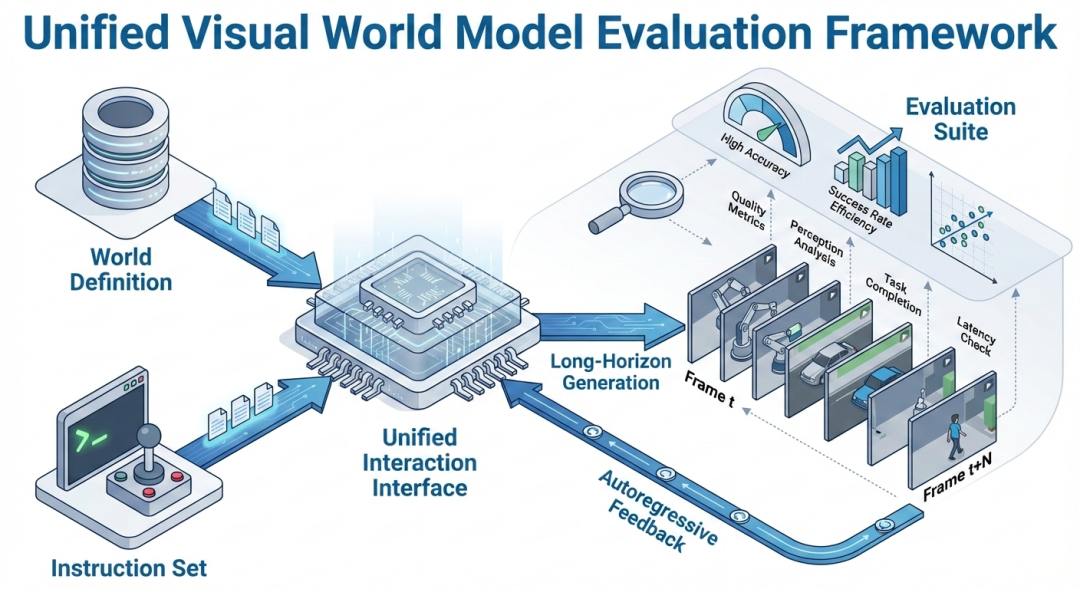
The Meituan LongCat team has officially open-sourced WBench, a pioneering evaluation framework designed to measure the capabilities of interactive video world models. Functioning as a diagnostic "CT scanner," WBench provides a systematic approach to identifying the technical bottlenecks that occur when AI models transition from passive video observation to active, multi-round interaction. By testing models across diverse scenarios—ranging from lunar moonwalks to complex cyber cities—WBench establishes a new standard for assessing how world models handle interactive environments. This release marks a critical step in the evolution of AI, offering researchers a precise tool to evaluate the boundaries of current world modeling technology and its ability to sustain coherent interactions over multiple stages.
Key Takeaways
- Pioneering Benchmark: WBench is introduced as the first systematic multi-round evaluation benchmark specifically for interactive video world models.
- Diagnostic Precision: The framework is described as a "CT scanner" for AI, capable of precisely locating where models fail during the transition from passive viewing to active interaction.
- Open-Source Contribution: Developed by Meituan's LongCat team, the tool has been made open-source to facilitate broader industry research and development.
- Diverse Scenarios: The benchmark evaluates model performance across a wide spectrum of environments, including lunar settings and futuristic urban landscapes.
- Focus on Interaction: Unlike previous benchmarks, WBench prioritizes the assessment of "active interaction" and multi-round consistency in world modeling.
In-Depth Analysis
The Transition from Passive Observation to Active Interaction
One of the primary challenges in the development of world models is the shift from "passive viewing" to "active interaction." Traditional video models are often evaluated on their ability to generate or predict frames based on static data. However, the Meituan LongCat team identifies a significant gap when these models are required to engage in interactive processes. WBench is designed to bridge this gap by providing a systematic multi-round evaluation. This approach ensures that a model is not just generating a single sequence of video but is maintaining a coherent and responsive "world" across multiple rounds of interaction. By focusing on this transition, WBench highlights the boundaries of current technology, showing exactly where a model's understanding of physics, spatial consistency, or interactive logic begins to break down.
WBench as a "CT Scanner" for World Models
The metaphor of a "CT scanner" is central to understanding the utility of WBench. In the context of AI development, a diagnostic tool must do more than simply provide a pass/fail grade; it must offer deep insights into internal structural failures. WBench achieves this by pinpointing the specific stages and types of interactions where a world model loses its stability or accuracy. Whether the model is simulating a "moonwalk" or navigating a "cyber city," WBench analyzes the multi-round performance to detect inconsistencies that might be invisible in a single-round test. This level of diagnostic precision allows developers to see the "internal" logic of the world model, identifying whether the failure lies in the initial perception, the interactive response, or the long-term memory of the environment.
Systematic Multi-Round Evaluation Framework
The complexity of WBench lies in its systematic nature. By implementing a multi-round evaluation, the benchmark forces world models to demonstrate sustained performance. In a multi-round scenario, the output of one interaction becomes the context for the next, creating a cumulative challenge for the AI. This method is essential for testing the true "world" aspect of a model—ensuring that the environment remains persistent and logical even as the user or the system takes multiple actions. The LongCat team's decision to open-source this framework suggests a move toward standardizing how the industry measures the maturity of interactive AI, moving beyond simple visual fidelity to complex, interactive reliability.
Industry Impact
The introduction of WBench by Meituan's LongCat team is poised to have a significant impact on the AI industry, particularly in the field of world modeling and interactive media. By providing an open-source, systematic benchmark, the team has established a common language for researchers to discuss and measure the "interactive" capabilities of their models. This could accelerate the development of more robust AI environments used in gaming, simulation, and robotics. Furthermore, the "CT scanner" approach to diagnostics encourages a more rigorous engineering mindset within the AI community, shifting the focus from merely scaling models to deeply understanding and fixing the specific bottlenecks that prevent true interactive autonomy. As world models become more integrated into complex systems, benchmarks like WBench will be vital for ensuring they can handle the unpredictability of real-world or simulated interactions.
Frequently Asked Questions
Question: What is WBench and who developed it?
Answer: WBench is the first systematic multi-round evaluation benchmark designed for interactive video world models. It was developed and open-sourced by the Meituan LongCat team.
Question: Why is WBench compared to a "CT scanner"?
Answer: It is compared to a CT scanner because it provides a precise diagnostic look at world models, allowing researchers to pinpoint exactly where a model fails when moving from passive observation to active, multi-round interaction.
Question: What types of environments does WBench test?
Answer: The benchmark covers a variety of scenarios to test the boundaries of world models, ranging from lunar environments (moonwalks) to complex, futuristic urban settings (cyber cities).