Meituan LongCat Team Unveils LongCat-AudioDiT: Revolutionizing Zero-Shot TTS Voice Cloning via Waveform Latent Space Diffusion
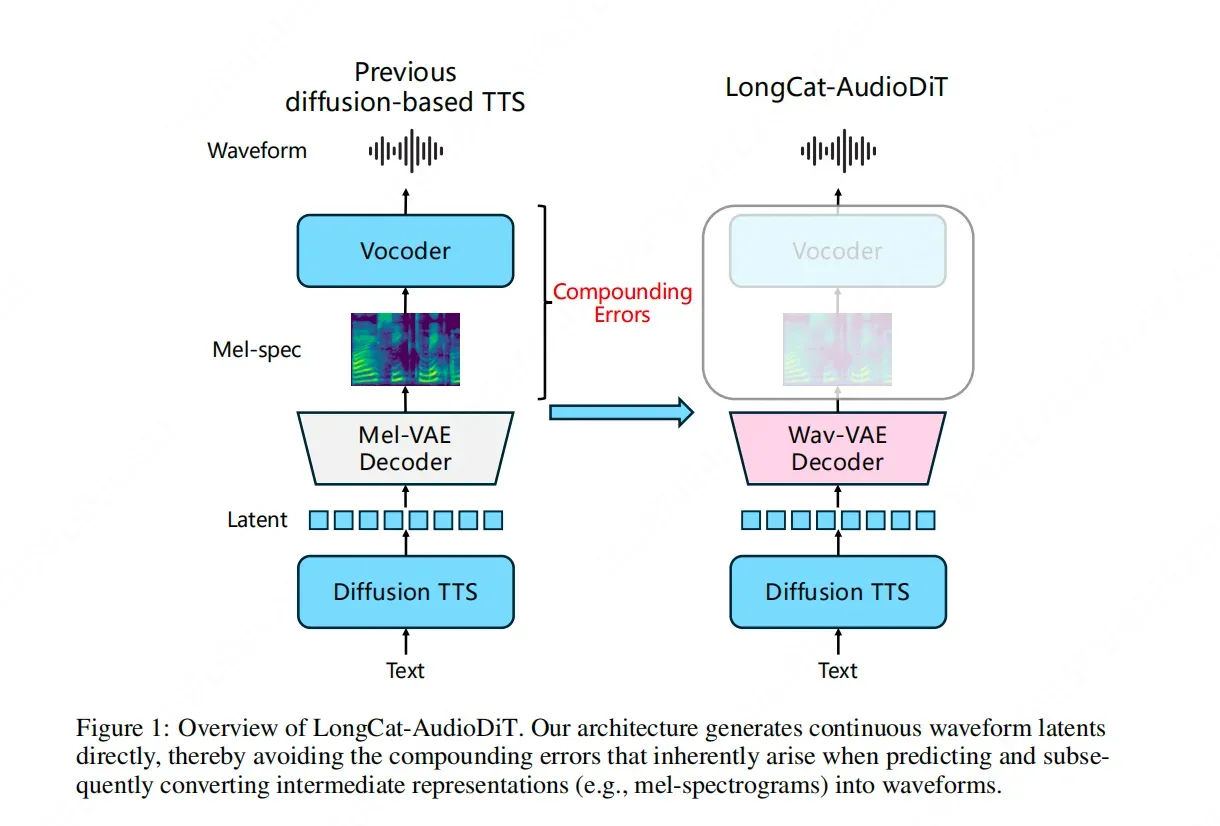
The Meituan LongCat team has officially released LongCat-AudioDiT, a pioneering model designed to overcome the technical limitations of zero-shot Text-to-Speech (TTS) voice cloning. By fundamentally redesigning the synthesis pipeline, the model abandons traditional intermediate representations such as Mel-spectrograms. Instead, it operates directly within the waveform latent space using a diffusion-based framework. This strategic shift is intended to eliminate cascade errors caused by multi-stage data conversion, allowing the AI to learn the inherent laws of sound directly from the source. LongCat-AudioDiT represents a significant advancement in audio synthesis, offering a more streamlined and high-fidelity approach to replicating human voices without the need for extensive target-specific training, thereby setting a new benchmark for the industry.
Key Takeaways
- Elimination of Intermediate Representations: LongCat-AudioDiT completely removes the need for Mel-spectrograms, which are traditionally used as a bridge in TTS systems.
- Waveform Latent Space Operation: The model performs text-to-speech synthesis directly within the waveform latent space, ensuring higher fidelity and fewer conversion artifacts.
- Diffusion Model Integration: It utilizes a diffusion-based architecture (AudioDiT) to generate audio, leveraging the strengths of generative modeling for sound synthesis.
- Reduction of Cascade Errors: By bypassing intermediate steps, the model prevents the accumulation of errors that typically occur during data transformation stages.
- Direct Learning of Sound Laws: The AI is designed to learn the fundamental patterns and laws of sound directly, enhancing its zero-shot voice cloning capabilities.
In-Depth Analysis
Breaking the Bottleneck of Intermediate Representations
For years, the field of Text-to-Speech (TTS) has relied heavily on intermediate representations, most notably Mel-spectrograms. These representations serve as a simplified visual-acoustic bridge between text and raw audio. However, the Meituan LongCat team identified this reliance as a primary technical bottleneck. The transition from text to Mel-spectrogram, and subsequently from Mel-spectrogram to waveform (often via a vocoder), introduces what is known as "cascade errors." Each stage of conversion loses a degree of information and introduces noise or artifacts, which ultimately limits the upper bound of voice cloning quality.
LongCat-AudioDiT addresses this by fundamentally altering the architecture. By abandoning Mel-spectrograms, the model removes the primary source of these cumulative errors. This allows the system to maintain the integrity of the acoustic data from the initial generation phase to the final output. The focus shifts from "translating" between different formats to generating the sound structure in a more unified environment.
Direct Learning in the Waveform Latent Space
The core innovation of LongCat-AudioDiT lies in its operation within the waveform latent space. Traditional models often struggle with the high dimensionality and complexity of raw audio waveforms. By utilizing a latent space—a compressed, mathematical representation of the audio—the LongCat team has found a way to make direct waveform generation computationally efficient and qualitatively superior.
This approach allows the AI to "directly learn the laws of sound itself." Rather than being taught to approximate a spectrogram that looks like speech, the model is trained to understand the underlying physical and mathematical patterns of audio waves. This direct engagement with the waveform allows for a more nuanced capture of vocal characteristics, which is essential for high-quality zero-shot voice cloning. In a zero-shot scenario, where the model must replicate a voice it has never encountered during training based on a very short sample, the ability to understand the fundamental "laws" of that sample's sound is a decisive advantage.
The Power of Diffusion Models (AudioDiT)
The integration of diffusion models into this architecture, specifically through the AudioDiT framework, marks a significant evolution in generative audio. Diffusion models have already revolutionized image generation by iteratively refining noise into a coherent structure. LongCat-AudioDiT applies this iterative refinement process to the waveform latent space.
By using a diffusion-based approach, the model can generate highly detailed and realistic audio by gradually shaping the latent representation. This method is particularly effective at capturing the subtle textures and prosody of human speech that are often lost in deterministic or simpler generative models. The "DiT" (Diffusion Transformer) aspect suggests a scalable and robust backbone capable of handling the complex dependencies required for long-form speech and intricate voice cloning tasks. This combination of latent space operation and diffusion modeling provides a robust solution to the long-standing challenges of voice synthesis.
Industry Impact
The release of LongCat-AudioDiT by Meituan's LongCat team has profound implications for the AI and audio synthesis industry. By proving that high-quality TTS can be achieved without intermediate Mel-spectrograms, Meituan is challenging the standard operating procedures that have dominated the field for nearly a decade. This shift could lead to a new generation of TTS models that are more efficient and capable of producing near-perfect voice clones with minimal data.
Furthermore, the reduction of cascade errors opens the door for more reliable applications in professional media, personalized assistants, and accessibility tools. As the industry moves toward more "zero-shot" capabilities, the ability to replicate a voice accurately without fine-tuning becomes a critical competitive advantage. LongCat-AudioDiT sets a high technical bar, encouraging other research teams to explore direct waveform generation and latent space diffusion as the future of acoustic AI.
Frequently Asked Questions
Question: What makes LongCat-AudioDiT different from traditional TTS models?
Traditional TTS models usually convert text into an intermediate visual representation called a Mel-spectrogram before turning it into sound. LongCat-AudioDiT skips this intermediate step entirely, operating directly in the waveform latent space to avoid the errors that happen during those conversions.
Question: Why is "zero-shot" voice cloning important?
Zero-shot voice cloning allows the AI to replicate a person's voice using only a very brief audio sample, without needing to be specifically trained or "fine-tuned" on that person's voice for hours. This makes the technology much more flexible and faster to deploy for various applications.
Question: How does the model avoid "cascade errors"?
Cascade errors occur when mistakes in one stage of a process (like creating a spectrogram) are passed on and magnified in the next stage (like turning that spectrogram into audio). By using a single, direct path in the waveform latent space, LongCat-AudioDiT eliminates these multiple stages, thereby blocking the source of these errors.