LARYBench Launch: Defining the ImageNet for Embodied Action Representations and Measuring Generalization from Human Video Data
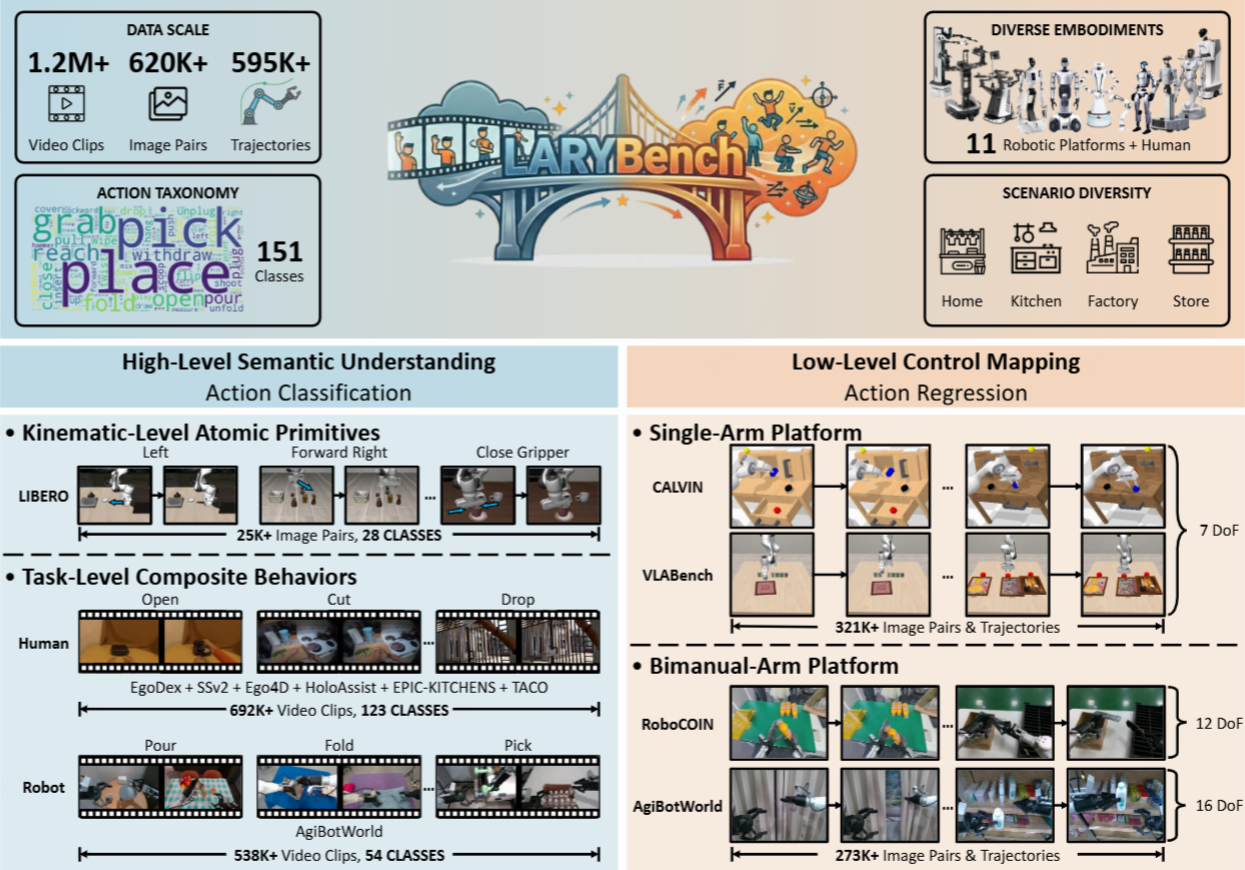
The Meituan Technical Team has introduced LARYBench (Latent Action Representation Yielding Benchmark), a systematic evaluation framework designed to guide the learning of general latent action representations from large-scale visual data. This benchmark serves as a foundational tool, akin to ImageNet for computer vision, but specifically tailored for embodied intelligence. Experimental results from the benchmark reveal a significant discovery: general vision models demonstrate superior performance in action generalization and control precision compared to specialized action expert models designed specifically for embodied AI. This indicates that sophisticated embodied action representations can emerge naturally from training on extensive human video datasets, suggesting a new pathway for developing robotic control systems through general-purpose visual learning.
Key Takeaways
- Introduction of LARYBench: A systematic benchmark designed to evaluate and guide the development of general latent action representations from large-scale visual datasets.
- Superiority of General Models: Experimental data shows that general vision models significantly outperform specialized embodied AI expert models in both generalization and control precision.
- Emergence from Human Video: The benchmark proves that embodied action representations can emerge from large-scale human video data, rather than requiring exclusively robot-specific data.
- New Standard for Embodied AI: LARYBench aims to define the "ImageNet moment" for embodied action, providing a standardized metric for measuring how well models understand and execute physical actions.
In-Depth Analysis
The Paradigm Shift: General Vision Models vs. Action Experts
The release of LARYBench (Latent Action Representation Yielding Benchmark) marks a critical turning point in the field of embodied intelligence. For years, the industry has focused on developing "action expert models"—specialized AI systems trained specifically on robotic trajectories and narrow physical tasks. However, the findings presented by the Meituan Technical Team challenge this specialized approach.
According to the benchmark results, general vision models—those trained on broad, diverse visual data—exhibit a higher degree of action generalization and control precision than their specialized counterparts. This suggests that the underlying features required for physical interaction are not necessarily unique to robotic data but are instead embedded within the broader context of visual understanding. By outperforming expert models, general vision systems demonstrate a more robust ability to adapt to new environments and tasks, which is a primary hurdle in the quest for universal embodied AI.
The Emergence of Action from Human Video Data
One of the most significant insights provided by LARYBench is the validation of human video data as a primary source for learning embodied actions. The benchmark demonstrates that latent action representations—the internal mappings an AI uses to translate visual input into physical movement—can "emerge" from large-scale human video datasets.
This finding is transformative because human video data is far more abundant and diverse than specialized robotic data. If embodied action can be learned by observing humans, the bottleneck of data collection for robotics could be significantly alleviated. LARYBench provides the first systematic measurement of this phenomenon, proving that the visual patterns of human movement contain sufficient information to inform the control precision and generalization capabilities of AI models in embodied contexts. This effectively bridges the gap between passive observation and active physical execution.
Industry Impact
The introduction of LARYBench is poised to redefine the development pipeline for robotics and embodied AI. By establishing a systematic evaluation standard, it allows researchers to measure progress in a way that was previously fragmented. The revelation that general vision models are more effective than specialized ones may lead to a shift in investment and research focus, moving away from narrow task-specific training toward the development of large-scale general visual learners for physical tasks.
Furthermore, the ability to leverage human video data for action representation means that the scaling laws observed in Large Language Models (LLMs) may soon be fully realized in robotics. As models are exposed to more diverse human activities through video, their ability to perform complex, precise, and generalized actions in the physical world is expected to improve, accelerating the deployment of autonomous systems in domestic and industrial environments.
Frequently Asked Questions
Question: What is the primary purpose of LARYBench?
LARYBench (Latent Action Representation Yielding Benchmark) is a systematic evaluation framework designed to measure how well AI models learn general latent action representations from large-scale visual data. It aims to provide a standardized metric for embodied intelligence, similar to what ImageNet provided for general computer vision.
Question: Why are general vision models performing better than specialized expert models?
Based on the experimental results from LARYBench, general vision models show superior action generalization and control precision. This suggests that the broad visual features learned from diverse datasets provide a more robust foundation for understanding physical actions than the narrow, task-specific data used to train specialized embodied AI expert models.
Question: Can robots really learn to move by watching human videos?
Yes, the LARYBench findings indicate that embodied action representations can emerge from large-scale human video data. This means that by analyzing how humans interact with the world in videos, AI models can develop the necessary latent representations to perform actions with high precision and generalization in robotic or embodied contexts.